Morphosis founder Thom Mayne on the future of facades

From October 25 to October 26, The Architect’s Newspaper is hosting its Facades+ conference in Los Angeles for the fourth year in a row. The conference features UCLA Department of Architecture and Urban Design professors Heather Roberge, principal and founder of Murmur Architects and Thom Mayne, founding principal of Morphosis Architects as well as other leading architects based in Los Angeles including Tammy Jow, associate director of AC Martin and Stan Su, director of enclosure design at Morphosis Architects. To learn more about emerging facade technology, wider industry trends, and what’s on the boards at Morphosis, AN sat down with Thom Mayne in the firm’s New York office.
"The Architect’s Newspaper: When did you start getting interested in facade innovation, and what do you find most interesting about it today?
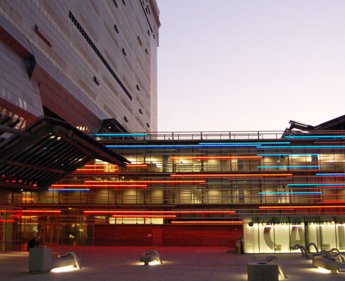
The skin of the Caltrans opens and closes in reaction to temperature and lighting conditions. (Courtesy Ted Kane/Morphosis Architects) Thom Mayne: It started in the early 2000s; we were working on a project in Seoul, on the Sun Tower. We were investigating the possibility of a second skin, an artifact that was much more connected to an aesthetic formal exercise because it freed us of the norm of a window curtain wall and the whole notion of facade. We had a continuous surface and that allowed us a lot of freedom in a completely different direction.
After that, we were working on the Caltrans project in Los Angeles and the General Services Administration (GSA) project in San Francisco. Both were very distinct projects that required real thinking on performance, using facade openings and scrim walls to take advantage of natural light and exterior temperature conditions. The whole thing became a huge exercise in environmental performance. We saw it as part of our responsibility to represent architecture within a state-of-the-art context in terms of its use of energy.
It is not something we’re focused on, but there’s nothing that comes out of the office that doesn’t require some level of environmental facade performance.
When we opened the GSA building, Nancy Pelosi was there and she didn’t like it. She likes Victorian architecture, and I said, “Nancy, actually this is how it works, and you have to understand its performance,” knowing that she’d agree that our values are parallel. In fact, that’s interesting too, that the average person relates to a building just in terms of its appearance. It’s fairly straightforward. In reality, the skins had to do with weight and their ability to move and their technological performances. It wasn’t about the metal; we didn’t start it by wanting to do a metal building. It’s a result.
In terms of the metals, I think the Bloomberg Center at Cornell Tech was quite successful. We’re experimenting with textures and imprints on metal, and in that case, it resulted in a set of random pieces and it looks like it’s dynamic, in a perpetual state of movement based on the reflection of the sun. The facade’s 500,000 perforations are stationary, but if it looks like its moving, it’s moving. We used metal skins at Cornell Tech, but we are sort of done with the whole metal thing; we want to move on since people link us with metal buildings.
What are you working on and what do you think we’ll see in five years?
TM: We are pursuing a couple other projects making the skin active and literally dynamic, which presents another set of possibilities. It just keeps changing the whole notion of facade. A large segment of the profession today is recognizing completely new opportunities."— Matthew Marani, Oct. 8, 2018


This post is an excerpt. Read the full article on the Architect's Newspaper website.
Read more about Thom Mayne here.
Stay engaged. Use #UCLAarts to stay connected.


