Mary Nooter Roberts, Champion of African Art, Is Dead at 59
ROBERTS’ LEGACY LIVES ON IN THE LIVES SHE TOUCHED AND HER CULTURAL CONTRIBUTIONS
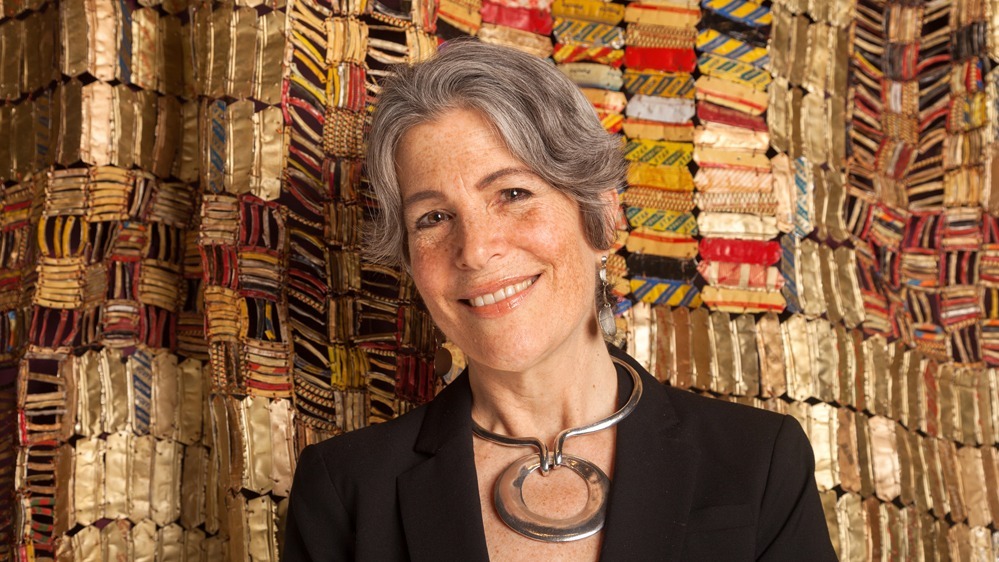
Mary “Polly” Nooter Roberts, UCLA professor of world arts and cultures/dance, died peacefully in her sleep at home on Tuesday, Sept. 11. She was 59, and had been living with stage four metastatic breast cancer for more than eight years. Roberts was trained as an art historian and became one of the world’s foremost scholars of African arts. She focused her research in the Democratic Republic of the Congo, where she undertook long-term dissertation research among Luba peoples, and in Senegal, where she conducted field research on the arts of a local Sufi movement called the Mouride Way.
Mary Nooter Roberts, a scholar of African art who helped change the way non-Western art is presented in Western museums, died on Sept. 11 at her home in Los Angeles. She was 59.
The cause was breast cancer, said her husband, Allen F. Roberts, a professor in the Department of World Arts and Cultures/Dance at the University of California, Los Angeles, where she also taught.
Professor Roberts, known as Polly, came to her work at the beginning of the multiculturalist revolution of the 1980s, when a linear Western approach to art — “history with a capital H,” as she put it — was being replaced by a dynamic concept of varied and parallel stories. She was well prepared to embrace these ideas.
Born in St. Louis on Oct. 26, 1959, Mary Nooter became a world traveler before she was 3. Her father, Robert, joined the Foreign Service and moved the family first to Uruguay and then to Liberia. He then worked for the World Bank in different parts of Africa, where he and his wife, the anthropologist Nancy Ingram Nooter, became collectors of African art.
Professor Roberts attended Scripps College in Claremont, Calif., where she majored in philosophy and French literature. But in 1979, after a summer visit to her parents in Tanzania, she decided on art history as a career and enrolled at Columbia University.
While at Columbia, where she received her doctorate in 1991, she met her future husband. She also met Susan M. Vogel, a curator of African art at the Metropolitan Museum. When Ms. Vogel left the Met in the early 1980s to start her own museum, the Center for African Art, in a townhouse on the Upper East Side, she hired Professor Roberts as her first staff member.
The museum opened with a spectacular show of classical African sculpture in the same season that the Museum of Modern Art presented its widely criticized exhibition “ ‘Primitivism’ in 20th Century Art: Affinity of the Tribal and the Modern.” The MoMA show, which presented African art as source material for European painters, instantly became a touchstone for how not to approach non-Western cultures. The Center for African Art’s show was perceived by many as a corrective example and established the new museum as an institution to watch.
When the center, renamed the Museum for African Art, moved to new quarters in SoHo in 1993, Professor Roberts, by then senior curator, organized the first exhibition, “Secrecy: African Art That Conceals and Reveals.” The show was the product of two years of doctoral research among the Luba peoples of the Democratic Republic of Congo, where, in an effort to access restricted kinds of knowledge, Professor Roberts, in consultation with a female diviner, underwent a rigorous Luba initiation.
“It was a moment of letting go of everything that I had come with to Congo, to Luba country,” she recalled in a 2018 interview published by the U.C.L.A. School of Art and Architecture. “I had to let go of all my assumptions, and I also had to let go of being the one who was the interviewer.”— Frank Rose

This post is an excerpt. Read the full article on the New York Times website.
This article draws extensively from an interview conducted at UCLA in May 2018.
Stay engaged. Use #UCLAarts to stay connected.


