DIALOGUE: Rebeca Méndez and Polly Nooter Roberts
One artist & designer. One scholar & historian. Both teachers, explorers, curators, & activists.
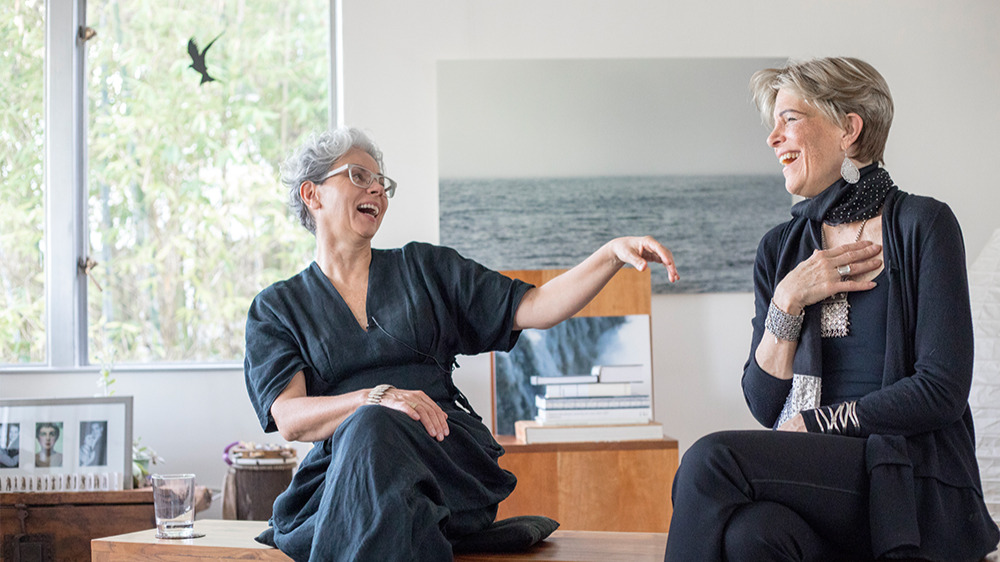
One, an artist and designer. One, a scholar and historian. Both explorers, curators, and activists who share a passion for teaching and a conviction in the power of the arts and artists to illuminate and transform the world.
Earlier this spring, UCLA Arts invited Rebeca Méndez, Professor in the Department of Design Media Arts, and Polly Nooter Roberts, Professor in the Department of World Arts and Cultures/Dance, to sit down in conversation to share their stories and insights about the arts, teaching, learning, unlearning, memory, and the importance of cultivating a sensitivity to one’s place in the world, to other cultures, and to different ways of knowing.
The following is an edited version of their conversation.
Polly Nooter Roberts: It's such a delight to be able to have this conversation with you, Rebeca. I've been wanting to get to know you better since we participated in the An Imaginative Offer film for the school. I was so struck by things you said in the film and sense a real camaraderie and shared spirit with you. I am guessing we have more in common than we know. You were born and raised in Mexico City, right?
Rebeca Méndez: Yes, yes. I was. What's your connection to that part of the world?
Polly: I was born in the United States, but my earliest memories are from South America. My father joined the Foreign Service in 1962, and when I was two and a half years old our family of seven moved to Uruguay. From there, when I was five, we moved to Liberia, which is where the African part of my life really begins. My mom is a former artist and scholar of the arts of Africa. And my father is an art collector with a real eye for aesthetics. So I grew up literally surrounded by art. My mom also worked at the National Museum of African Art, so I spent a lot of time with her at the museum.
These experiences had a tremendous impact on me, but I think the really critical moment was when my parents moved to Tanzania, when I was studying philosophy and French literature in college. I went to live with them for two summers, and it was during this time that I found my calling. I had a revelation that I wanted to work with the arts of Africa for the rest of my life.
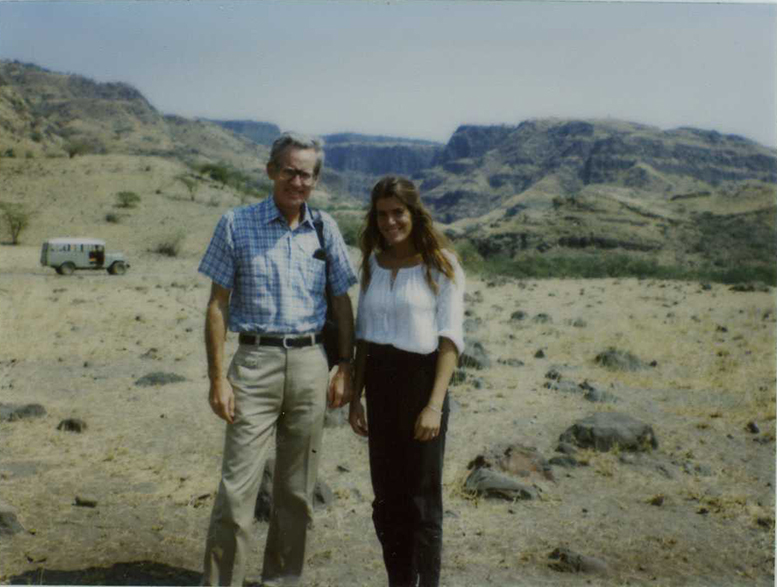
Polly with her father, Bob Nooter, in Tanzania in 1979, when she found her calling to study African Arts.
So I went to graduate school at Columbia University to become an art historian. Early in my studies, I met Susan Vogel, then curator for African art at the Met, who invited me to be a volunteer research assistant.
When Susan left the Met to start her own museum called The Center for African Art (later called The Museum for African Art), she hired me as her first staff member. Eventually, I became senior curator.
Rebeca: What an amazing experience to start something from nothing.
Polly: Yes. It was amazing to start from nothing. Of course, everyone told us that the chance of successfully opening a museum from nothing was less than zero. But in 1984 we opened the doors with a show of the most beautiful arts of Africa borrowed from a museum in Paris. It was a huge success because, in contrast to the “Primitivism” show that was on view concurrently at MOMA in which African arts were only being seen and thought about from Western perspectives, we were presenting the arts of Africa from African perspectives. So that was the beginning of a remarkable 10-year experience producing a whole series of thought-provoking exhibitions at this museum. Eventually, that is what led me to the Fowler Museum, where I was deputy director and chief curator for almost another decade, and to the Department of World Arts and Cultures/Dance (WACD), where I have been a Professor since 2009. Throughout these incredible years, I have worked closely with my husband, and the love of my life, Al Roberts, who is also an Africanist scholar and a professor in WACD.
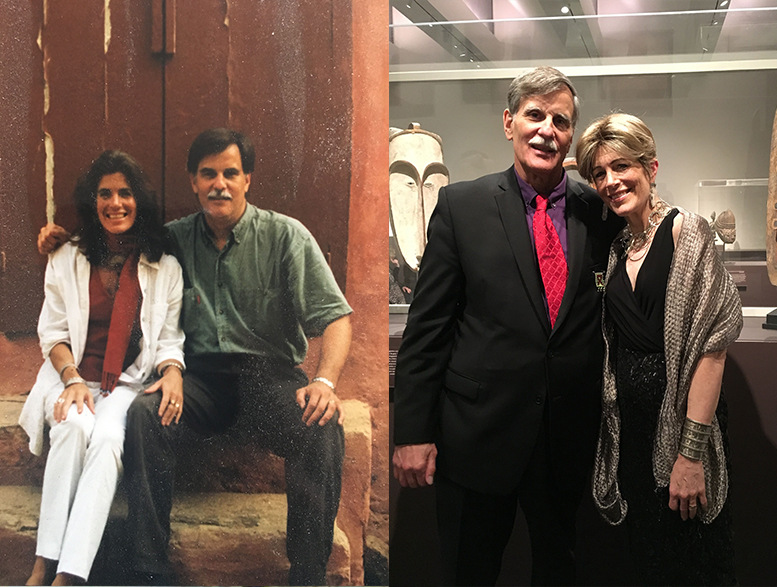
Left: Polly and Al in Senegal. Right: Polly and Al in the LACMA exhibition, The Inner Eye: Vision and Transcendence in African Arts, curated by Polly.
Rebeca: Beautiful. What an amazing journey.
Polly: And I understand yours has been as well. Tell me about being raised in Mexico City.
Rebeca: Yes, I was born and raised in Mexico City, to parents educated as chemical engineers, which explains how I experience the world. They taught me to see the world from a physiochemical point of view and were even known to bring out massive tomes of organic chemistry and inorganic chemistry when they needed to explain something complicated. They instilled in me respect and love for the natural world, but most importantly, for the nature of matter—its composition, organization, and behavior; its cycles and systems—so, I now understand that they taught me to relate to the world through its design. They fostered in me not just a sense of ‘self-identity,’ but primarily a sense of ‘self-in-relation,’ to humans, to animals, all living beings, and my environment.
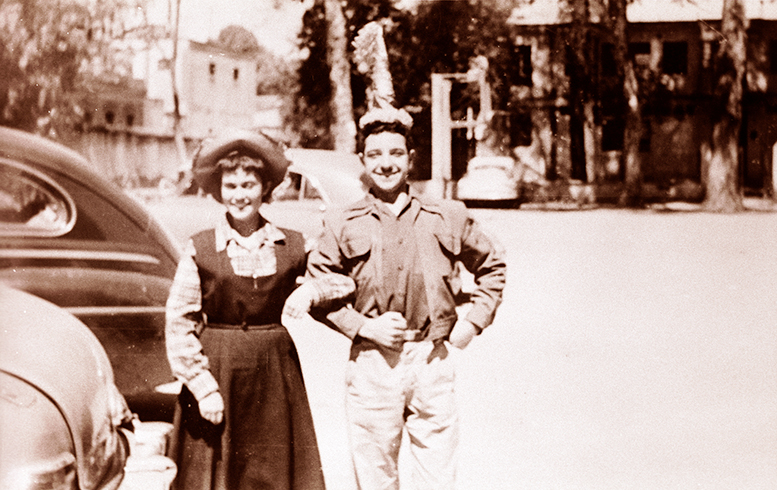
Rebeca's mother and father at the National Autonomous University of Mexico (UNAM) as chemistry students.
Polly: Amazing. It is so interesting to think about how our respective parents influenced our interests and passions.
Rebeca: Yes. My father has a real energy and vitality. He was a bull fighter, a car racer.
Polly: Oh my God!
Rebeca: Yes, but his greatest passion is Mesoamerican archeology. My family spent many of our summer vacations deep in the jungles of southern Mexico in pursuit of obscure Mayan archeological sites. As early as I can remember, every summer, mom and dad would pack four kids and two dogs in a Volkswagen van and drive from Mexico City all the way to the Chiapas and the Yucatán peninsula. During extensive expeditions, we would spend one or two months every year, most of the time camping in the jungle, experiencing its overwhelming presence and sounds—I could at times separate the loud oscillating sound of cicadas, or the soft roar of the howler monkeys, and feel the jungle’s dense humidity.
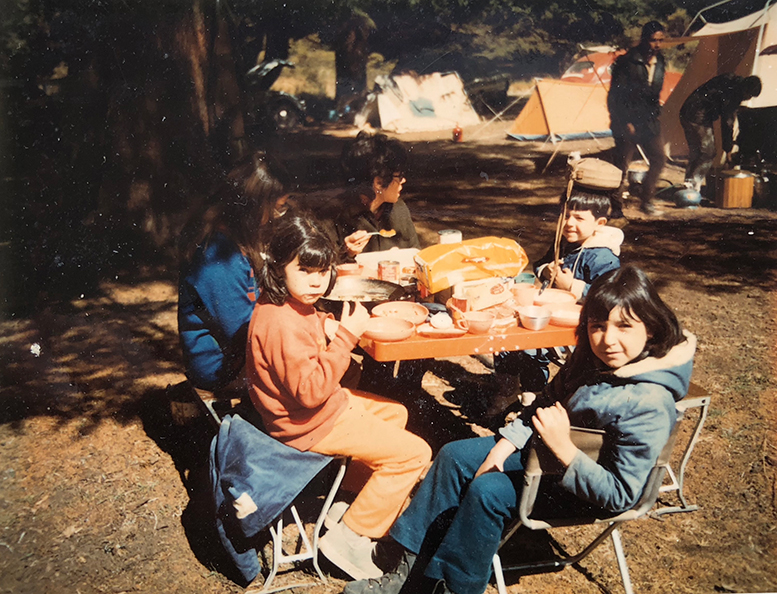
Rebeca camping with her family in Nexpayantla circa 1970.
Polly: Oh, how beautiful. Would you camp in tents?
Rebeca: In tents, and sometimes no tents, sometimes just camping in the open.
Polly: Out in the open sky?
Rebeca: Yeah, the open sky. Sometimes, we were able to camp among the Mayan temples surrounded by powerful iconography. My father would read to us from the book Incidents of Travel in Central America, Chiapas and Yucatán by the American explorer John Lloyd Stephens, who, together with architect and draftsman Frederick Catherwood, travelled to Mesoamerica in the mid 1800s, and began creating detailed written and visual evidence on the Mayan culture and temples. My father would plan our trips according to the routes they took. And, a lot of the time, those pathways did not exist anymore, and we would have to carve our way through the jungle.
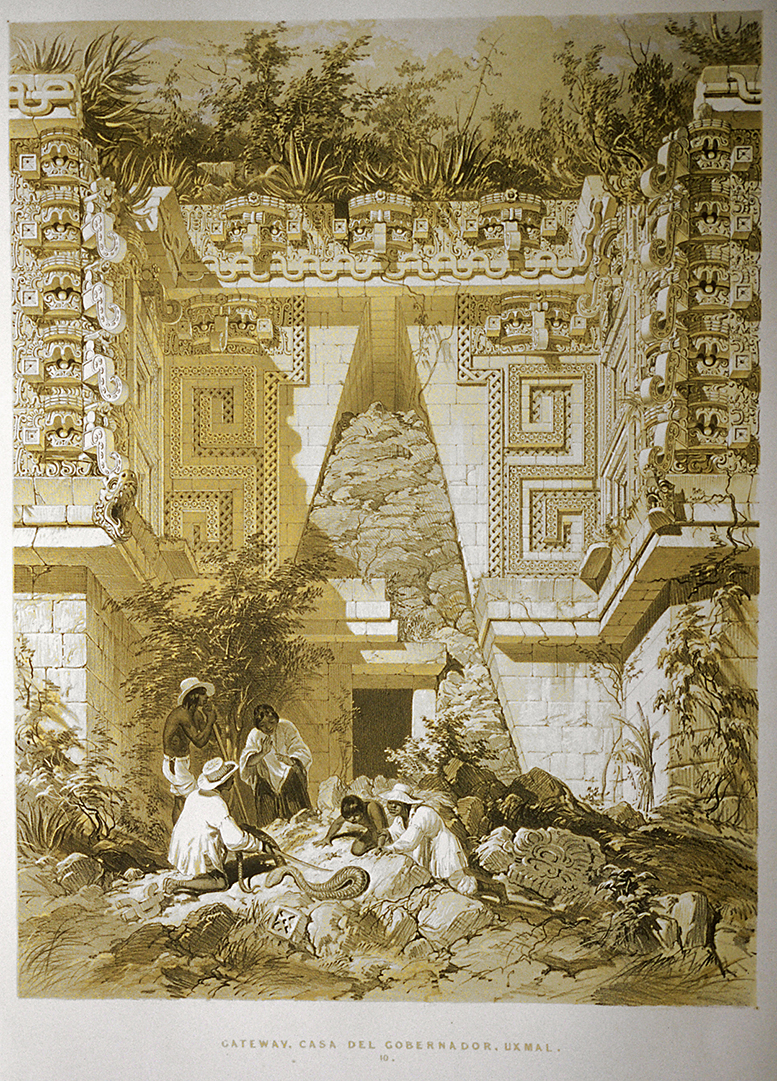
Illustration from Frederick Catherwood's book, Incidents of Travel in Central America, Chiapas and Yucatán.
Polly: That is amazing!
“With charcoal from our campsite fire, I would make rubbings of the glyphs on paper, becoming fascinated by this ancient form of symbolic storytelling. I believe that my love for iconographic visual languages, for synthesizing an idea into symbolic storytelling began then, and I became fascinated with the stories left by our ancestors.” – Rebeca Méndez
Rebeca: With charcoal from our campsite fire, I would make rubbings of the glyphs on paper, becoming fascinated by this ancient form of symbolic storytelling. I believe that my love for iconographic visual languages, for synthesizing an idea into symbolic storytelling began then, and I became fascinated with the stories left by our ancestors. My father also introduced me to photography, starting with his explanation of how Catherwood made his drawings with the aid of a camera lucida. I was always contemplative and looking for the aesthetic in things, and my father—who loved art and technology—would then tell me the whole story behind it.
Polly: Wow.
Rebeca: So I think this is where the idea of telling stories through symbols, telling stories through design, started for me—though I was also sure I was going to be a physicist and an astronaut...and then, I was a gymnast as well.
Polly: Really? I didn’t know that about you.
Rebeca: Yes. In 1979, I was the national champion of Mexico, and was on the Olympic team that was going to go to the Moscow Olympics, but Russia invaded Afghanistan in December 1979. The United States boycotted the Olympics and then Mexico did the same thing and I didn't get to be an Olympian. I got so lost in that time. I did not know what or who I was, because I had been training for this since I was 6 years old. It was at this point that I had to choose what to study. My cousin, Laura Ruelas, who was studying industrial design in Mexico, introduced me to design. I listened to her.
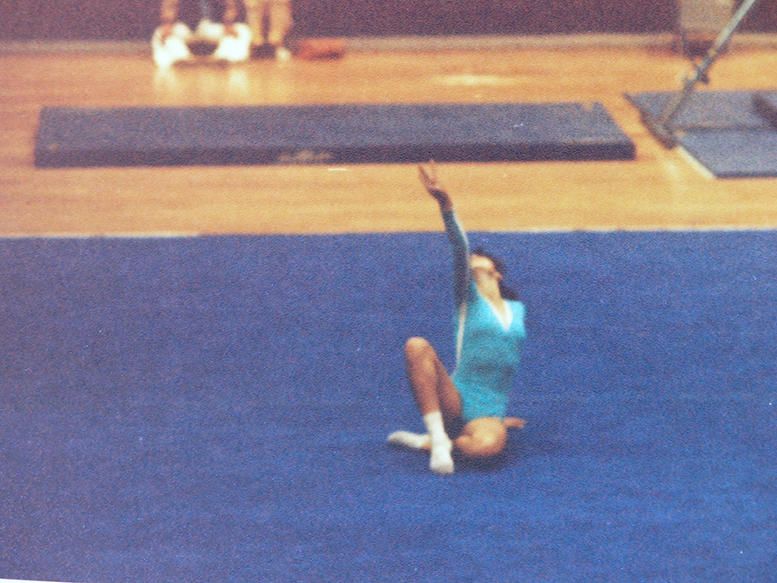
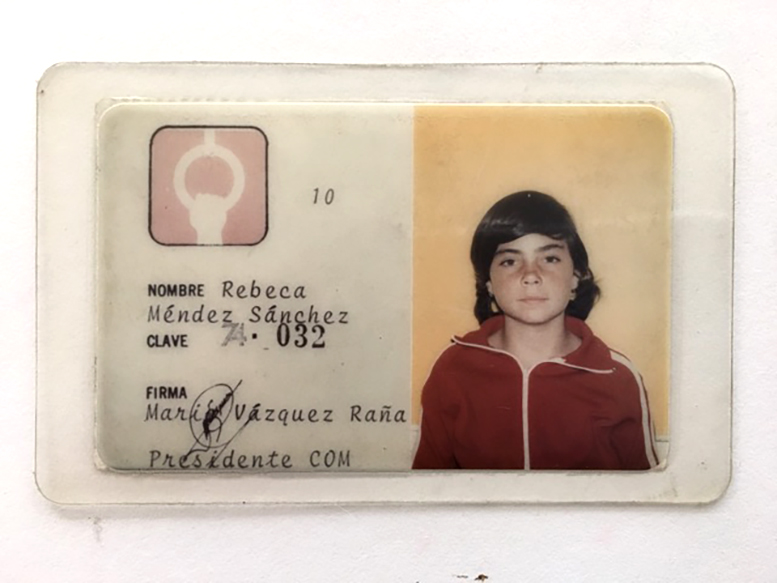
Top: Rebeca competing in the 1979 Mexican National Championship. Bottom: Rebeca's identification card for the 1972 Junior Olympic Team.
Polly: It was a detour in your life.
Rebeca: Everything I chose, I would be talked out of. My father told me, "Rebeca, you are going to the United States of America." And that was the last thing I wanted to do. In my 16, 17-year-old world, the U.S. was the enemy. I was with "The Communist Manifesto" under my arm, singing to free Cuba and free Angola from the Yankees of the United States. Like most young people, it is at this age that you have revolutionary thoughts—when you want to change the world.
Polly: Exactly. But that's where he wanted you to go.
Rebeca: So I ended up arriving to San Diego State University with my sister who was studying Marine Biology, and it was there that a professor from Art Center saw design talent in me and told me about Art Center and CalArts…so, I drove my little blue Volkswagen to Pasadena and began to discover what one could do. I applied immediately…
Polly: Wow.
Rebeca: ...and got in. I studied design and loved it. It really connected with my sense of systems and the precision aspect of my life. As a gymnast going to design, it just clicked immediately. The same way that I would train eight hours a day, I would design twelve hours a day. The iterative process of a gymnast, became the iterative process of a designer.
Polly: Amazing. And where did this lead you?
Rebeca: Well, after working in a few design studios for five years, I felt that there was something missing…something profound about life. I wanted to ask the deep questions. Doing a project for The Getty Center, I learned about the Fluxus artists, and it became clear that I needed to do that, so I decided to pursue a Master in Fine Art. I ended up at Art Center in 1989, both working full time as the designer for the college, teaching, and going through school. It took me many years to finish my M.F.A. When I graduated, my career as a designer was taking off. I was beginning to understand the value of communicating to people, and I understood the value of telling stories.
It was then that I actually had my first exposure to UCLA. [Professor and then Chair] Sylvia Lavin invited me to do some work designing posters and print collateral for the Department of Architecture and Urban Design, and she introduced me to Thom Mayne, who, in turn, gave me my first big architectural scale project. He asked me "Rebeca, have you ever done a large architectural work?" And I said, "Well, no." And he said, "Okay, this is the project." And I said, "Sure, I can do it." I love the new, I love to throw myself into the unknown. So, he was the first one to give me a project that allowed me to explore immersive spaces and environments. And, at the same time, that was moment that I really felt, "Ah, I'm a fine artist. This is what I want to do." That is really when I began working in parallel as both a designer and as an artist. Prior to that moment, I was very much a designer.
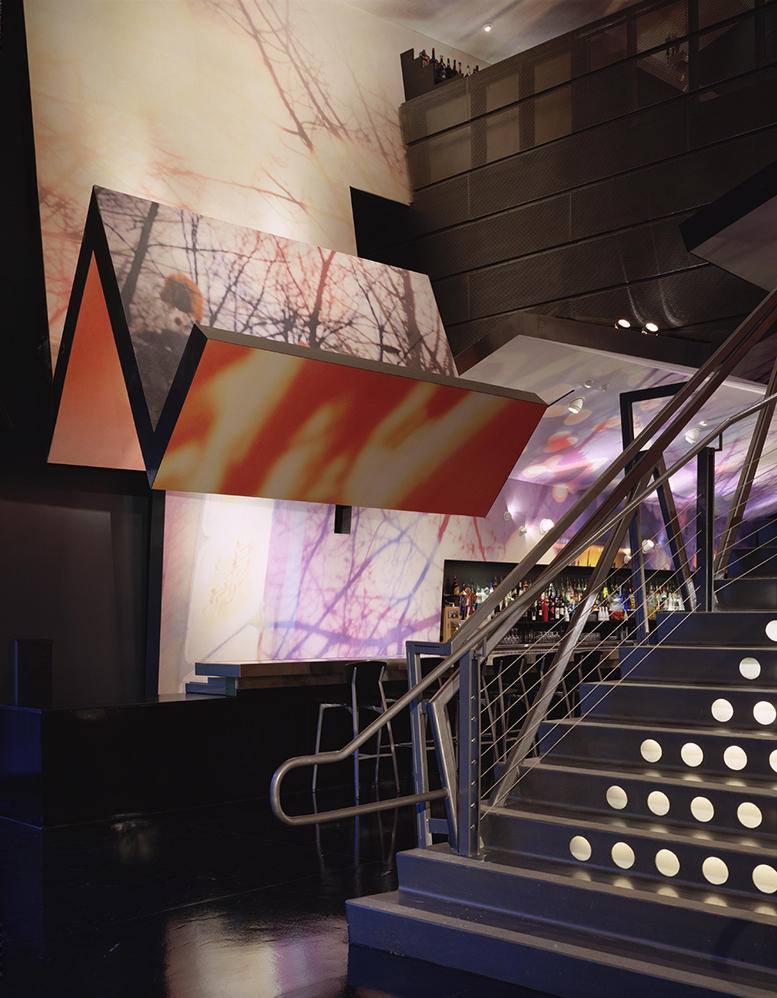
View of the Tsunami Asian Grill Restaurant in the Venetian Casino in Las Vegas for which Rebeca did visual identity design and mural and video installations with Thom Mayne's Morphosis, 1998–99.
Polly: That’s so wonderful. And how did you end up at UCLA in the Design Media Arts department?
Rebeca: Ah. That was not a straight line. There was a point in my career when I said, "I want to learn how to communicate to millions, to affect millions." So, I gave myself five years in advertising and global branding. I worked as art director at Wieden & Kennedy and as creative director at Ogilvy & Mather, New York for a few years, culminating with becoming senior partner leading the Brand Integration Group at Ogilvy here in Los Angeles.
That was a very good experience, but I was tiring of the advertising world and thinking “I’ve had it.” Just at the moment when I am going down in flames with the advertising world the letter came inviting me to join the department of Design Media Arts.
Polly: That's beautiful.
Rebeca: That really helped to ground me in a beautiful place where everything is possible.
Polly: Almost everything you've said…there are just so many...
Rebeca: Parallels?
Polly: Yes. Parallels.
One of the things that I've heard you speak about so beautifully is this idea of the unknown and also your concept of unlearning—as a mentor and as a teacher and as a researcher and as a human being in the world, the importance of unlearning as part of your process.
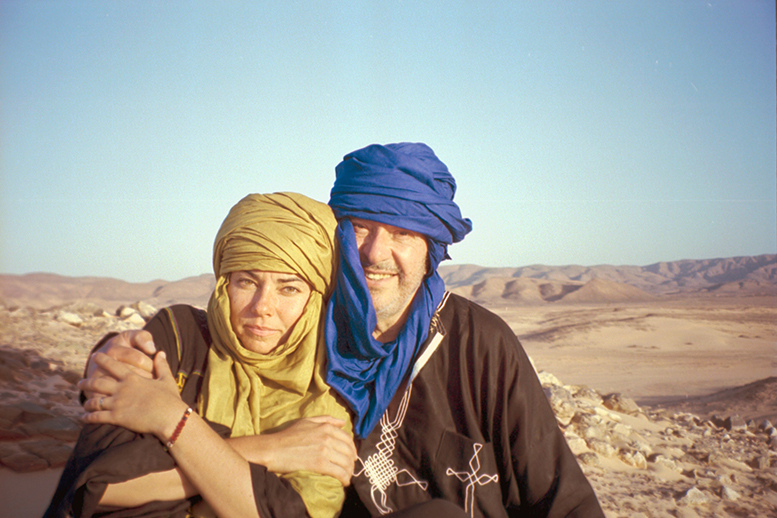
Rebeca exploring with her father in the Saraha.
Rebeca: I do believe that so much of how I grew up with my mother and my father—exploring new territories and throwing themselves into the unknown constantly—shapes who I am in this way. For example, there would be moments where we would be going into a cave and my father would just set the rope and say, "Let's go." And it's pitch black and our hearts are just like ba-boom, ba-boom, ba-boom, ba-boom.
Polly: And you just have to trust, right?
Rebeca: Exactly. So I remember so many times, I'm rappelling and I'm going down and it's getting darker and it's getting darker and there's the unknown, there's the exhilaration of exploring the unknown and at the same time the complete fear of letting go of what you know. Cave exploration became such an important part of what we did as a family, so I think that the unknown began to intrigue me.
Polly: Such a wonderful metaphor too.
Rebeca: The unknown is fantastic. The unknown is beautiful. So what does that mean then? To unlearn? I think it's that kind of beginner’s mind and that moment when you begin to let go of that knowing, let go of that shell of who you think you are so that you’re allowed to, perhaps, become something else. And there is both fear and excitement.
Whenever I feel that I'm getting to know a subject matter a little bit too much, then I do go through the process and ritual of shedding the shell I've created for myself that is called “knowledge”.
“If you don't have a question to ask, there's no way you can learn. It is through the question that we go into the unknown, that we can be curious to get to know.” – Rebeca Méndez
For so long, education has been about responding to ready-made problems, and forcing us to “solve” them. I share with my students what philosopher Henri Bergson said with regards to a key problem in childhood education, which was: “It is the school teacher who ‘poses’ the problems; the pupil’s task is to discover the solutions. In this way we are kept in a kind of slavery. True freedom lies in a power to decide, to constitute problems themselves.” I tell them how important it is for them to ask questions, not to wait for me to always formulate the questions, and them to answer them. It’s almost like they have to re-learn what education is supposed to be, where the students’ critical mind is capable of bringing about change through the questions they ask. If you don't have a question to ask, there's no way you can learn. It is through the question that we go into the unknown, that we can be curious to get to know.
Polly: That's a very courageous stance. To be in education and to put that forth as a value is actually antithetical to what so many think knowledge and teaching and education should be, but I completely agree with what you're saying.
I think an emblematic moment that connects to this idea of unlearning happened when I was in the Congo (formerly called Zaire), in a rural region that was very far from any cities. I got around by motorcycle. One time, I ended up at the great Congo river, the Lualaba, and I had to get my motorcycle—my red Honda—into a canoe to make my way across the river.
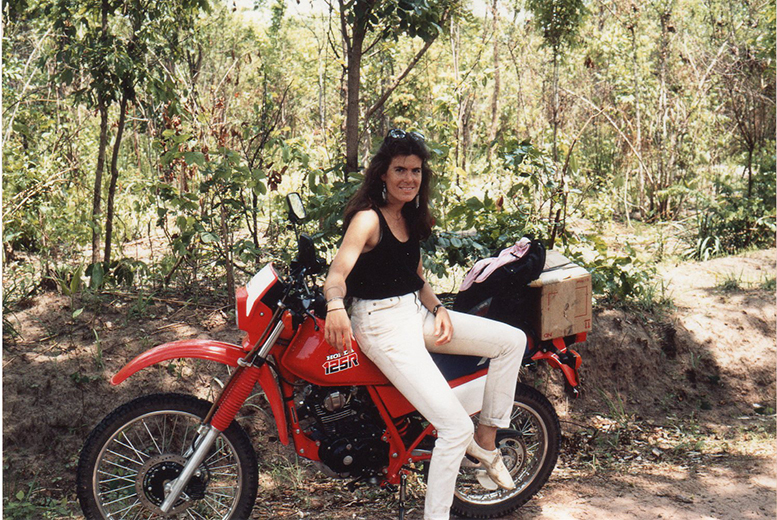
Polly and her motorcycle in Zaire (Democratic Republic of the Congo).
Rebeca: That's incredible.
Polly: The stories go on and on.
So I was crossing the Congo river, because I wanted to learn about the role of these art forms that were royal arts of Luba peoples—who had a great central African kingdom in the 18th and 19th centuries. There were thrones and sculptures and spears and staffs and ceremonial items that all depicted women, but they were all owned by men and they were made by men, because sculpture traditionally in Africa was done by men. And very early on, I recognized that these weren't just status symbols, they weren't just emblems of prestige, they were storytelling devices.
They were mnemonics, and when people brought out these objects, they began to recite histories that were based on memory. One of the deep subjects of my work, and that I have pursued with my husband, Al, is memory and how memories are transformed into histories. But really what memory—and its transformation into a historical account—comes down to is the telling of a story. It's the narration of a story from a particular person's point of view at a specific moment in time, in front of a certain audience—and that is history. And another person reciting another story in another place is telling history too, but it may be a completely different history because it is a different person with a different perspective on the past. Perhaps they’re speaking on behalf of another king, with their own political motivations, and for a different audience. It’s a performance.
So as I began to question people more and more about these mnemonic devices and what they meant, what the symbols were that they alluded to, they said, "We cannot talk to you anymore about it unless you become initiated into our historical association,” an association that was for the preservation and transmission of knowledge and history. And then there was a long process through which I had to find a town where a chief would support my becoming initiated. But I thought it was so interesting that they didn't say, "We can't talk to you because you're a foreigner," or they didn't say, "We can't talk to you because we don't want to share." Rather, it was, "We can't talk to you because the information is secret, and you're not a member. But if you become a member, then we can continue our conversations to the higher levels."
So I underwent a long initiation, which is why I'd been crossing the river in the canoe, and I kept going back and forth to this particular town. And in that moment of initiatory process, I experienced an unlearning.
It was a moment of letting go of everything that I had come with to Congo, to Luba country. I had to let go of all my assumptions and I also had to let go of being the one who was the interviewer.
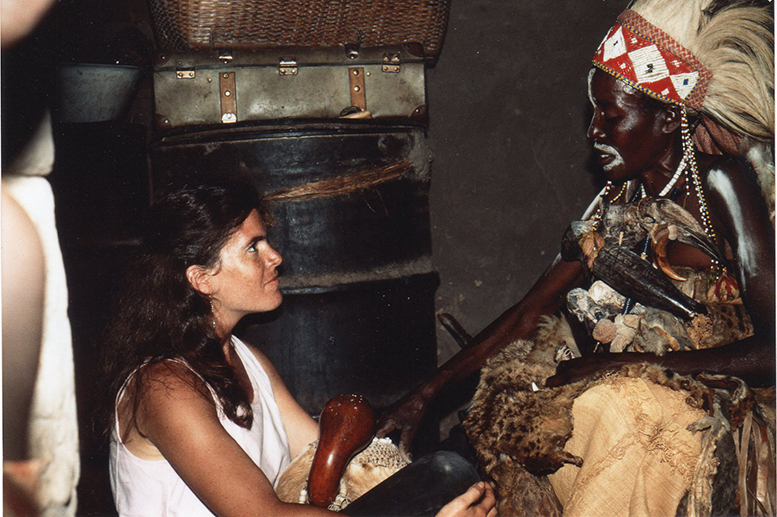
Polly in consultation with Luba female diviner in Zaire (Democratic Republic of the Congo).
I had to let it reverse so that they, my teachers and mentors, were the ones guiding how I would learn about this incredibly complex body of knowledge, which was very much anchored in objects. First and foremost, there is this absolutely phenomenal memory device, called a lukasa, which means “the long hand.” It’s a wooden tablet, somewhat bigger than a human hand, and pegged with beads of all different colors. And only members of this association know how to read and decipher the pathways through the “forests of symbols,” as Victor Turner would say, that are the pathways through memory.
Luba say that memory is like “a string of beads.” You can take the “loci of memory”—people and events and places of the past—and string them together to tell a story that has intentionality. It entails a decision of what elements from the past I am going to emphasize to tell this story, as well as what elements I will leave out.
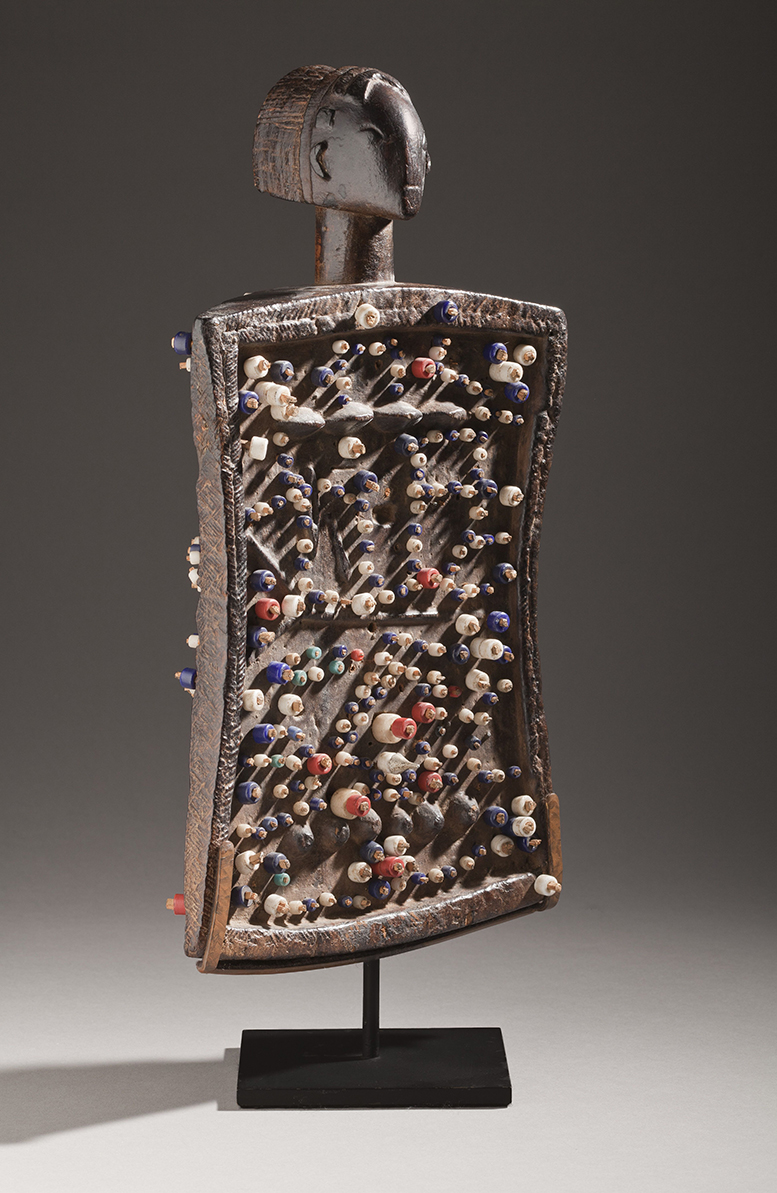
Lukasa Memory Board of Luba peoples, Democratic Republic of the Congo.
That's a very amazingly post-modern way to think about history.
A lot of the thinking, in America, up until the time of my doctoral fieldwork in the late 1980s, was still grounded in ideas of history with a capital H—“History” in the singular that was written by a dominant group. But in the 1990s, a number of scholars began to recognize the tensions between memory and history and the political motivations behind history-making. And more people were going to therapists to talk about repressed memories, and school boards were beginning to modify school curricula, so that different cultures and different ethnic groups’ “histories,” with a small h and in the plural, could become part of official textbooks—
Rebeca: The multiplicity.
Polly: Right. The multiplicity. And it was this de-centering, the de-stabilizing and unlearning of what was taken for granted as history that was set before my eyes in Luba country. This performative process of using a visual object (the lukasa) together with recitation to bring it into a life of its own, but with the recognition that any particular history was very much in the present, because memory is always in the present. People think that memory is something of the past, but we only remember in the present.
So all these ideas were emerging and it made me realize that—as an example of unlearning—we all think we know what memory is. We consider it a universal that all cultures experience memory. But what Luba individuals taught me is that memory is culturally specific. There is no universality about it. There may be things that everybody experiences, but not in the same way, not with the same words, and not with the same kinds of performances or visual expressions. And so when we encounter cultures different from our own and want to learn and then to share and transmit and teach about these phenomenal ways of knowing, I think the most successful work takes place when we allow ourselves to unlearn. To let go of and shed everything that we depended upon as truth, and recognize that there is no truth, but there are many truths. And we need to be respectful and sensitive and listen to how people speak about their ways of understanding the world. That's where my passion is.
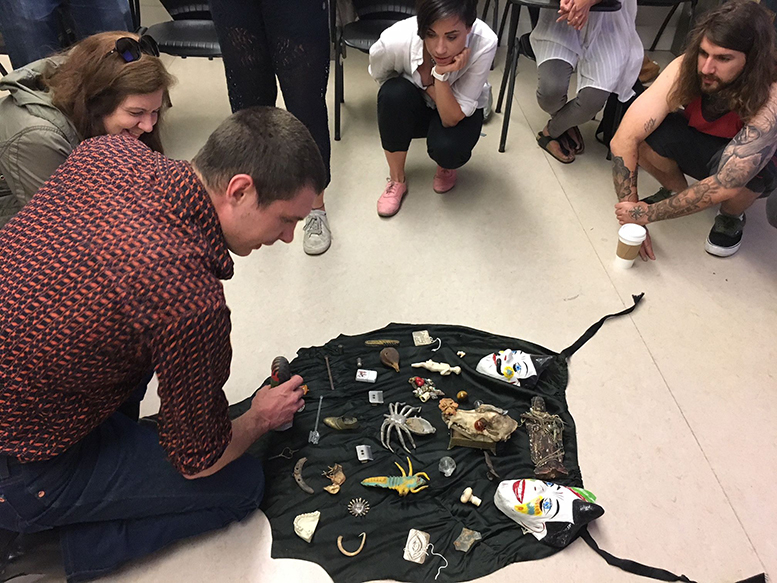
Student Degenhart Brown performing lukasa memory device in Polly's Performing Memory seminar.
Rebeca: Claro.
Polly: And the thing is, like your background, your parental inspiration and influence, the chemistry, that idea of chaos and order, that's exactly what the lukasa memory board is all about. Because, when you look at this board covered with beads in all different colors and configurations that seem so random, you just think chaos. You think, “How can there be knowledge and history and order and a sense of understanding within this object?” And yet, when you begin to watch a court historian, a man or a woman of memory as they're called, hold the board in their hand and point to the beads as they recite and brush their fingers across the surface of the board, almost like Braille, this order and this story come into being.

Luba man of memory reciting a lukasa memory board, 1989, Photo by Mary (Polly) Nooter Roberts.
Rebeca: Claro. I wanted to ask what is the most important learning that we have now? I think we need to unlearn the idea of the human being as we know ourselves right now because we're going in a direction that is so not the direction in which we will survive. How is it that we unlearn and relearn our relationship to the natural world, to the non-human world? How can we bring the wisdom of the earth and the intelligence of the animals into our learning? I think this unlearning, it's so important...
Polly: So important.
Rebeca: Author Barry Lopez says in his book Crossing Open Ground that contemporary American culture, with its over consumption, has become a culture that devours the Earth, and that we need to consider a change in attitude towards nature. He says that the question before us is, “How do we find a viable natural philosophy, one that places us again within the elements of our natural history?” His answer, he believes, lies with wild animals. This might help us remember who we are on this Earth, and help unlearn this horrible understanding of “progress” that is actually destroying us.
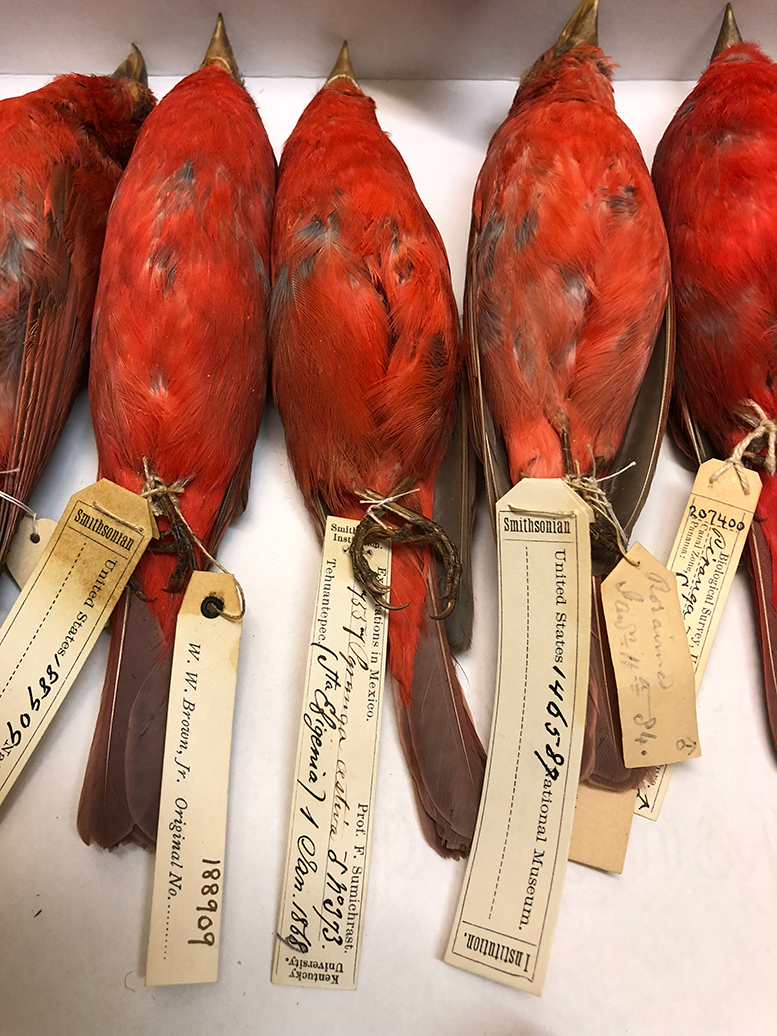
Rebeca is working with specimens from the collection of the Smitsonian National Museum of Natural History for her latest curatorial project, a fall 2018 exhibition at the Cooper Hewitt Smithsonian Design Museum.
Polly: That’s so interesting. It's often in encounters with other people that help me to think about that question of what do we need to be, as human beings, in the world. Because when we encounter diverse cultures, so much of, say, value and wealth, resides in family, in children, in the relationships that people have and not so much in their possessions. For the vast majority of people with whom I work, their wealth is really in the people—who they are, who they know, and the values that bind them. And when we come into contact with those kinds of values, and watch them in action, hear them expressed, it transforms the way we think about what our world has become.
“In Yoruba culture of Nigeria, there is this notion that artists are explorers: they take us to the very edges of the unknown, and then push us just a little bit further. I truly believe artists are the agents in our society who are the most capable of taking us by the hand and showing us a pathway beyond the known, the familiar, and the comfortable.” – Polly Nooter Roberts
In Yoruba culture of Nigeria, there is this notion that artists are explorers: they take us to the very edges of the unknown, and then push us just a little bit further. I truly believe artists are the agents in our society who are the most capable of taking us by the hand and showing us a pathway beyond the known, the familiar, and the comfortable. That's why I love to work with artists, and love to see and hear about what you're doing, Rebeca, because, to me, artists provide such an important way for us to be able to get back to that humanity, to retrieve something that we have lost very badly.
I know a little bit about the work you have done, going to the edges of the unknown, going to explore and photograph the Arctic. What drew you there? Why is it that you wanted to go to these extremes?
“When I was going up to the Arctic in Svalbard, in the sailboat, there was, every instant, a moment of ‘Okay, this could be it’...And then, when we were going to land, they would tell us, ‘When you go from the sailboat to the dinghy and then go to shore, in that moment, if you fall...in the water, you live for six minutes.’ Six minutes. There was that sense that your life was on the line at any moment. In a way, it's like in the moment you survive, you have the possibility of being a new person.” – Rebeca Méndez
Rebeca: There is this idea that we can control everything, that we are dominating Earth. So, when I find myself in these remote places, it puts me back in proportion. It helps me find my location on the planet, my location in the universe. It helps me contemplate, “Where is the place of humans in the planet?” When I am exploring, there is a sense of disintegration of my sense of security, my sense of safety, that which binds me to an identity, and binds me to continuing to have this sense that I am above others or that I’m above animals or I’m above plants. When I was going up to the Arctic in Svalbard, in the sailboat, there was, every instant, a moment of "Okay, this could be it...," because we could see icebergs ahead. We can navigate pretty well, but the winds are pretty strong. And then, when we were going to land, they would tell us, “When you go from the sailboat to the dinghy and then go to shore, in that moment, if you fall”...and there we were carrying equipment, cameras...“If you fall in the water, you live for six minutes.” Six minutes. There was that sense that your life was on the line at any moment.
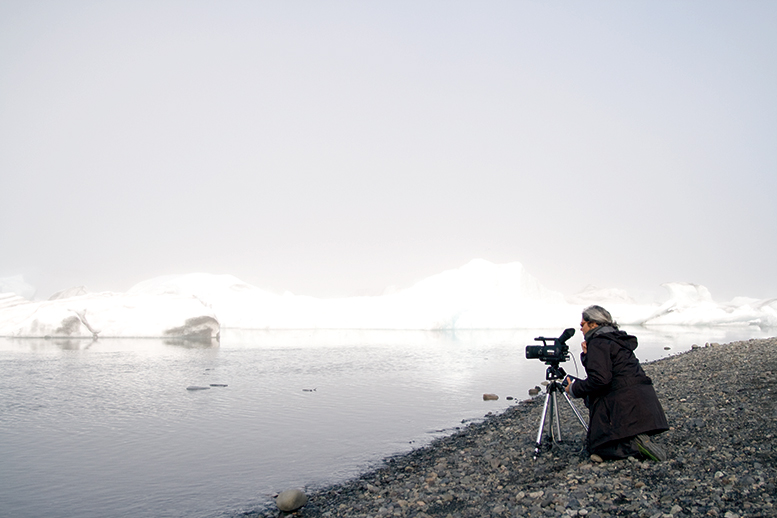
Rebeca filming in Jökulsárlón, a glacial lagoon, bordering Vatnajökull National Park in southeastern Iceland.
Polly: That's just incredible.
Rebeca: So, this idea of being able to feel your own possible dissolution, it is a refreshing moment in which you can relate to the animals, you can relate to another person, because you are so much more open to being another, to being different. In a way, it's like in the moment you survive, you have the possibility of being a new person. So, I think that when I'm putting myself out in those explorations, it’s a way to stop knowing who I am. It is a dissolution of self and the reintegration to the earth, the reintegration to the animal kingdom, and the reintegration to nature.
That idea of losing the identity is very powerful. I think, again, of Henri Bergson, who's so much my guide, and when he speaks about how it is only in the moment of the present that we are becoming. Whereas, the moment of knowing—the projecting yourself or your identity—is literally static. In identity, I am. And therefore, I am static and, therefore, I stop being in the movement of constant becoming. Action, change, intuition, all exist in that very instant of pure becoming.
Polly: Interesting. While you were talking, I was thinking about our students. One of the things that I love so much about teaching in our department is that it attracts people who are so open to becoming. Most students, and especially undergrads who are in an especially liminal stage of their lives, are very much in a state of becoming.
But I think a problem in our culture is to think of college as a final stage of initiation. We tend to see college as a time of fundamental development, when people become something different from what they had been as a child, and when they define themselves in some way, professionally, personally, or intellectually. And then there's a tendency to stop there.
And yet, in almost every culture of the world other than our own, you are very much expected to continue to become. I can think of a few cultures in particular where it's almost a requirement that you continue to pass through new stages of learning and new stages of initiation, and let go of the past. You shed that, and you move into a new state. And it's not predetermined what you will become in that state, but it's just about knowledge acquisition, and exposure to ideas, values, morals, and ethics, and to the acquisition of insight. You know in Africa, elders are by far the most cherished of individuals of any other age grade in society.
Rebeca: So different than in our culture. Here, the ones who have so much experience are not respected and not listened to.
Polly: That's just a beautiful concept to me—the idea of constantly becoming. And in one culture in Africa called Lega, that idea even extends into the afterlife as the ultimate stage of initiation, the ultimate stage of learning, unlearning, and learning anew. In some ways, I think this eases the tension of death and liberates the idea of mortality, because it suggests that this is really just one phase of the journey, and there will be more...
The arts are also where we are remaking ourselves constantly.
Rebeca: So much of what I have done—going in a sailboat, filming Arctic terns, for example—never would have occurred to me as something I would be doing. So I feel that it is in the arts that we are born and die so many times, because our projects are new initiatives. We work them, we lift them, we generate something that stays, but at the same time we shed that. We move again to the unknown, constantly.
“I think that as I've grown with teaching, it has become increasingly clear to me that what's more important than just the transmission of knowledge is the transmission of passion.” – Polly Nooter Roberts
Polly: I feel the same about teaching. I think about how I’ve changed over the years that I've been teaching. I teach a lot of thematic courses about memory, body politics in African arts, arts of writing and inscription, arts of time, and courses in the realm of curatorial studies. I think that as I've grown with teaching, it has become increasingly clear to me that what's more important than just the transmission of knowledge is the transmission of passion. It's about really getting at that core of, “Why does this matter?” “What is that we're here for?” “What is it that you love?” “What do you love and care about so much that you would be willing to give your whole life, and to which you would be willing to make a commitment, as you would to a lover?” But in this case, your art, your work, your research, your activism, your ethnography. I find more and more that what students really care about in the end is that emphasis on meaning and purpose and transformation.
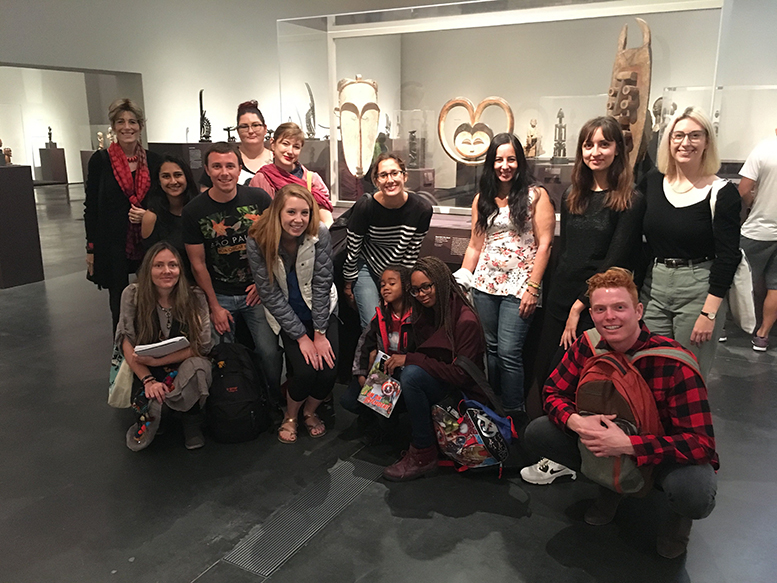
Polly visiting The Inner Eye exhibition that she curated at LACMA with students from her Ways of Seeing seminar.
Rebeca: I completely agree with you. I do feel like our students have changed somewhat, especially under this climate. They're more concerned about the political state, the state of the environment, climate change. But I have changed so much as well. It is, indeed, about finding much more meaning. What is meaningful as I'm teaching? When I'm teaching my “Contemporary Landscape Photography” course, it's not only about them learning how to see. It’s about giving them a chance to explore their concerns, a chance to create work that has meaning. I know that I am teaching with more focus on social issues and environmental issues, so that at the same time that my students develop a skill and gain all the knowledge of their discipline, they also stop and think, "What matters?"
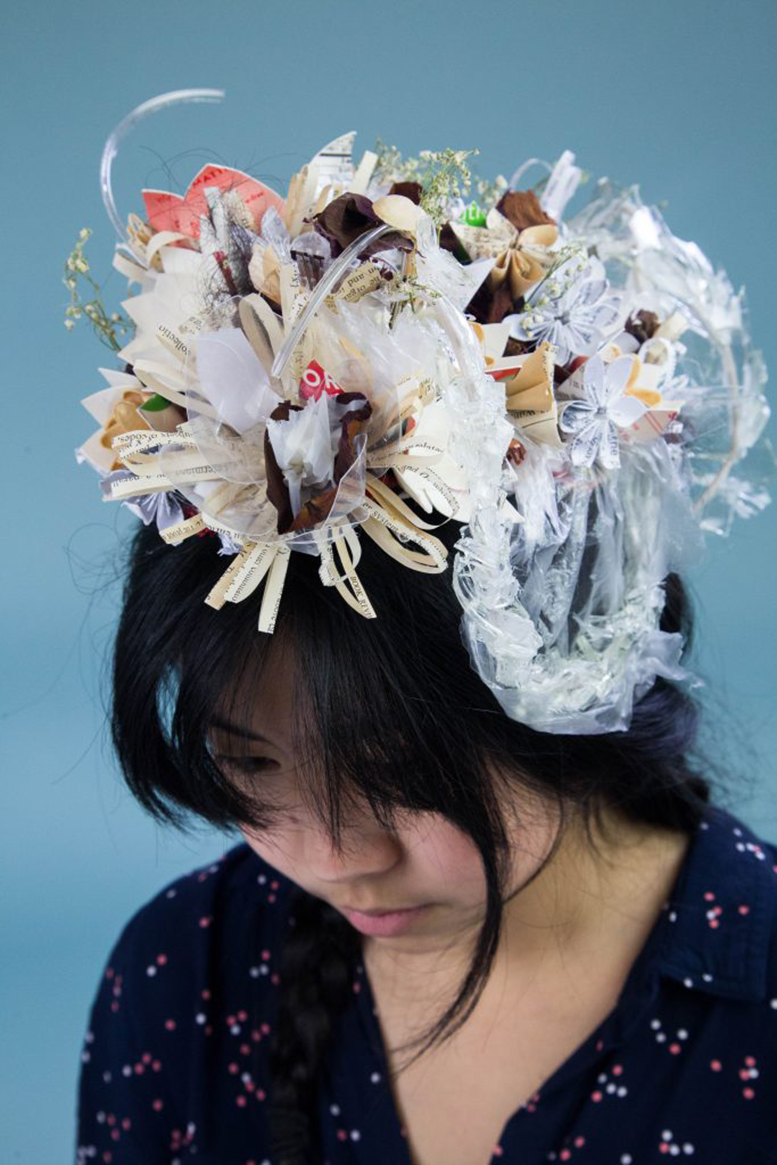
Design Media Arts student, Hikaru Bakoshi, wearing a hat she made out of waste as an assignment to document the waste she produced for seven days for Rebeca's Word & Image course. The course focused on the issue of waste, and culminated in the citywide Junk Battle which challenged design and architecture students to propose creative projects addressing institutional waste.
Polly: When I became a curator, I didn't even know what it was. This was not a profession that was taught at that time. I had no conscious intention of becoming a curator, it just happened. Much later, when I started teaching my Curating Cultures class, the thing that got me so excited was to learn that the word “curator” comes from a Latin word, curare.
Rebeca: Curare.
Polly: Which means to cure, but also means to be a caretaker, to be somebody who cares for souls and cures, and therefore heals.
I thought that is so beautiful. In the work I do, as a curator of arts from cultures that are not my own, there comes this enormous responsibility to be exceptionally sensitive and to work with individuals to understand how they would want to be represented. All of the art forms that we curate are forms of representation—although, frankly, a lot of the art forms that we study and work with in the arts of Africa or in Byzantine icons or in the devotional arts of India, that Al and I are working on now are actually not representations. They're presences.
We think in Western cultures that everything should be obtainable, collectible, visible, and knowable. That's what our academy is built on. And yet, in so many cultures of the world that's not always the expected behavior or the privileged value. In Buddhist temples, for example, you may view works in almost total darkness. There are masquerades in Africa that you may see only peripherally or just for a few fleeting moments. So there's this sense of fragmentation of viewing; peripheral viewing or viewing in motion, or not viewing at all.
Rebeca: Or even viewing so you can really concentrate. So that you shut down all the other senses and that you're focusing on one sense—so that the perception can be so much more profound.
Polly: Or viewing with all the other senses in a way that's also very multisensory. It can be both. In many African cultures, vision does not have the dominance that it has in our culture, but in museums vision rules. You are not allowed to eat, make noise, light incense or have candles—all the things you would really need if you truly wanted to create the aura and the environment in which most of these things are performed. In our culture, in museums, most things have to be in glass cases, when in fact, at least in the cultures where I have worked, the art, the objects, were kinetic, performative, or narrative.
Rebeca: This reminds me of an immersive installation I did some time ago. I filmed in 16mm the largest waterfall of all Europe—Dettifoss in Iceland—and projected it very large, and installed it with a few tons of lava rock and gravel. The edge of the ‘lava field’ indicates an implied boundary, not necessarily saying, “Don't go in,” but, of course, all of the adults are perfectly obeying the line while, you know, the little ones immediately ran into the lava field and towards the waterfall.
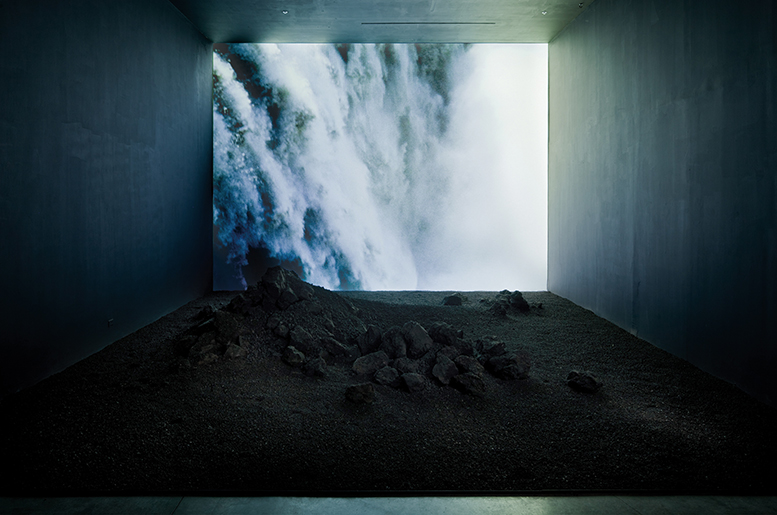
At Any Given Moment, Fall 1 with Volcanic Rocks, 2010. Video art installation consisting of a video projection measuring 22×19 feet, 3 tons of volcanic rock, and sound by Drew Schnurr. Installation view at ‘Energy’ group exhibition at Alyce de Roullet Williamson Gallery, Pasadena. On view from October 07, 2010 through January 26, 2011.
Polly: Isn't that amazing!
Rebeca: And it was beautiful. I mean, I thought, “Well I really didn't want people to go in, but I like it more that they did.”
Polly: That is so beautiful. A perfect moment of discovery and tactility.
Rebeca: It was that discovery that was so beautiful.
Polly: So that reminds me of an example from the Saint in the City show my husband Al and I did for the Fowler in 2003. It was a big show about a Senegalese saint, a mystic named Sheikh Amadou Bamba. One room in the exhibition was what we called the “imagorium.”
Rebeca: I like that name.
Polly: It was a recreation of a Sufi holy man’s home in Senegal—of his living room where devotees would come in the afternoon to sing the names of God and to pray and to be together and drink tea. It was this beautiful room that was saturated with paintings of the saint and his family and that were made by one of the artists with whom we'd worked.
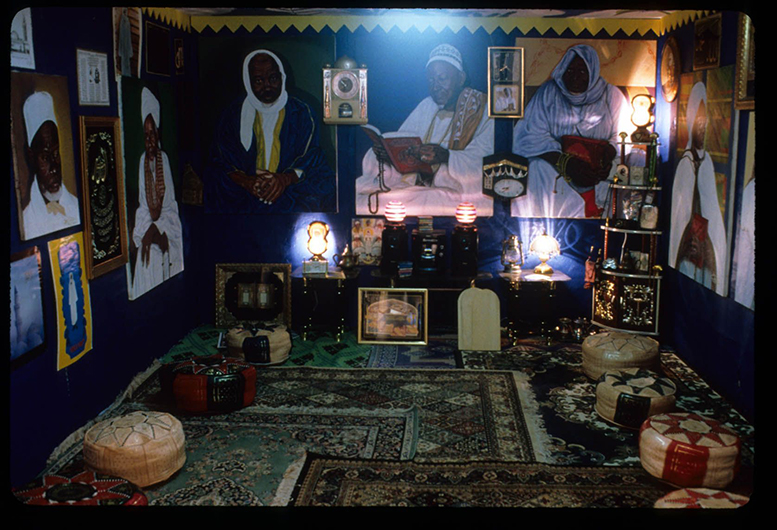
Imagorium in the Fowler Museum's Saint in the City exhibition in which devotees took blessing from the works on view.
We told the guards in advance, "You know the museum rule, 'Do not touch’? If you see Senegalese visitors coming for the opening and throughout the course of the exhibition, they are very likely going to touch the paintings in deference to the Saint. And we want you to let them do that."
So they understood, and lo and behold, on the opening night, people came and circumambulated the room. When they were Senegalese devotees, they touched every single painting, and then touched their foreheads and their chests to register the holy blessing energy emanating from the images. And that room took on a life of its own.
It’s very powerful when there is a call and response between the work of art and the visitors. Those who are beholding the work of art, engaging with the work of art like the little ones in your work, you know, running straight into the waterfall…
Rebeca: Exactly. That there's something that's so curious that it wakes one up to being alive and in dialogue with the work.
Polly: It opens up these new territories that we could never have imagined. That's why I love the arts so much.
My first project was on secrecy—African art that conceals and reveals. I had this revelation that I needed to do an exhibition on the concept of secrecy. Because all the fieldwork that I had been doing in Congo, in Zaire, was built on trust. The trust that people gave me to be witness to their world. And to be a documentarian. And to be a listener and a translator for these incredibly rich concepts, and incredibly complex art forms. In any given culture, knowledge is power. And it's very difficult when students who do fieldwork are expected to go out there and collect knowledge, bring it back and write a dissertation, and publish it to make it known to the world. There is the sense that the more data you have the better. The more interviews you do the better. The more insight that you can offer into cultural nuances the better.
But the fact of the matter is, that's not really how it works.
What we ought to be doing is teaching students about the limitations of knowledge, how to be respectful of the boundaries that define culturally diverse ways of knowing. It is about registering, “What am I being told?” “What do people want me to know?” “When should I stop pushing the envelope by asking questions?” Or, “How should I ask?” “How can I best be a participant?”
“How do you capture the contradictions?” “How do you capture the conflicts?” That's the reality of culture. It's not a seamless, neat, linear story. It's a messy and complicated one as James Clifford tells us. So how can we—and I love to teach about this because I want my students to think—how can we go into a cultural context and come back with not only that respect and sensitivity, but also knowing when to maintain a certain distance, and when to honor secrecy? It’s like my initiation with the Luba historians who bestowed upon me something sacred, which should not be elucidated in all its detail outside of that particular cultural context.
Rebeca: Beautiful. One of the things I am working on right now is collecting the stories of people and their relationship to the arctic tern, you know, the birds I have been studying. Collecting the stories and being with the people who know these birds. What does it mean? There's very little written about the birds. I am shocked that there are not many poems, not many songs, nothing.
Polly: That's beautiful that you are doing that.
Rebeca: And they are incredible birds. Theirs is the longest migration of any creature in the world. How come there's no anthology about them?
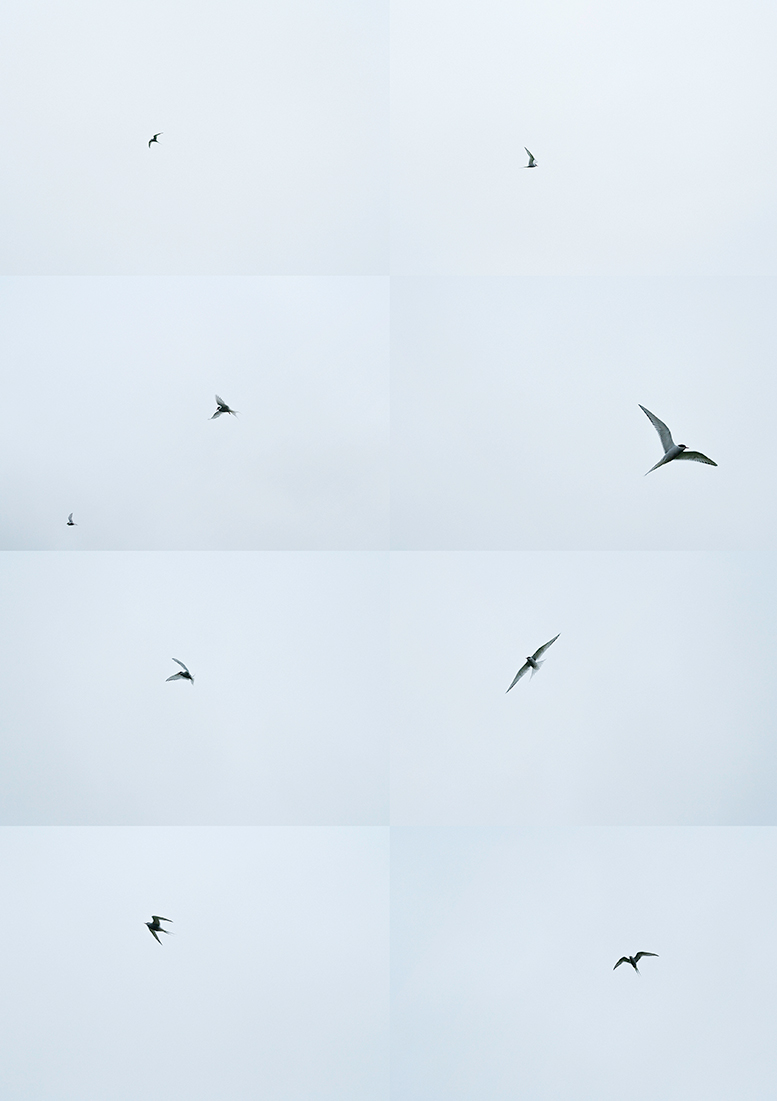
Rebeca's work, Circum/bi/polar 1 (Arctic Tern), 2013.
Polly: And when you gather those stories there will be such texture in them. I am working with that right now too with the Indian saint Shirdi Sai Baba about whom I have collected so many powerful devotional accounts, and I'm struggling so much to think about how to present these because, more and more, I just want the voices themselves to do the talking.
Rebeca: Exactly. Like, for me, it is about what does the bird want?
Polly: Right.
Rebeca: Can I just let the bird speak and just be a conduit rather than trying to impose a story. How can I bring the voices? That is a challenge.
Polly: I think that that's also so relevant to a lot of objects.
What you're saying makes me think about that question of what objects want—especially when I am working with fragments, which is so often the case when studying the arts of Africa or cultures where objects weren't made necessarily as “art.” They are objects of aesthetic brilliance and achievement made by artists, but they were made for other purposes; for education, or healing, or governance, or spiritual mediation. I always say they are more than art.
So when you're working in a museum and you're going through the reserves and you're creating an exhibition from this multitude of fragments that have been decontextualized from earlier lives and from very complex histories of use, how do you listen to that object and allow for a mode of presentation, which—granted—is a medium of artifice? The museum is a place of artifice to some degree. The object is re-contextualized in a place that it was never meant to be.
How can we, nevertheless, listen to that object? To perceive whether it wants to be shown, or the ways that it wants to be presented, and the kind of delicacy and sensitivity that it wants to be known by to audiences and generations far beyond the ones for which it served its earlier purposes?
Rebeca: Exactly. Because in that moment when we isolate them and make them inert, they're dead. I'm thinking specifically of an example of a beautiful fish hook. How many hands touched that, how many people were fed because of it, how many fish did it kill? This object is so powerful.
Polly: Isn't that something? Amazing. The philosopher Gaston Bachelard calls this “a fellowship with things.” The layers, the accumulation of experiences and histories that become embedded within an object and the presence that an object, or a life, exudes, but also the secrets that it holds are all part of that wonder.
Rebeca: Or the shame it holds for having killed.
Polly: And the shame that it might generate for having been taken out of a cultural context by a colonial officer, or a missionary, or maybe just a goodwill person who didn't…
Rebeca: Taken away from its context in which it was performing its function.
“The fact is that objects travel and find their way around the world—and most often we don't know the specific stories about how they got where they got, but they got there. And once they reach a museum, or a collection, in my view, they're now serving a new purpose and a new chapter of their life history, their biography. And it may be a completely different purpose. It may be an educational purpose, it may be an aesthetic purpose for people to behold from the standpoint of their form and their beauty, or it may be an activist purpose. But whatever it is, in my view, that object is still alive.” – Polly Nooter Roberts
Polly: The fact is that objects travel and find their way around the world—and most often we don't know the specific stories about how they got where they got, but they got there. And once they reach a museum, or a collection, in my view, they're now serving a new purpose and a new chapter of their life history, their biography. And it may be a completely different purpose. It may be an educational purpose, it may be an aesthetic purpose for people to behold from the standpoint of their form and their beauty, or it may be an activist purpose. But whatever it is, in my view, that object is still alive.
Rebeca: And we will die and the object will remain.
Polly: There you go.
Rebeca: And in the context of the history of human beings, it is the object that will outlast us.
Polly: Again, suddenly the tables turn, and we have much to learn.
Rebeca: This has been so beautiful.
Polly: Really beautiful.
Read more about Rebeca Méndez
Read more about Polly Nooter Roberts
Stay engaged. Use #UCLAarts to stay connected.


