How Belkis Ayón’s Explorations of Ritual Make for One of 2017’s Best Shows
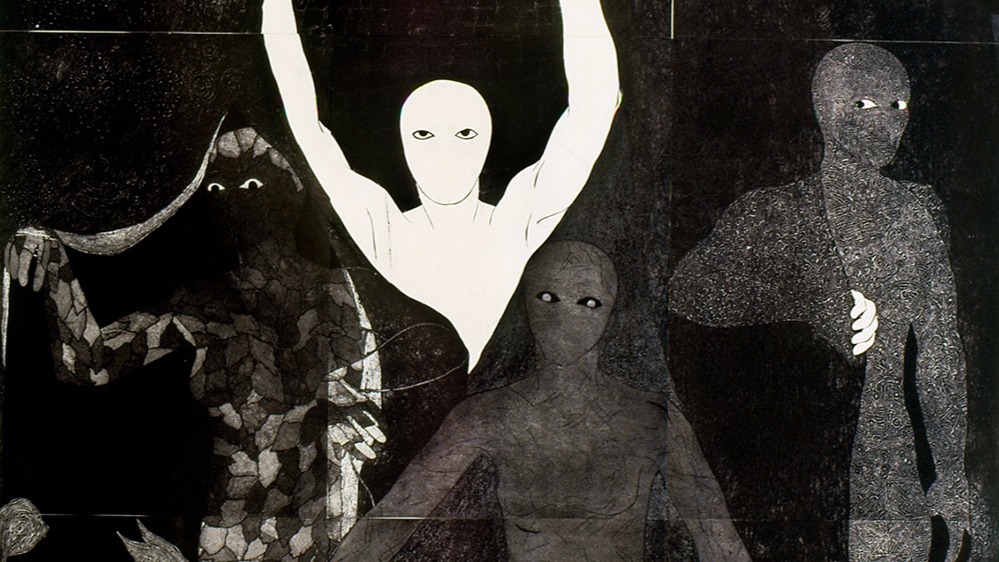
Nkame: A Retrospective of Cuban Printmaker Belkis Ayón, is the first solo museum exhibition in the United States dedicated to the work of Belkis Ayón (1967–1999)—the late Cuban visual artist who mined the founding myth of the Afro-Cuban fraternal society Abakuá to create an independent and powerful visual iconography. Ayón was known for her signature technique of collography, a printing process in which a variety of materials of various textures and absorbencies are collaged onto a cardboard matrix and then run through the press with paper. Nkame, now at El Museo del Barrio was first exhibited at the Fowler Museum at UCLA Oct. 2, 2016—Feb. 12, 2017.
"In her late teens, the Cuban artist Belkis Ayón became fascinated by Abakuá, an ancient Afro-Cuban tradition centered on the transmission of sacred knowledge, shared in secret lodges restricted to men. Ayón was in art school in Havana at the time — the late 1980s — specializing in printmaking. Though Afro-Cuban herself, she had no personal or family connection to this rite, which was more obscure than Santería, with deep African roots.
Ayón would go on to study Abakuá, befriend its initiates, witness its ceremonies. With this information, she devised the original and striking artistic language she would develop throughout her career. Hers was an idiom dense with ritual figures and symbols, yet feminist — she empathized with the crucial female character in Abakuá mythology — and open to plural interpretation. Her medium was collagraphy, a painstaking technique that allowed for detailed texture and nuance in shading. She worked in black, white, and shades of gray, giving her prints — with their silhouettes devoid of facial features save for intently staring eyes — the air of ghostly symphonies.
Ayón’s career was tragically brief, however. When she took her own life — with a gunshot to the head in her grandmother’s house in Havana, in September 1999 — she was only thirty-two. But she left a large body of work, some two hundred pieces of breathtaking impact, many of monumental scale, made in her steadfast, utterly singular vocabulary.
“Nkame,” the Ayón retrospective now at El Museo del Barrio, is a jaw-dropping experience, perhaps the city’s most arresting exhibition this year; the show also offers — amid the soul-sapping politics of the moment — a salutary injection of mystery. It takes us into the realm of ritual, but in the hands of an artist who identified as atheist, who deployed Abakuá myth (and its syncretic ties to Catholicism) in pursuit of a more private deliverance. It is also a journey to a particular time in Cuba, the “special period” after the fall of the Soviet Union severed the country’s economic lifeline — a time of penury when Ayón, invited to show at the 1993 Venice Biennale, had to travel to the airport by bicycle, her father carrying her packed-up work — the dramatic eighteen-panel Pa’ que Me Quieras por Siempre, on view in the retrospective — behind her on another bike.
Ayón was not completely unknown in the United States. In her final year of life, she had a gallery show in Los Angeles and residencies at the Rhode Island School of Design and three Philadelphia art institutions. Still, “Nkame,” which made a first stop at the Fowler Museum at UCLA last winter, is the first U.S. museum showcase for an artist whose brief career and iconoclastic approach might have consigned her to historical neglect. Instead, her friends and a family foundation, led by her sister Katia Ayón Manso, have doggedly cultivated her memory. Organized by Cuban curator Cristina Vives, this show draws on a larger one held in Havana in 2009, also titled “Nkame” (Abakuá for chant or praise).
The current version has forty-three works, some the size of altarpieces. It is light on Ayón’s early career, when she won prizes while studying at the Instituto Superior de Arte in Havana. During this time she made mostly small pieces, still in color, with residual elements of abstract formalism; the turn to the dark, complex vision rooted in Abakuá happened in earnest once she graduated, in 1991. Smartly, the first room takes us through this process, affording a kind of Ayón 101 through a major work, La Cena (“The Supper”), which she first made in color in 1988 using a naïf-art palette of pink-yellow-green. Disliking it, she made a new, six-panel version in 1991 in black-and-white, to much more absorbing effect. Both takes are here, plus the original printing plates of cardboard glued with carefully cut paper of different textures and etched patterns, showing just how meticulous was her process."— Siddhartha Mitter, Aug. 22, 2017

Read the full article at the The Village Voice website.
Read more news about Nkame: A Retrospective of Cuban Printmaker Belkis Ayón from Cuban Art News, Los Angeles Times, UCLA Newsroom