The late Cuban artist Belkis Ayón's mysterious world unfurls at the Fowler Museum
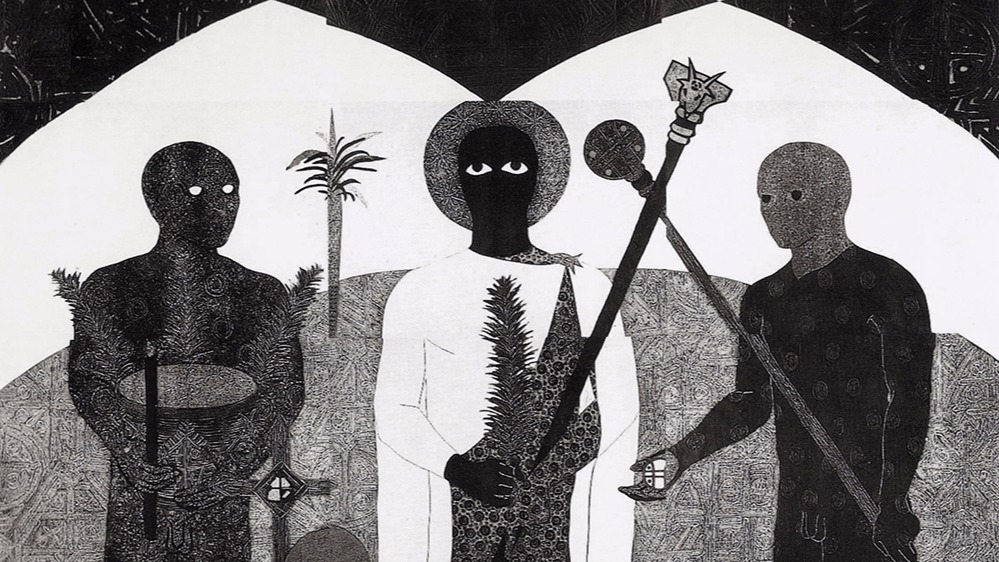
The Fowler Museum is pleased to present Nkame, the first solo museum exhibition in the United States dedicated to the work of Belkis Ayón (1967–1999)—the late Cuban visual artist who mined the founding myth of the Afro-Cuban fraternal society Abakuá to create an independent and powerful visual iconography. Ayón was known for her signature technique of collography, a printing process in which a variety of materials of various textures and absorbencies are collaged onto a cardboard matrix and then run through the press with paper.
"The moment is shrouded in secrets.
Cuban artist Belkis Ayón’s family home sits on a quiet street of central Havana, the charm of the house belying the mysteries of her death. White shutters open to leafy banana trees and crowing roosters. A warm, mango-scented breeze wafts through the central hallway, which is lined with the artist’s storied prints.
But a certain heaviness also flows through the house. In 1999, at just 32, one of the most important Cuban artists of the decade shot herself in the head with her father’s gun. Ayón didn’t leave a suicide note, but she did leave behind a prolific body of work that explores the dark mythology of Abakuá, an all-male, Afro-Cuban secret society not unlike the Masons.
Today, three generations of Ayón’s family live here, looking after her oeuvre. In the living room, Ayón’s sister and niece talk about the enormous unframed prints that are nearly as tall as the wall they’re tacked to. The haunting black-and-white artworks will travel for an exhibition at the Fowler Museum at UCLA opening Oct. 2; but on this humid May afternoon, the works are on view for visitors to the house who seem equally drawn to and frightened by the imagery. The prints are teeming with graphic renderings of snakes and fish and goats; dark silhouettes and ghostly-white figures with oblong heads and empty, almond-shaped eyes take part in Abakuá rites and rituals.
“The work is powerful but can be scary too,” Ayón’s older sister, Katia Ayón Manso, says in Spanish through a translator. “The clean precision in the lines and the high level of her work reveal the mastery she reached in printmaking.”
Ayón was a pioneer of large-scale printmaking and collography, a complex, labor-intensive technique using intricately collaged cardboard plates. She rose in the contemporary art world in the 1990s, a period of dire poverty in Cuba after the fall of the Soviet Union, when supplies for artists were hard to come by. Her innovative, multi-paneled works boldly mine the insular brotherhood of Abakuá through a distinctly feminist lens and offer veiled commentary on contemporary Cuban politics and culture"— Deborah Vankin, Sept. 23, 2016

Read the full article at the Los Angeles Times website.