Designing with climate change in mind
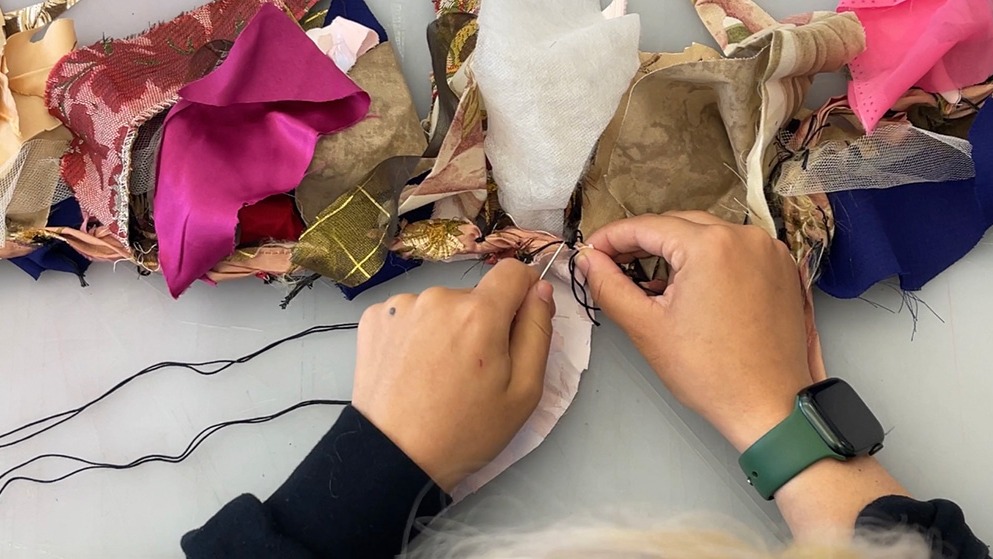
Design media arts students worked alongside environmental science students this spring to create design and art projects that draw attention to climate change and ecological inequality.
Professor and department chair Rebeca Méndez led the “Introduction to Ecological Art and Justice” class this quarter, the final part of a three-quarter sequence, and joined several students to discuss design’s ability to change minds and spur action.
The “Ecological Art and Justice” class was inspired by “Brand Laboratory,” which Méndez created in 2004, a year after arriving at UCLA, and co-taught over two quarters with another faculty member, splitting the time between research and practice and focusing on issues of organization, culture, and identity.
Méndez also founded and runs the research studio Counterforce Lab, which harnesses the power of art and design to address the global ecological crisis and environmental injustice. She also formed an interdisciplinary group of University of California faculty and lecturers to explore the possibilities of ecological art and justice.
“It was critical to start thinking, how do we teach the young students to begin to address the environment?,” she said. “How is it that we can design to become better ancestors?”
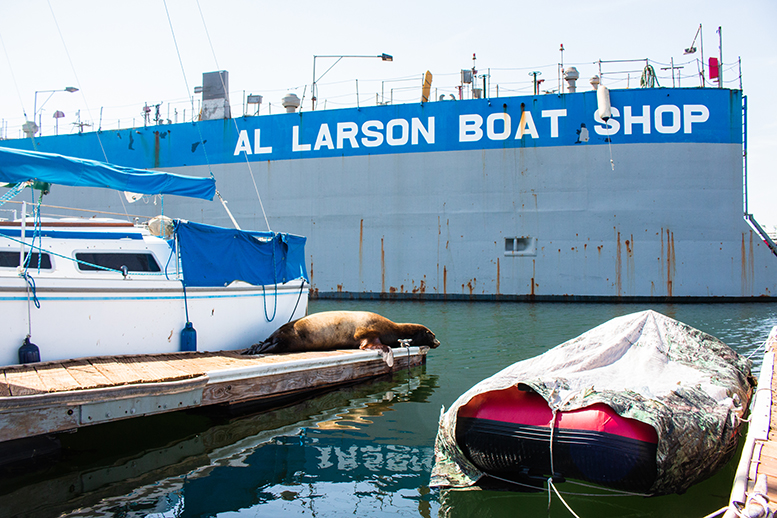
Christine Kao, image from Fishing for the Stories Left. A sea lion rests on the dock at Fish Harbor on Terminal Island, while a facility of Al Larson Boat Shop sits in the water behind the creature.
The fall course was taught by lecturer and recent alumna Erin Cooney, with students working as a group to create an immersive video installation called “Ritual of Return” in the Experimental Digital Arts space at Broad Art Center (read more about the fall course here).
In the winter, professor Peter Lunenfeld had students focus on research strategy. Students studied cases of environmental racism in Southern California, with an emphasis on the cities of Santa Barbara and Vernon, and proposed design projects that would incorporate their research (read more about the winter course here).
Méndez, whose own practice bridges art, design, and science, taught the spring quarter class with an emphasis on design practice and on ocean health.
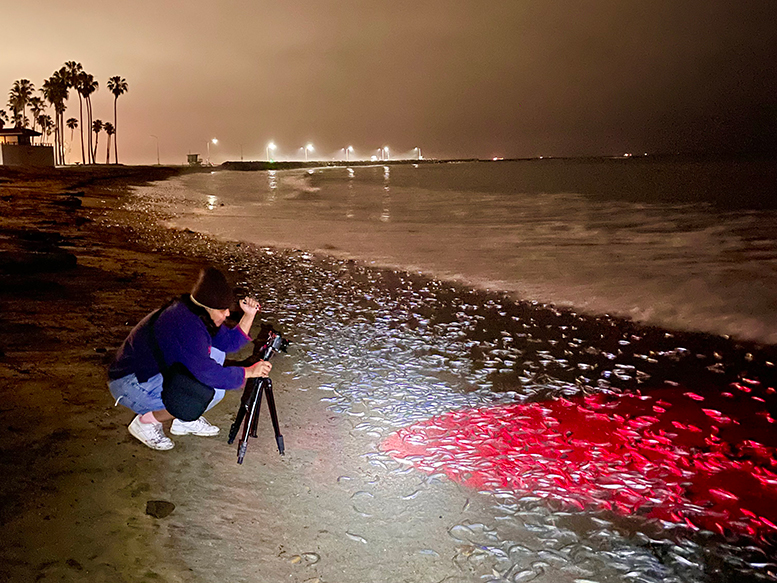
Anubha Gupta and Paige Brunson, GRUNION. They documented the grunion run on May 17 using a video camera and low-wavelength red lights.
Just as Méndez’s own work includes graphic design, video installation, photography and more, she encourages her students to explore different mediums.
“What is really beautiful is that some of them are doing a whole activist campaign, while others are doing installation work, and others are doing publications. The medium should never be the one dictating what your message is,” she said.
Méndez also encourages students to do their own field research for the class. One group is documenting the grunion run, when small silver fish called grunions come ashore at night during the spring and summer to spawn. Another student is studying snowy plover conservation at Santa Monica Beach.
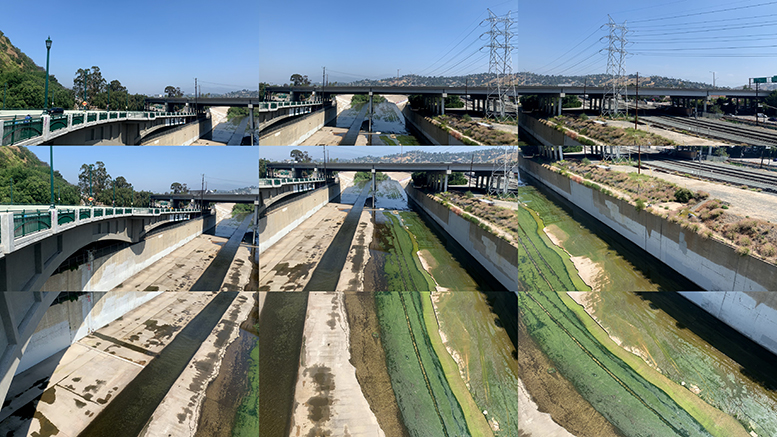
Philip Otto, still from The River Will Be What It Wants To Be.
Philip Otto, a fourth-year design media arts student, is working on a project about the 51-mile Los Angeles River as it traces its way to the Pacific.
The nine-channel video installation, called The River Will Be What It Wants To Be, will “show the river as this multifaceted, living being, that is, despite our attempts at colonizing it and channeling it and really diminishing it in so many ways, still very much alive,” Otto said. The project also connects the river to Otto’s own life story, including the recent loss of his father.
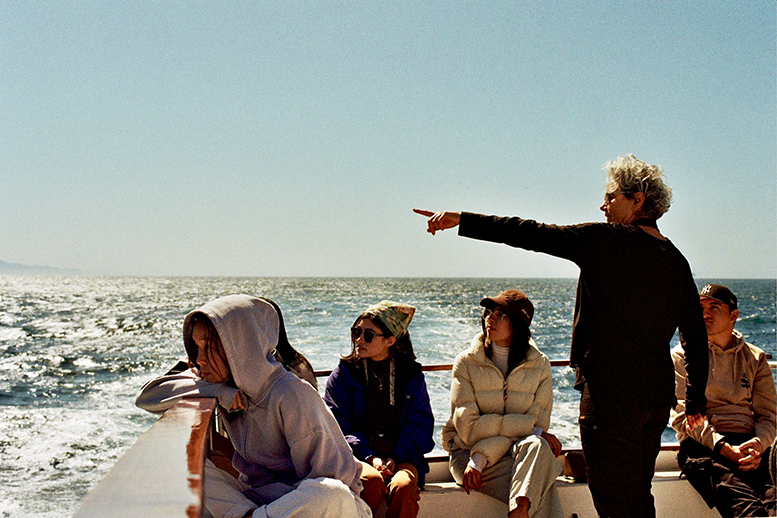
Méndez and students participate in a marine mammal field expedition as part of “Introduction to Ecological Art and Justice.” Photo by Marc Thureau-Dangin.
In April, Méndez brought students on a marine mammal field expedition led by marine biologist Holly Lohuis. They sailed off the coast of Ventura for several hours to look for whales and other sea creatures. The class also went to the Hammer Museum to see oceanographer and explorer Sylvia Earle discuss her marine expeditions and how to reverse planetary decline with actress and activist Laura Dern.
The students read articles, essays and book excerpts about anthropogenic climate change. Such a syllabus could make any student depressed about the future, Méndez acknowledges, and there has been crying in the class.
But by making art in response to these ideas, she says, “rather than feeling that depression that one feels when one is paralyzed and doesn't know what to do, it powers them to be able to have a voice, to be able to know how to think about it, to be able to collaborate with others, to just say, ‘hey, I am going to do something about this.’”
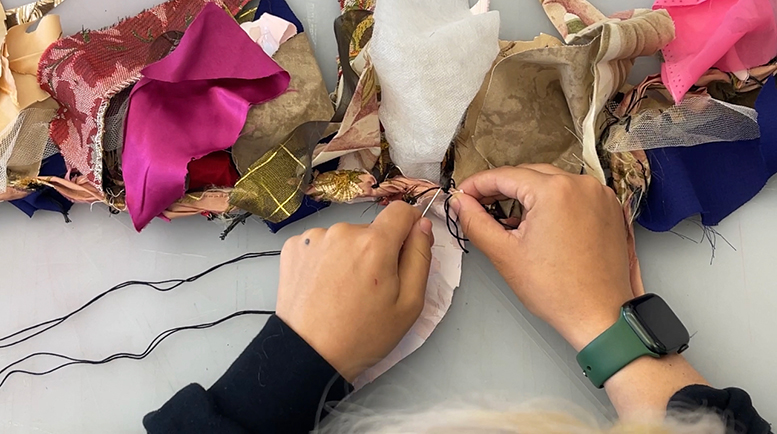
Alexia Magdaleno, Intertwined.
Several students are focusing on kelp as a sustainable material for designing fabrics, water bottles, and other products.
Alexia Magdaleno, a third-year student transferring into the design media arts program, is installing a kelp forest using sound, light, and sculpture, and made out of recycled textiles and donated clothing, which she will donate and recycle afterwards.
“It will really just be an immersive experience that'll use all the senses to make people think about this concept,” Magdaleno said. “We grow food. So why can't we grow our clothing as well?”
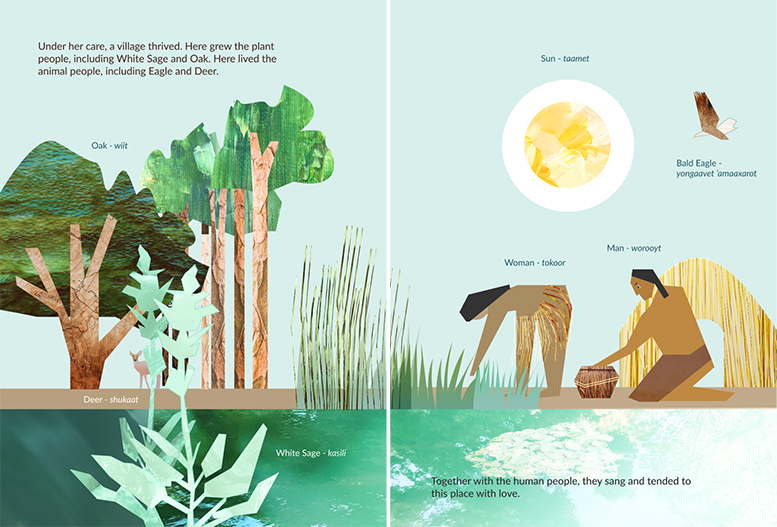
Jane Ann Wang, Kuruvungna Springs storybook illustration.
Jane Ann Wang is a second-year design media arts student making an illustrated storybook for children that honors Kuruvungna Springs, a sacred spring located near UCLA’s campus that was used and continues to be used as a source of natural fresh water by the Tongva people. The book is told from the perspective of the village’s last remaining spring.
“I want to talk about how people used to live harmoniously with the LA River, their story about how they were dispossessed of their lands, what happened to the LA River, and then how they are currently working to preserve the LA River and help restore it to the place that it once was,” Wang said.
Another group is differentiating between publicly-owned and privately-owned beaches, and how environmental crises have affected them differently. They will produce a zine that will compile annotations, articles, and imagery that references the ideas, field work, and photographs they collected, “investigating what it means to be a part of a white affluent beach community, and also examining what it means to have those spaces be inaccessible,” said Ella Rose Bandouveris, a third-year design media arts student.
“We're basically looking at Pacific Palisades and Malibu as case studies to look at how these wealthy, suburban beach towns impact the way that these beaches are preserved as ecological sites and how that also contrasts with more public beaches, namely Venice or Santa Monica,” said Lauren Leung Cramer, a fourth-year design media arts major.
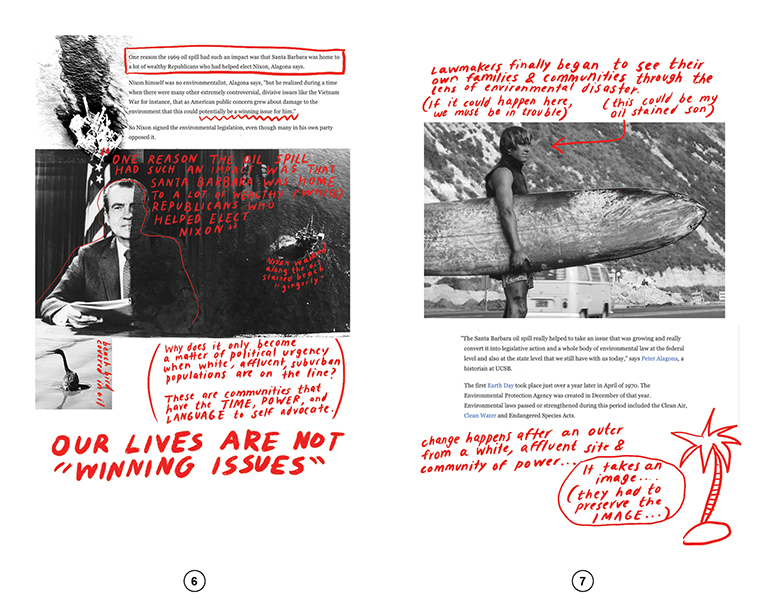
Spread from Observations from the Slope, a zine by Ella Rose Bandouveris, Lauren Leung Cramer, and Maya Lu with found imagery, article clippings, and handwritten annotations pertaining to the Santa Barbara Oil Spill.
Maya Lu, also a fourth-year design media arts major, says the project was informed by studying the response to the 1969 Santa Barbara oil spill in Peter Lunenfeld’s winter course, which has been credited with birthing the modern environmental movement.
“The imagery of Santa Barbara tainted with an oil spill was really what pushed lawmakers to start enacting policies that are still seen today,” Lu said. “And that just is a parallel to affluent communities like Malibu and the Pacific Palisades that still see that kind of privilege of lawmakers paying attention to those communities over, for example, chemical pollution happening in downtown L.A.”
Students will show their final projects on Wednesday, June 1 in spaces across Broad Art Center.
Social activism has increasingly become part of Méndez’s own practice, and she believes that design can play an important role in encouraging people to change their habits.
“Starting to change minds is at the core, at the very beginning, so that one can start affecting behavior,” she said. “I think that through art and design, we can do that.”
Story by Avishay Artsy
Stay engaged. Use #UCLAarts to stay connected.


