Reconnecting with nature through immersive exhibition “Ritual of Return”
Art and science students collaborate on ecological justice project
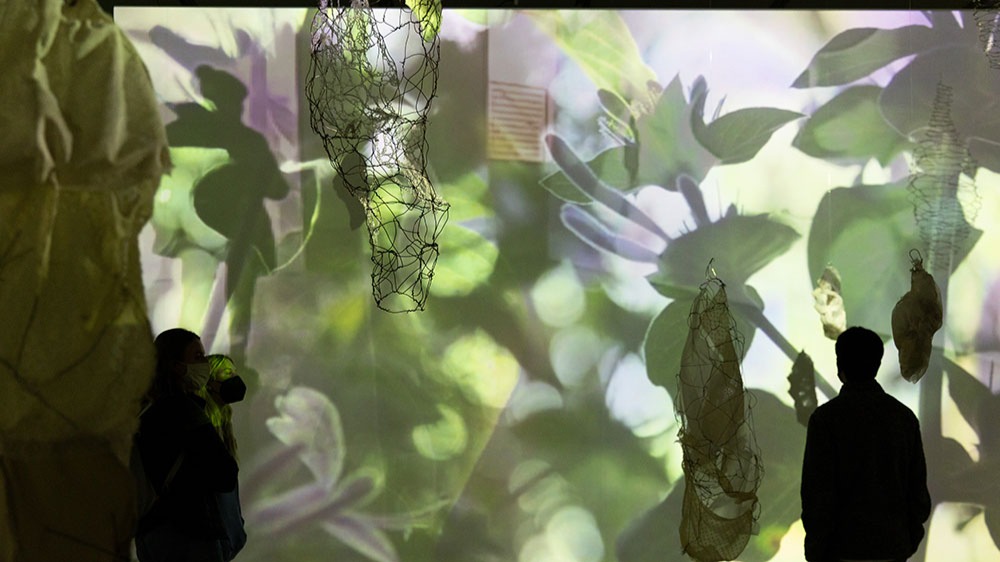
Art and science students at UCLA want you to reconsider the human relationship with nature, even if it means shrinking you down to the size of an insect – or at least creating an immersive environment that helps shift your perspective to the scale of tiny creatures.
This past fall, 11 students in the design media arts course “Introduction to Ecological Art and Justice” staged an installation in the Experimental Digital Arts space, or EDA, at Broad Art Center. The exhibition “Ritual of Return,” held on Dec. 9, 2021, combined immersive video, audio, sculpture, and performance to make visitors feel fully embedded in a natural environment. Students also produced an illustrated booklet about the research and iteration that led to the final exhibition.
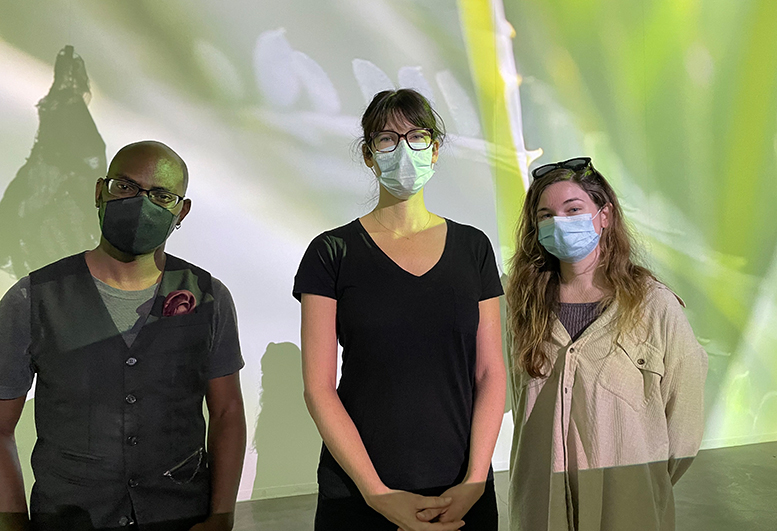
From left: Leslie Foster, Erin Cooney and Jen Hotes in the EDA space at Broad Art Center. Photo by Avishay Artsy.
Students from the Department of Design Media Arts collaborated with environmental science, biology, and public policy students to create the project.
Erin Cooney, a lecturer in design media arts at UCLA and an alumna of the program, said the class took a transdisciplinary approach to exploring “the idea that human beings are not separate from nature.”
“The strength of the arts is to tell stories. And we are very interested in retelling the story of ourselves in relationship to the natural world. We're bringing together these different disciplines that are necessary in order to tell that story responsibly,” Cooney said.
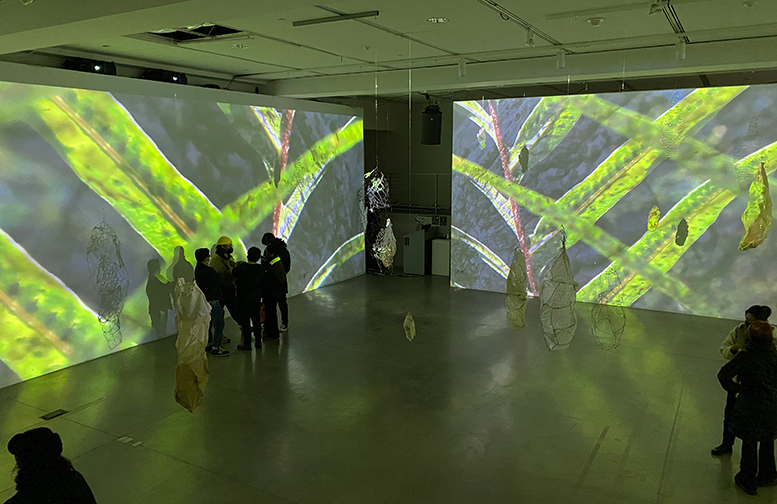
Chrysalis-like sculptures hung from the gallery’s ceiling cast shadows across the video projections. Photo by Erin Cooney.
The resulting project is grounded in scientific rigor while still appealing to our senses and emotions.
“We're in a space where those fields need to be working together more anyway, especially as we're thinking about the Anthropocene and how we're dealing with climate change,” said Leslie Foster, the class’s teaching assistant and a second-year graduate student in the department.
Foster acknowledged that it can be challenging for students who have such different approaches to research to work together and create something new, but that both artistic production and scientific research require collaboration.
Three full walls of the exhibition space were blanketed in video projections showing close-up shots of sun-dappled leaves and twigs and flowing water. Foster brought a group of students to the UCLA botanical garden to shoot for several days.
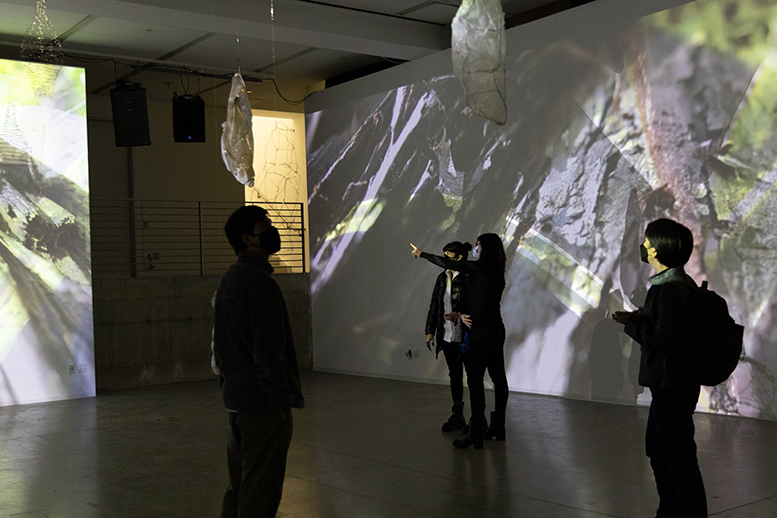
Visitors immerse themselves in a multimedia environment that’s meant to challenge an anthropocentric view of nature. Photo by Chloe Belinsky.
In the center of the room, several wire and fabric sculptures resembling chrysalises hung from the ceiling. The chrysalis-like forms glowed from within and cast shadows along the walls. The hollow interiors are “meant to be spaces for transformation,” Cooney said.
The installation also included an ambient soundscape designed by undergraduate design media arts student Jen Hotes, featuring ethereal synthesizers and deeply resonant bass notes that reverberated throughout the space.
During the exhibition, a student performer walked around the space with a GoPro attached to their body. The video feed from this circulating GoPro was then projected onto the walls in real time, and superimposed onto the nature footage, further complicating the relationship between subject and object.
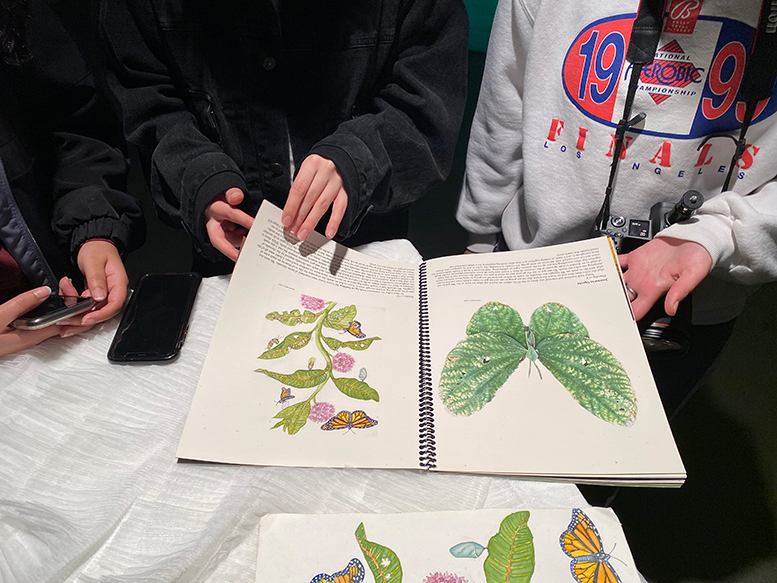
A student-produced book captures the collective thought and research that went into “Ritual of Return.” Photo by Erin Cooney.
Cooney said this class was unlike most traditional design classes. Rather than have students working on individual projects, the students had to work together as a singular cohort in the class. First, the students gave presentations on assigned readings that looked at ecological crisis and environmental injustice, such as "The Trouble with Wilderness; or, Getting Back to the Wrong Nature" by William Cronon, and "The Persistence of Vision" by Donna Haraway. The readings explored how ecological crises, such as climate change, pollution, fossil fuel extraction, and mass extinction, are inexorably tied to legacies of racial and social injustice. They also learned about artists and designers whose practices address these topics. The students then presented project ideas that coalesced into a cohesive group project.
“The students did find that challenging, to be honest – to give up that sense of absolute control over the project and to make space for each other,” Cooney said. “I'm excited for students to be training in that way, because that's the kind of work we need to be doing to solve these large problems that we're dealing with, including the climate crisis.”
In addition to the installation, students created a book that corresponds to the four stages of a butterfly’s life – egg, larvae (caterpillar), pupa (chrysalis), and adult butterfly – as an organizing principle and a reflection of the stages of iteration that the class project went through, Foster said.
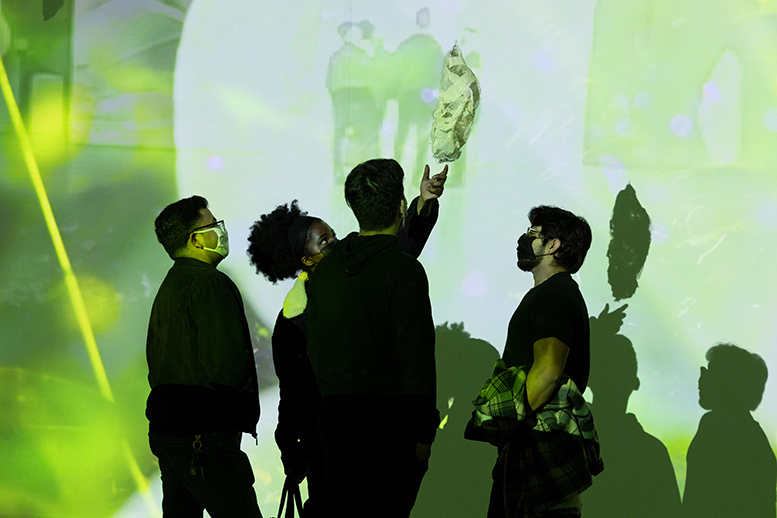
Students examine one of the chrysalis-like forms in the exhibition. Photo by Chloe Belinsky.
The instructors hope the project inspires others to use collective decision-making and transdisciplinary solutions to resolve problems in the future. Combining art and science can make for better storytelling, they said, which can in turn change perspectives.
Hotes said the project also challenges “these fragmented understandings of art and science being fundamentally different disciplines. They work in the same way. They work through inspiration. They work through questioning paradigms... Each one is based heavily in investigation. And I am really excited about this being a model for how education can move in the future.”
The course “Introduction to Ecological Art and Justice” continues this winter, taught by design media arts professor Peter Lunenfeld, and in the spring, taught by design media arts professor and department chair Rebeca Méndez. This story is the first in a series that will track the course across the following two quarters.
HEADER IMAGE: “Ritual of Return” immerses viewers in wall-sized projections of videos shot at UCLA’s botanical garden. Photo by Chloe Belinsky.
Stay engaged. Use #UCLAarts to stay connected.


