You See LA: Spring 2018
5 Things to See and Do Around Los Angeles Handpicked by Professor Sylvia Lavin
Professor Sylvia Lavin is a critic, historian, and curator whose work explores the limits of architecture across a wide spectrum of historical periods. She is the director of the critical studies, M.A., and Ph.D. programs in the Department of Architecture and Urban Design at UCLA—where she served as chair from 1996 to 2006—and director of The Curatorial Project, a collaborative design and research group that supports the critical engagement with experimental architecture in the public realm. Her most recent curatorial project, an exhibit entitled Architecture Itself and Other Post-Modernist Myths, opens at the Canadian Center for Architecture in November 2018.
L.A. is one of those places that has been either loved or hated, found sublime or ridiculous. Frank Lloyd Wright thought it was where all forms of cultural garbage are collected, “tip the U.S. on its side and everything loose will land in L.A.,” he famously quipped, while Reyner Banham saw it through such groovily rose colored glasses that he failed to see that the freeways he so admired were choking the city with smog. But of course, L.A. is all these contradictory things at the same time, so my suggestions about how to explore the city today are oriented towards the discovery of ways to have your sublimity and your ridiculousness too.
Sublime
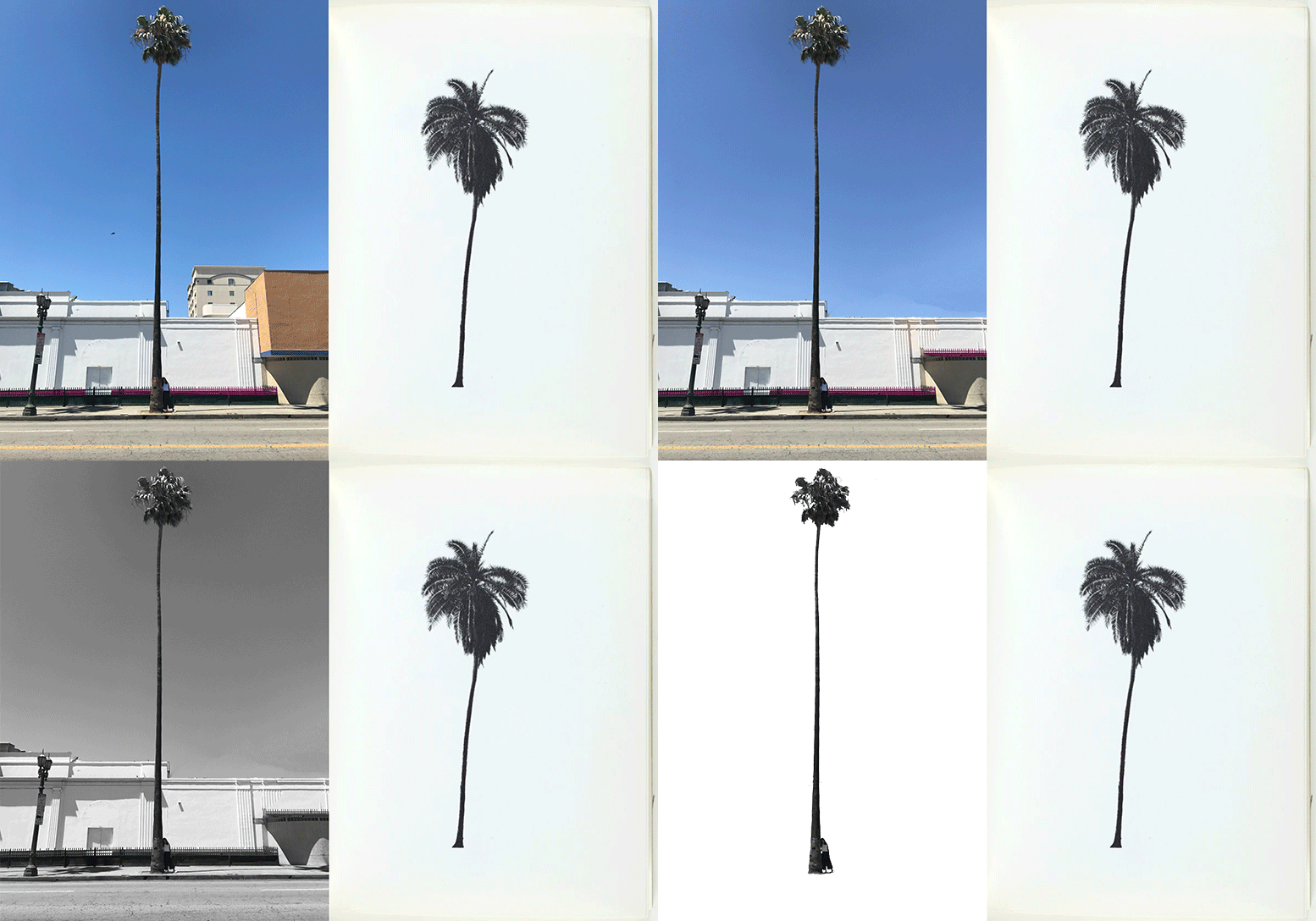
Summer Liu, excerpt from I Have Been to A Few Palm Trees, 2017.
There is no one who has had a more sublime take on the ridiculous features of Los Angeles than Ed Ruscha. The small, limited edition art books that he did in the 60s and 70s, Some Los Angeles Apartments (1965) and A Few Palm Trees (1971), are fantastic guides to this aspect of the city’s history. But they are also generating contemporary forms of surprising disjunction as current visitors to L.A. not only go to Hollywood and Vine or to Venice beach, but use GoPros to document Every Building on the Sunset Strip and take selfies as they revisit Some Los Angeles Apartments. If you go look for a few of Ruscha’s palm trees, not only will you traverse an unexpected cross section of the city, but you are likely to find other tourists looking for Ruscha palm trees and taking pictures—not of the palm trees but of themselves looking, channeling Ruscha. One of my current students, Summer Liu, recently completed a project reflecting on this weird and fascinating new subculture of Ruscha tourism.
Ed Ruscha, A Few Palm Trees, 1971
Photos taken at various locations throughout Los Angeles. A full viewing of the book, including addresses, can be found here.
Ridiculous
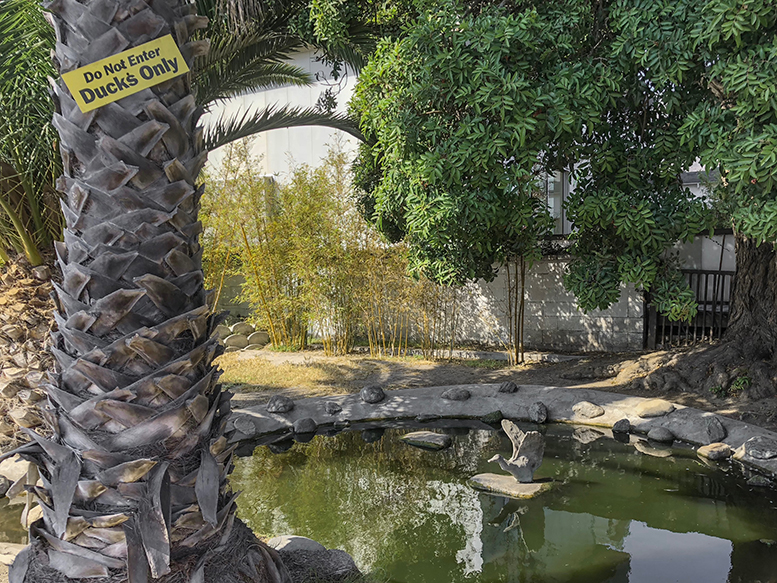
Ruscha, among other things, was interested in the logic of urban development in L.A. (a logic that relied on the idea that the city was a tabula rasa with no history), but today a prime urban force is redevelopment and gentrification (with its logic that selectively forwards some histories and erases others). For example, the Venice canals were created in 1905 by developer Abbot Kinney, who plopped what he thought of as the sublimity of Venice, Italy—replete with animals—onto the West side of the city. By the seventies and eighties, Venice beach had fallen into disrepair, the small one-room houses were full of squatters, artists, people of color, and other ‘misfits’—and the animals were getting sick. By the early nineties, rising real estate value led the California Department of Fish and Game to remove, or kill, hundreds of ducks and geese from the canals and nearby ponds, literally paving the canal way for a spectacular process of gentrification only amplified by the addition of Silicon Valley into the mix. The most significant marker to this complex history is The Duck Memorial, sponsored by the new residents of the canals, set up in honor of the 519 ducks and geese that were killed as part of the clean-up project. Perhaps appropriately, the memorial today is mostly visited by ducks.
Duck Memorial at Linnie Canal Park
200 Linnie Canal
Venice, CA 90291
High-End
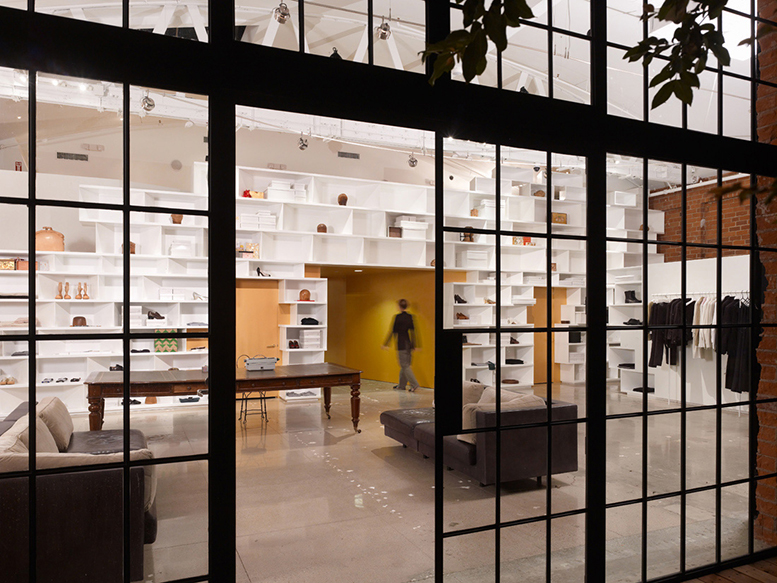
Johnston Marklee, Mameg, Beverly Hills, California, 2007.
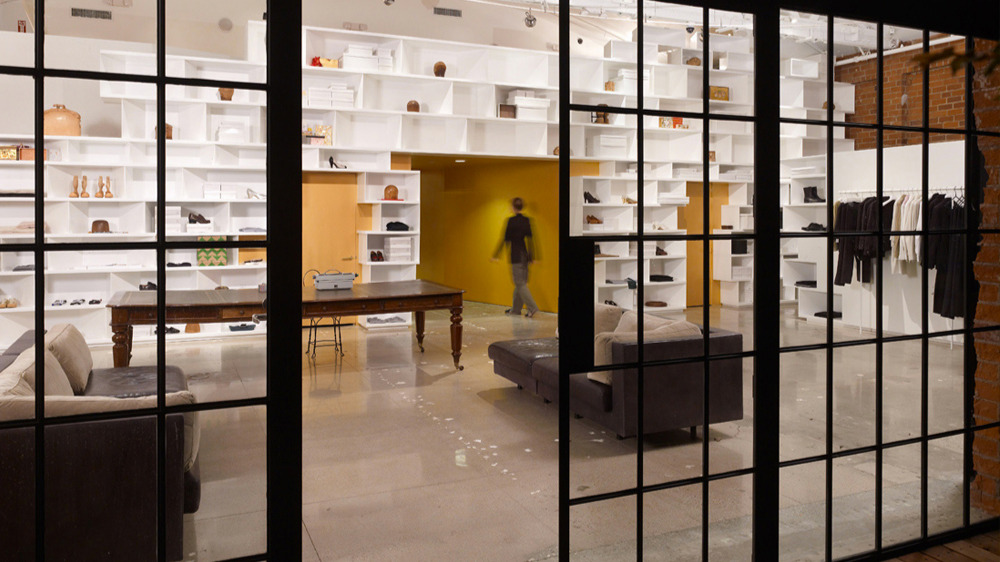
In the 18th century, if you were interested in the world around you, you were probably an amateur scientist; and since there were relatively few schools, most scientists were amateurs. Instead of university, a common form of education was to be had by going shopping for scientific instruments. While demonstrating their skill in making telescopes, for example, a consumer would be inducted into the logic of scientific experiment and observation. L.A. is home to the most extraordinary contemporary version of this kind of accidental education: Mameg—an exquisite and high end clothing store owned, perhaps curated is the better term, by the exquisite and down-to-earth Sonia Eram. Drop by and ask her about anything in the store, whether it is a dress or an object not for sale, and you will be treated to the most extraordinary education in design you could ever ask for.
Mameg
9970 South Santa Monica Blvd.
Beverly Hills, CA 90212
Low-End
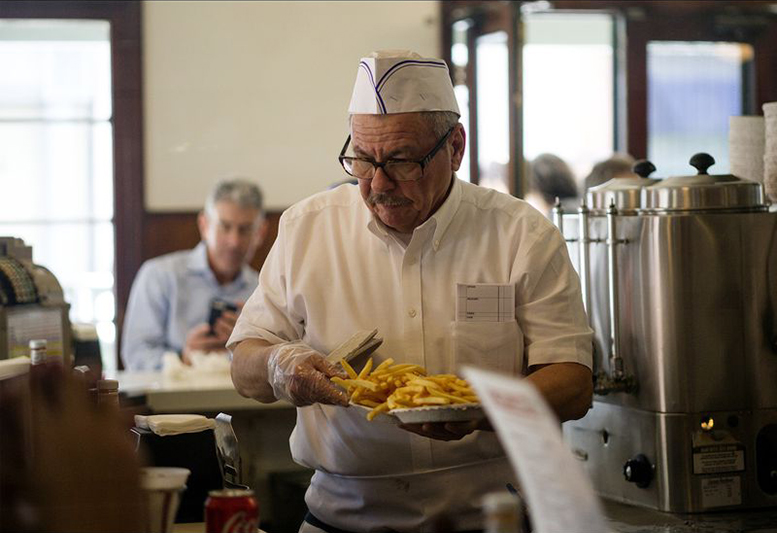
Hector Morales, a server for 41 years, is one of the most senior employees at the Apple Pan. "I feel that I’ve learned so much from the customers that come here," he says. (Gina Ferazzi / Los Angeles Times).
It seems that architecture gentrifies more quickly and thoroughly than food, so it’s something of a relief to know that among all the turmeric latte’s and $500 wagu steaks you can still get a $5 cup of hand sliced fruit with chili powder just about anywhere in town, or a heart-disease-inducing plate of fried sea critters at Neptune’s Net seafood restaurant on PCH in Malibu at the Los Angeles/Ventura county line. What’s important about cheap food is not its cheapness, or even the food as such, but that low-end places have a way of slowing gentrification by being too small to bother with. This is not unique to LA—on Orchard Street in NY you can still get a Knish because the old knish joints stay in business by also selling knishes with bacon. But every place like that is a wormhole that can take you down strange and unexpected historical byways. Go get some fries or a hickory burger at The Apple Pan—I assure you that the food will be new but the guy who hands it to you will probably have been working there since the place opened in 1947. If you get him to talk to you, he will have some good L.A. stories to share.
Great Western Steak & Hoagie Company
1720 Lincoln Blvd.
Venice, California 90291
Neptune’s Net
42505 Pacific Coast Highway
Malibu, CA 90265
Earle’s
3864 Crenshaw Blvd.
Los Angeles, CA 90008
Apple Pan
10801 Pico Blvd.
Los Angeles, CA 90064
Fruit Carts
various locations across the city
All Four: Sublime, Ridiculous, High-End, Low-End
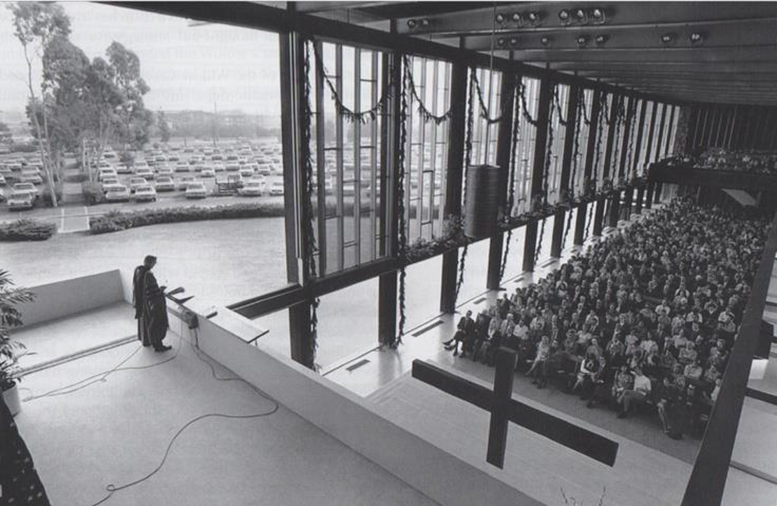
Richard Neutra, Garden Grove Drive-In Church, photo circa 1964.
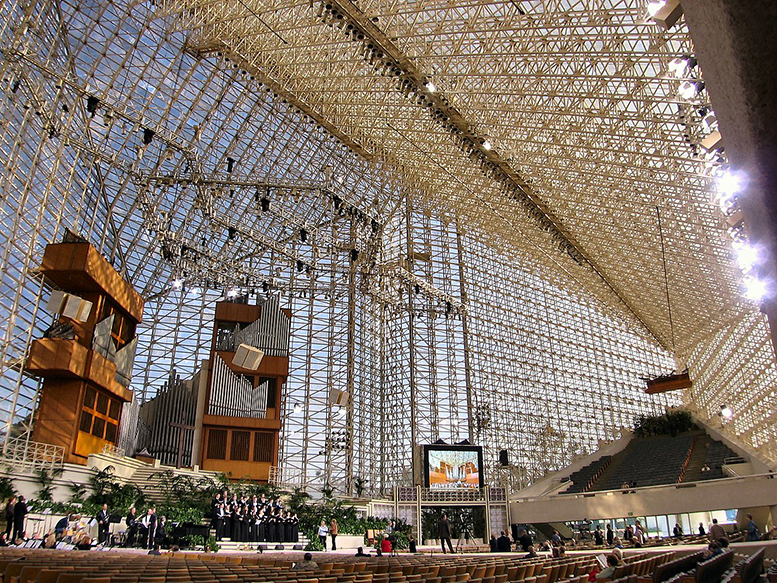
Interior of the Crystal Cathedral with the "Glory of Easter" set installed.
There's no place that is more precisely sublime and ridiculous in equal measure than the Crystal Cathedral complex in Garden Grove. Whether it's the original 1961 Richard Neutra building–an important monument to the now beloved mid-century modernism, but that was, when built, a not always well received drive-in church with a huge slider that opened not onto a luscious pool but to a parking lot of worshippers or the 1980 Phillip Johnson massive glass covered space frame that turned the small church into the first mega church designed not for the small scale of a drive-in but for the infinite audience of televised Christmas pageants, to the 1998 International Center for Possibility Thinking designed by Richard Meier–not only the architect of the Getty Center, but also the first architect to be publicly disgraced by the #MeToo Movement, the Crystal Cathedral complex has it all, for better or worse, from the sublime to the now, and perhaps finally, to the ridiculed.
Crystal Cathedral
13280 Chapman Ave.
Garden Grove, CA 92840
Stay engaged. Use #UCLAarts to stay connected.


