You See LA: November 2020
Internet projects from LA artists, picked by Design Media Arts associate professor Lauren McCarthy
Design Media Arts Associate Professor Lauren Lee McCarthy, who also earned her M.F.A. from the department, is an artist based in Los Angeles whose work examines how surveillance, automation, and network culture affect our social relationships. She is the creator of p5.js, an open source programming language with over 1.5 million users, for learning creative expression through code online. She is co-director of the Processing Foundation, a non-profit whose mission is to promote software literacy within the visual arts, and visual literacy within technology-related fields—and to make these fields accessible to diverse communities. She is also the interim Associate Dean of Equity, Diversity, and Inclusion for the UCLA School of the Arts and Architecture.
Well, it’s November and I’m here at home on my computer. This is the list of LA artists making the internet feel ok right now. More than ok really—they are lighting it up and burning it down. - Lauren Lee McCarthy
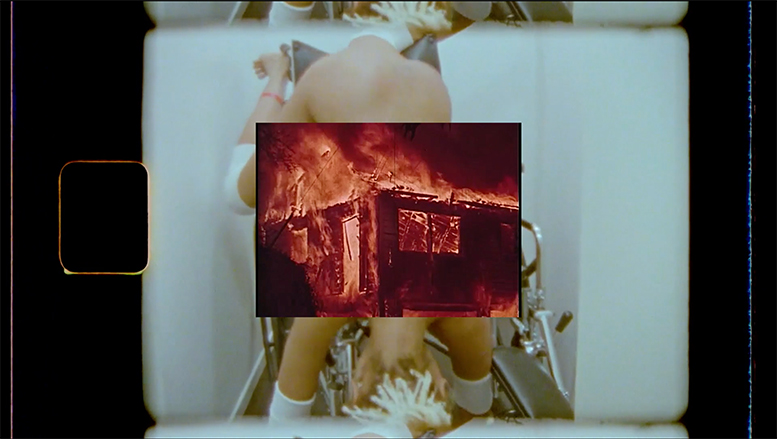
Still from Natural Disaster by Panteha Abareshi. [Image Description: Building burning in foreground frame with woman mounting a wheelchair headfirst, naked except for knee, elbow, and wrist wraps.]
Curated by Frances Breden and Romily Alice Walden, and including LA artists Panteha Abareshi and Johanna Hedva (now living in Berlin), this gift of an exhibition has audio descriptions, captions, scores, alt text, and all the space you need to imagine rebuilding a world around access for all. Why is this such a radical idea?
PRESENTS is an online screening of short video works that don’t require an abled or physically present body in order to be performative. Ten sick and disabled artists come together to expand the idea of ‘performance’, presenting work that is embodied, immediate, and present without forcing bodies to conform to ableist norms of art-making.
Human and Animal Locomotion, Kite and Devin Ronneberg
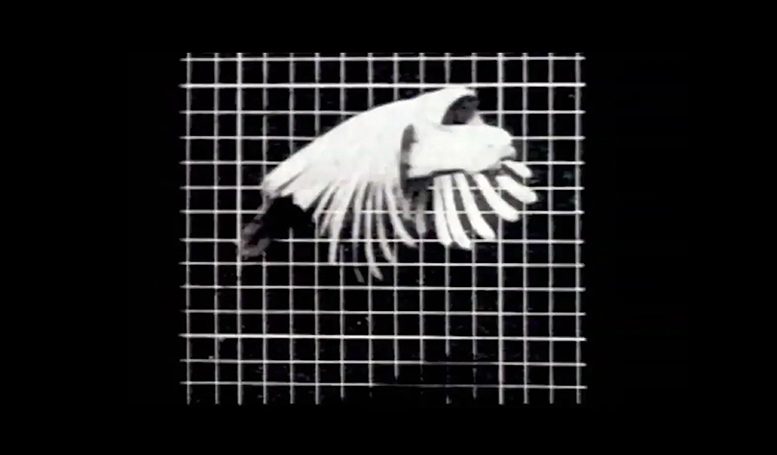
Still from Eadweard Muybridge’s motion studies. [Image Description: Bird mid-flight in front of white grid on black background.]
I met artists and musicians Suzanne Kite and Devin Ronneberg in a zoom window this spring. I was feeling my whole practice teeter and shift along with the world, and Kite’s work made me stop and reflect on the necessity of transformation. She expands on this in her text “How to Build Anything Ethically” for the position paper on Indigenous Protocol and Artificial Intelligence.
This space of transformation was present in the livestream screening of Eadweard Muybridge’s magical motion studies co-organized by LACMA and the Autry Museum of the American West. The stream was accompanied by a live score by Kite and Devin that illustrated how history is a constant process of reenvisioning.
Queer Correspondence, Beatriz Cortez & Kang Seung Lee, rafa esparza, Gelare Khoshgozaran
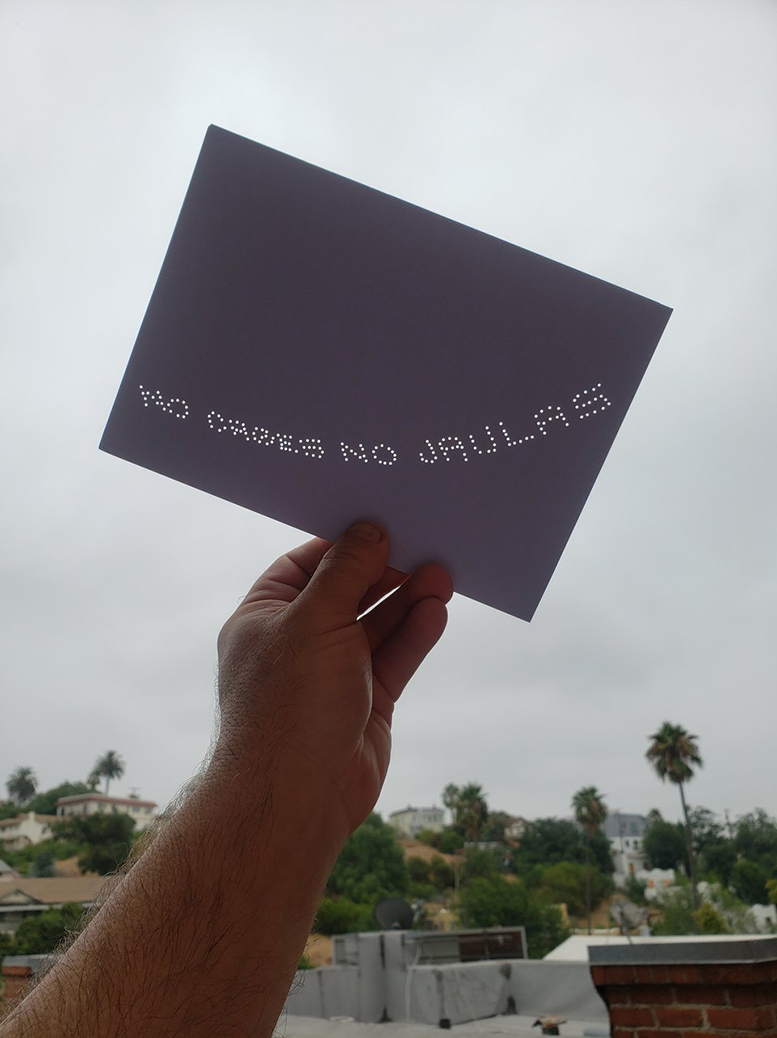
Beatriz Cortez & Kang Seung Lee, Queer Correspondence, 2020, Cell Project Space. Image submitted by Mark Verabioff from Los Angeles, California, USA. [Image Description: Hand holding postcard that reads “NO CAGES NO JAULAS” with LA in background]
At one point when I couldn’t remember if anything was real anymore, I found ground in Cell Project Space’s Queer Correspondence that invites artists “to begin correspondences that will establish connections between queer families,” making “literal and symbolic physical journeys, moving across borders, transiting private and public spaces and inviting its recipients on a multiplicity of past, present and future temporalities of possibility.”
The project includes LA artists Beatriz Cortez, Kang Seung Lee, rafa esparza, and Gelare Khoshgozaran. The postcard above connects to Beatriz Cortez’ project No Cages No Jaulas which skytyped the phrase over the Los Angeles Immigration Court on Olive Street on July 3 as part of In Plain Sight led by LA artists Cassils and rafa esparza.
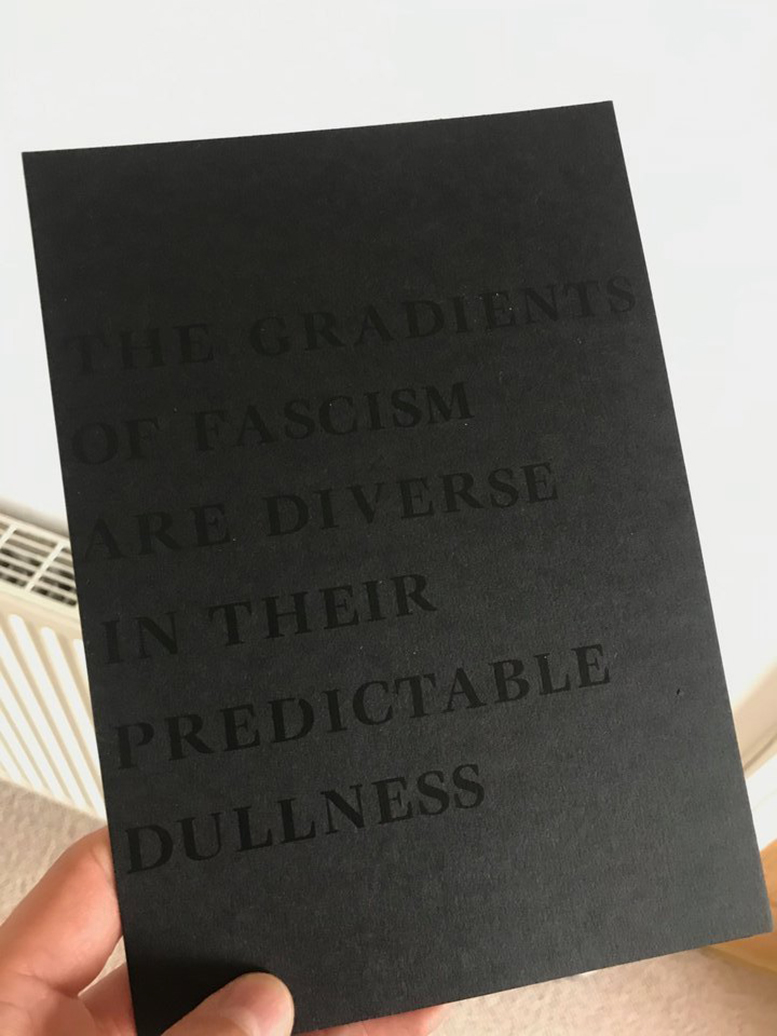
Gelare Khoshgozaran, Queer Correspondence, October 2020, Cell Project Space. Image submitted by Rowna Hughes from Athens, Greece. [Image Description: Hand holding black postcard with black text reading “THE GRADIENTS OF FASCISM ARE DIVERSE IN THEIR PREDICTABLE DULLNESS”]
This postcard is from Gelare Khoshgozaran’s contribution to the project. The curator writes:
Over this backdrop, which is made even more poignant by the context of a global pandemic, the artist delves into a revision of her engagement with cultural and literary history as a way into grounding herself with the tools and means that she associates with survival –those that come from the memory of a war, the passing of long spans of time at home and of having to find one’s own voice under the stronghold of fascist oppression.
I’ve been really appreciating getting to know Gelare and her work better as we’ve been working together on a project with the UCLA Arts Conditional Studio called Art and Internet in LA 1969+. With a group of collaborators, we’re creating an artist-made access-oriented archive of artists working on and with the internet since its birth at UCLA.
Soundings, Loren Britton & Romi Ron Morrison
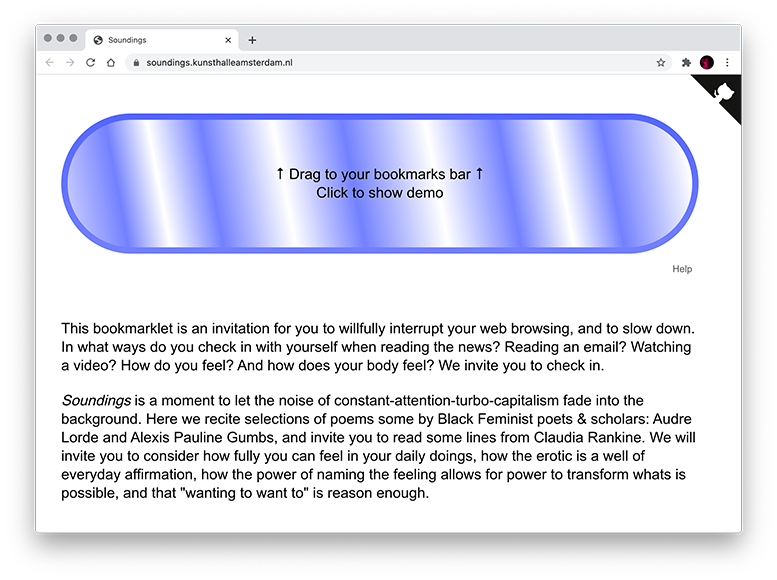
[Image Description: Browser window containing giant blue bookmark button and explanatory text excerpted below.]
Cutting through all of the urgency, panic, and endless lists of “resources,” Loren Britton and Romi Ron Morrison built the only bookmark you need. The browser experience is a virtual embodiment of their invitation:
...consider how fully you can feel in your daily doings, how the erotic is a well of everyday affirmation, how the power of naming the feeling allows for power to transform what is possible, and that "wanting to want to" is reason enough.
The Future of Memory, Xiaowei Wang, Qianqian Ye, Jasmine Wang, and Yang Yuting
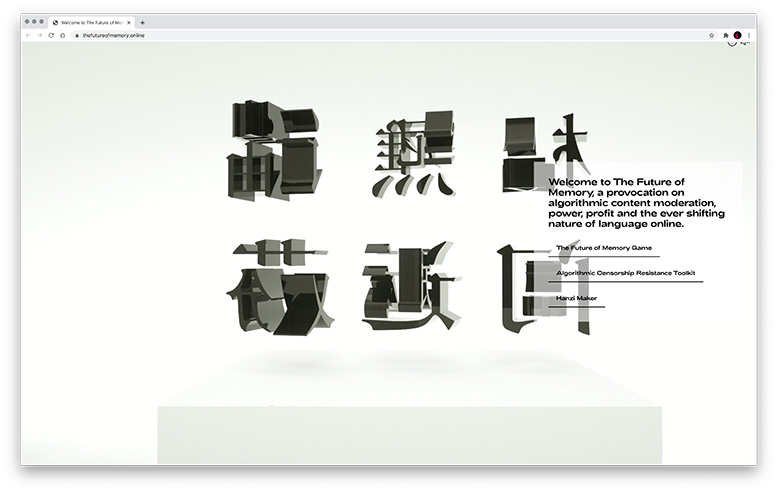
[Image Description: Screenshot of thefutureofmemory.online with 3D Chinese characters hovering above a white platform]
While nearly all of our communication is now mediated and surveilled, the Future of Memory team explores AI and automated censorship while straddling Chinese and US contexts. This work resonated deeply with me as I was remotely installing a show in Shanghai across the firewall, long SSH tunnels, time zones, and languages, relying on my mother and grandmother to translate the Chinese exhibition materials I couldn’t read. The Future of Memory is simultaneously a text-based adventure game, a generator for invented language, and a collective toolkit for algorithmic resistance. As Xiaowei writes, “The piece explores the boundaries of translation, the ways language changes under algorithmic logic and the limits of machine intelligence.”
‘Ye or Nay? A.M. Darke featuring Tajae Keith, Nick Yonge, and Seren Sensei
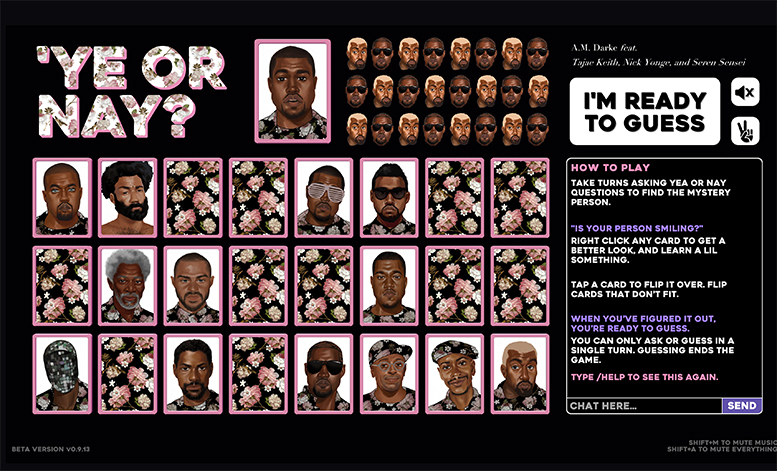
[Image Description: Screenshot of ‘Ye or Nay? board with cards featuring various Kanye’s and other Black celebrities all wearing flowered shirts]
Maybe you didn’t know you needed a lot more Kanye in your life right now, but that’s probably because you haven’t played A.M. Darke’s game ‘Ye or Nay? that dropped this summer, featuring writing by LA artist Seren Sensei. I immediately deleted all 29 of my chat platform apps and now only take calls through the game’s voice chat feature. How do we “guess who?” when we can’t fall back on racialized identity binaries? A.M.’s brilliance lies in the way she takes a problem, flips it on its head, and poses the question that should have been asked in the first place. In her own words:
‘Ye or Nay? also wrestles with the issue of the problematic fave, providing a critical analysis of popular Black men from a position of cultural subjectivity. What has each given and taken from The Culture? Can we love our icons while still holding them accountable? Is it a call out, or a genuine expression of our care, our pain, our disappointment, and our love, because we are always rooting for everybody Black, even when everybody Black ain’t rooting for us?
Cyberfeminism Index, Mindy Seu
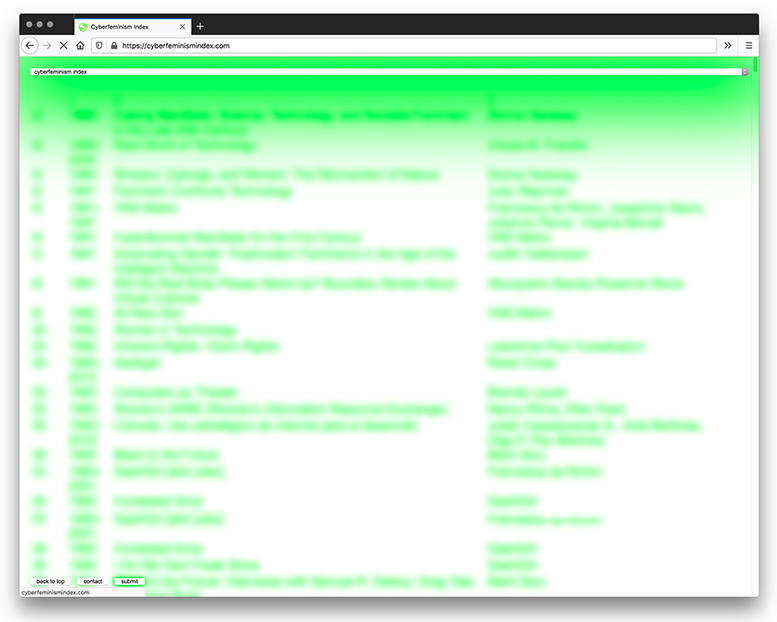
[Image Description: Screenshot of cyberfeminismindex.com with blurred green text and green gradient overlay]
Ok I’m cheating, Mindy Seu lives in Brooklyn but she’s got UCLA roots. And she’s compiled an index of techno-critical works from 1990–2020. Spanning categories from affective computing and sex work to slime and simulation, the growing archive seeks to explore the digital diaspora, womanism, feminist afrofuturism, hackfeminista, 여성주의, 女权之声, and more. I’ve been especially enjoying the throughlines I’ve found while reading Legacy Russell’s recent "Glitch Feminism," tracing the blurry breaks of gender, sexuality, and technology.
SHARE SCREEN, UCLA Design Media Arts MFA Class of 2021
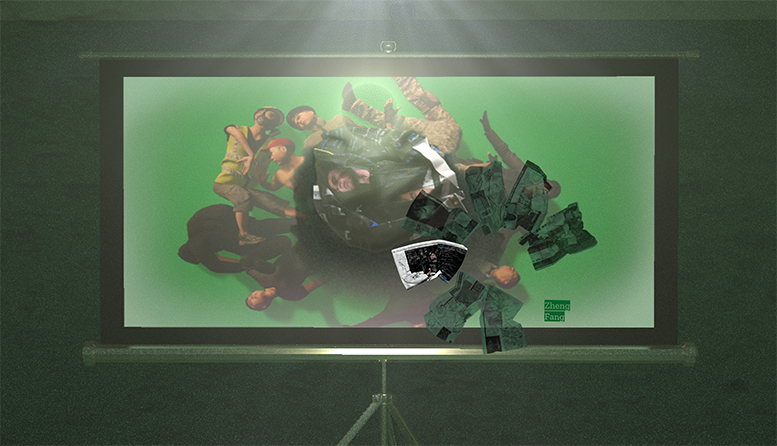
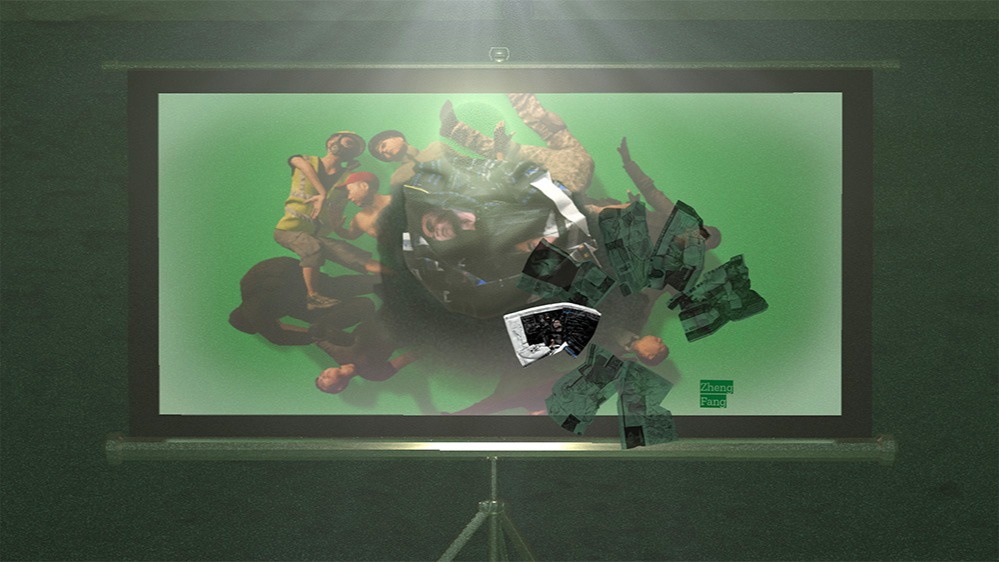
Image from SHARE SCREEN exhibition site featuring Zheng Fang’s As You Wish. [Image Description: Projector screen with pile of bodies and crumpled screenshots on top, illuminated by a greenish cast from above.]
Finally, SHARE SCREEN, a preview of MFA work from the DMA grads, opened last week. Every time I get lost in a zoom doom spiral, these artists snap me awake with their fearless embrace of everything you haven’t seen on your screen before. Their show statement states it all.
Screen is becoming a public space. In the context of the pandemic, we convene online and communicate through screens. The act of sharing screens is a public performance. Our desktop is both a home and a stage. There are times when we gather online and feel pixelated. Our voices are low-passed and we move with the speed of our network. Our image resolution becomes an important part of our presence. Speakers speak for us and the video portraits are our new faces.
Thank you all <3
Lauren