Why Splattering Eggs on a Museum’s Walls with Other Women Was So Satisfying
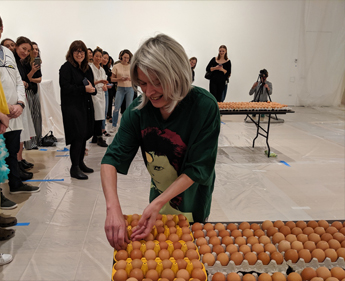
Sarah Lucas’s performance at the Hammer Museum was satisfying, liberating even. Women are not suppos

Sarah Lucas: Au Naturel is the first American survey of one of the UK's most influential artists. Alongside new sculptural works created for the exhibition, Au Naturelfeatures some of Lucas’s most important projects, including early sculptures from the 1990s that substitute domestic furniture for human body parts and enlarged spreads from tabloid newspapers from the same period that reflect objectified representations of the female body. These works, which complicate inscribed codes of sexual and social normativity, have never been shown together in the United States.
"I was apprehensive about attending Sarah Lucas’s performance piece “One Thousand Eggs: For Women” at the Hammer Museum last Friday. Presented as a part of her upcoming retrospective, Au Naturel, the performance, as the title might suggest, consists of a thousand eggs. To make the work, Lucas invited participants to throw, hurl, chuck, pitch, fling, volley, and otherwise break every last egg on an enormous wall in the gallery specifically treated for this purpose. Though the act of egg throwing never occurred to me as anything other than a Halloween prank or an arcane expression of disapproval, within this context, the act of destroying a thousand eggs took on an entirely new and somewhat personal meaning.
Sarah Lucas The egg, after all, has long been a symbol of female fertility, even before humans had any conception of how, well, conception, works. The ancient Egyptians believed the sun god Ra was hatched from a primordial egg. Likewise, the egg symbolized the ancient Babylonian goddess of war and sexual love, Ishtar, who, after hatching in the heavens, fell into the Euphrates. Even Easter egg hunts that seem to be devoid of any sense whatsoever have their origins in pagan symbols of fertility.
Since science drew a very literal line between eggs and fertility, politicians (particularly male ones) have erected (pun intended) institutions that bar women from controlling their own eggs, a hydra that has reared its many hideous heads again as of late. With this in mind and as a recently pregnant woman, I felt like “One Thousand Eggs” was dangerously positioned on the precipice of a dark undertone that I wasn’t sure I wanted to engage in.
However, I seemed to be alone in my apprehension as a group of about 80 participants, mostly women, assembled in the atrium. An air of jovial camaraderie pervaded the din of conversation as we waited."— Lorissa Rinehart, May 28, 2019


This post is an excerpt. Read the full article on the Hyperallergic website.
Stay engaged. Use #UCLAarts to stay connected.


