Who invented abstract art? Victor Hugo show at the Hammer proves critics and historians wrong
"The last several months have witnessed something rare in art — the birth and consolidation of a new art myth. A longstanding belief has been toppled, replaced by a brand-new conviction.
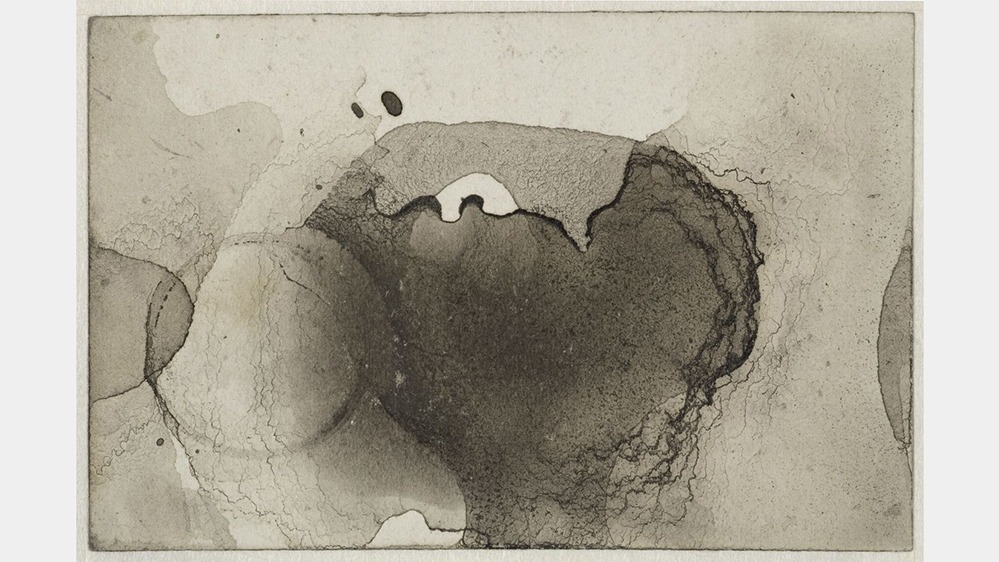
Victor Hugo, "Stains," circa 1852-59, ink and wash on paper. (Bibliothèque nationale de France ©BnFUCLA Hammer Museum) The fable: Hilma af Klint (1862-1944), a Swedish mystic and painter of remarkable skills who is not well known in the United States, invented abstract art.
Her extraordinary artistic accomplishment preceded by several years that of Russian-born Vasily Kandinsky and Kazimir Malevich and the Netherlands’ Piet Mondrian, one or another of whom is usually credited as abstraction’s inventor around 1911. As early as 1906, Af Klint began creating revolutionary works that bore no direct pictorial reference to the visible world.
The new myth has been prompted by “Hilma af Klint: Paintings for the Future,” a huge exhibition (167 paintings) that currently fills the spiral of New York’s Solomon R. Guggenheim Museum. Local reviews have been rapturous, the Swedish artist’s generative role acclaimed.
Given the powerful part that abstract art would play in Europe and the Americas as the 20th century unfolded, becoming virtually synonymous with modernity, the new myth is dramatic. Of course, it also isn’t true. Hilma af Klint didn’t invent abstract art. The answer to the question “Who did?” is unambiguous: No one did.
Art doesn’t work that way. I’m not talking about the abstraction that is found in most every culture in most every age, including prehistoric, but of other modern European artists who had already been exploring abstraction. And decades earlier than Af Klint.
In London, at the height of the Victorian Era, Georgiana Houghton (1814–1884) began making vivid paintings on paper of colorful swirls, staccato dots, linear spirals, feathery marks and assorted shapes and forms of visual energy. The product of 10 years of work was shown in an 1871 exhibition at a gallery on Old Bond Street, center of London’s art quarter, where the 155 abstractions were greeted with stunned puzzlement and often ridicule.
Thirty-five years later, when Af Klint began her abstract paintings, she kept them from public view for fear of similar negative reaction.
Victor Hugo (1802-1885) was in exile when he began to make abstract art in earnest. The great and controversial French Romantic poet and novelist — “Les Miserables,” “The Hunchback of Notre Dame,” “The Legend of the Ages” — had run afoul of Louis-Napoleon Bonaparte, dictator of the Second Empire. Cast out to the island of Guernsey in the English Channel off the coast of Normandy, he applied the writer’s common tools of quill pen, ink and paper to abstract ends.
“Stones to Stains: The Drawings of Victor Hugo,” a darkly beautiful exhibition at the UCLA Hammer Museum to Dec. 30, lays out the absorbing result.
In collaboration with Swiss independent scholar Florian Rodari, curators Cynthia Burlingham and Allegra Pesenti of the museum’s Grunwald Center for the Graphic Arts have assembled 65 drawings made between 1837 and 1876, the bulk of them from the 1850s and 1860s. Most pertinent are those referred to as “stains” — sensuous, layered washes of primarily brown, sometimes black or blue ink, often evoking a morose nocturnal gloom from which light seems to be pushing its way through."— Christopher Knight, Dec. 4, 2018


This post is an excerpt. Read the full article on the Los Angeles Times website.
Stay engaged. Use #UCLAarts to stay connected.


