Up to 20 tons of sand will be poured into an L.A. museum for fall’s biggest spectacle
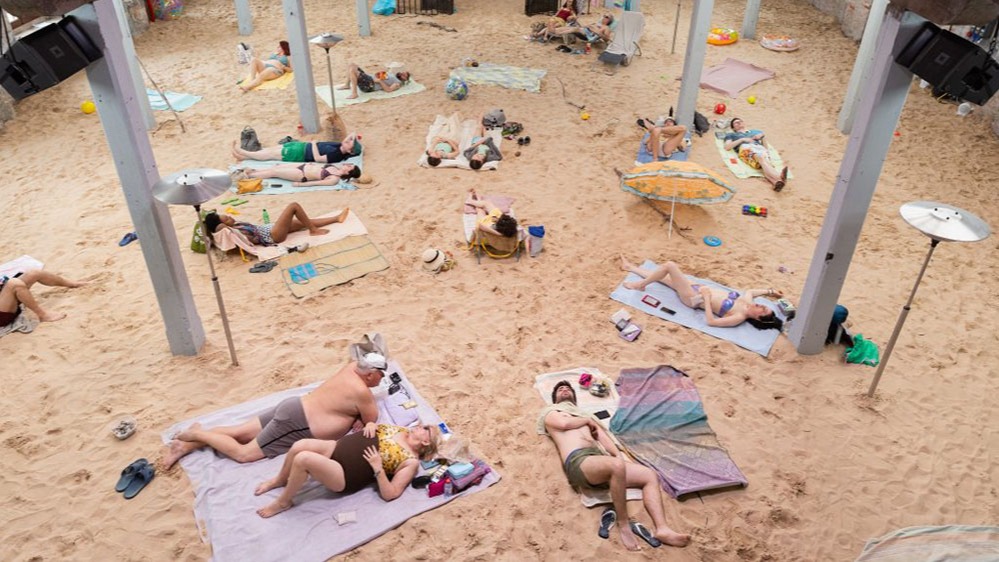
The Hammer, MOCA, and CAP UCLA present Sun & Sea's Los Angeles premiere, transforming The Geffen Contemporary at MOCA with 13 vocalists and 25 tons of sand.
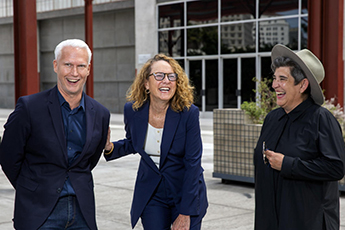
MOCA’s Klaus Biesenbach, left, the Hammer’s Ann Philbin and CAP UCLA’s Kristy Edmunds teamed up to bring “Sun & Sea” to L.A. (Irfan Khan / Los Angeles Times) If autumn 2021 is anything like last year, hordes of Angelenos will flock to the beach in mid-October, seeking refuge from a heat wave. Some will trek north, to Malibu’s high bluffs and boulder-lined shores; others south, to the picturesque La Jolla seaside.
And some people will head downtown, to the Museum of Contemporary Art’s Geffen Contemporary.
“Sun & Sea,” the climate-crisis opera that earned the top prize at the 2019 Venice Biennale, will make its West Coast premiere at the Geffen Contemporary on Oct. 14. The L.A. production — part contemporary opera, part crowdsourced performance art, part diorama come to life — is a joint presentation of MOCA, the Hammer Museum and the Center for the Art of Performance at UCLA. Directors of all three organizations — Klaus Biesenbach, Ann Philbin and Kristy Edmunds, respectively — joined forces to bring the work here as part of a U.S. tour.
The piece — directed by Rugilė Barzdžiukaitė, written by Vaiva Grainytė and scored by Lina Lapelytė, all Lithuanian women — addresses climate change in what could best be described as an operatic lament about the disintegration of our planet. Audience members will watch the performance from a U-shaped balcony, looking down onto a beach bathed in high noon sunlight — the Geffen Contemporary, transformed with 10 to 20 tons of locally sourced sand. Thirteen singers and eight non-singing performers, all part of the Lithuanian company Neon Realism, will relax on towels, slather on sunscreen, play badminton, nibble on snacks and build sandcastles as they perform the libretto, translated from Lithuanian into English. A live dog and several children fill out the crowd, and there’s plenty of ambient beach noise — chatter and laughter, the crinkling of food wrappers, a popping volleyball — layered over the recorded musical soundscape and live singing.
Soloists — playing societal archetypes such as a wealthy family, a retired couple, a single 20-something woman — wax anxiously poetic about the destruction of Australia’s Great Barrier Reef, the warming Earth and species extinction as well as global tourism’s effect on the planet. The result is a disquieting tension between the happy-go-lucky, voracious and profitable leisure industry and looming environmental catastrophe, conveyed with somewhat ironic levity by a panoply of swimsuit-clad characters in an otherwise merry setting.
“It’s sending a message that is so profound,” Philbin says. “But in the subtlest, most beautiful way that it’s disturbing.” — Deborah Vankin, Aug. 23, 2021


This post is an excerpt. Read the full article on the Los Angeles Times website.
HEADER IMAGE: The climate crisis opera, “Sun & Sea,” performed at the 2019 Venice Biennale.(Photo: Andrej Vasilenko / from the artists)
Stay engaged. Use #UCLAarts to stay connected.


