UCLA Arts Newsletter
August 30, 2019
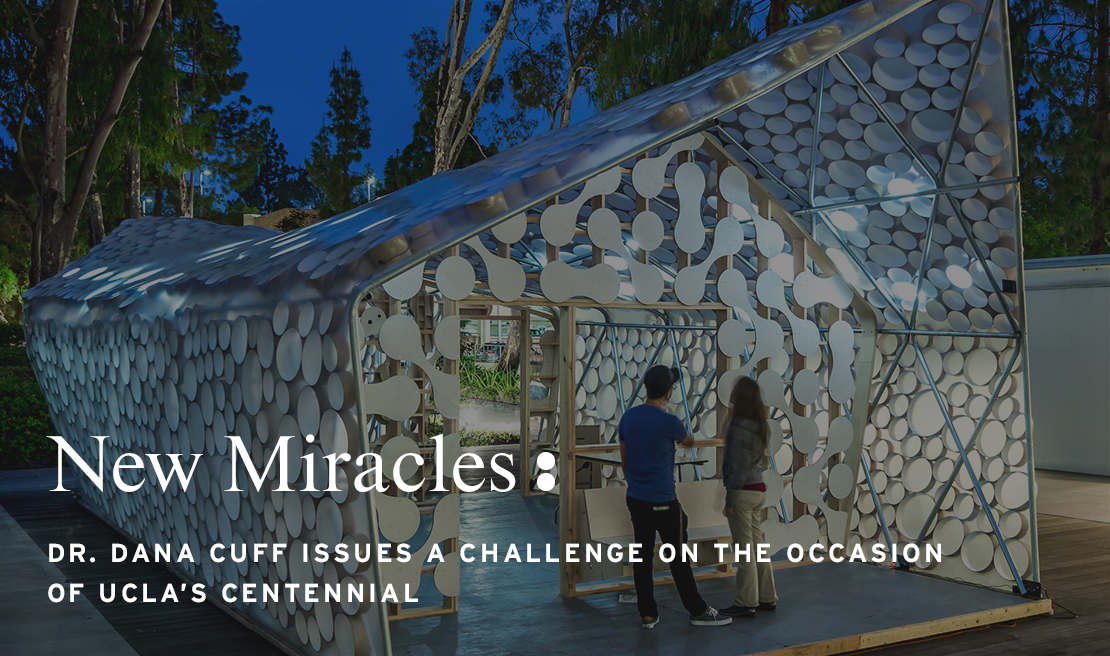
On the occasion of UCLA’s Centennial, UCLA Arts is proud to present 100 for 100—a collection of stories that celebrate the rich history of the arts at UCLA over the past century. Each monthly newsletter throughout the yearlong celebration will feature a new story that reflects on our past and imagines what’s possible for our future. We invite our community to explore these stories and contribute their own to the collection.
This month's contribution is by Dr. Dana Cuff, director, UCLA cityLAB & professor, UCLA Department of Architecture and Urban Design
When I arrived at UCLA to join the faculty of Architecture and Urban Design in 1993, architecture was in an extraordinary place vis-à-vis culture at large. The Guggenheim in Bilbao was underway, and would open four years later with a New York Times Magazine cover that announced Frank Gehry had produced “A Miracle in Bilbao.” Then Dean Richard Weinstein joined the profession’s swoon over the power of architecture and the attention from the glitterati. It was a work of groundbreaking, creative genius that was credited with regional economic development in the rusted industrial Basque Country. The ties of architecture to the city, with its economic, social, and political complexities, were not lost on Weinstein, an architecture-trained urban designer who cut his teeth in Mayor John Lindsay’s Manhattan. Meanwhile, the fresh terrain of digital technologies overtook the academy in 1994 with the advent of the paperless studio at Columbia, soon embraced at UCLA. Simultaneous with my arrival, the Graduate School of Architecture and Urban Planning broke apart, the departments administratively divorcing in 1994. With the split, UCLA abandoned the theory that architecture should be united with planning to create an integrative architecture of the city. Instead, it was the Guggenheim-as-monument that gave architecture its grandest public stage, and there was a strong sense that individuals—particularly older white men—would be performing the miracles. As for me, I was stealthily nursing my second child between interviews with the faculty I hoped would hire me.

 |
 |
|
| Female Disruptors: How Kristy Edmunds has shaken up contemporary art |
 |
 |
|
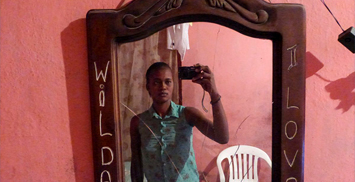
| Fowler Museum to feature personal photo essays from people affected by HIV |
ARTECHOUSE's Chelsea Market space will let visitors experience |
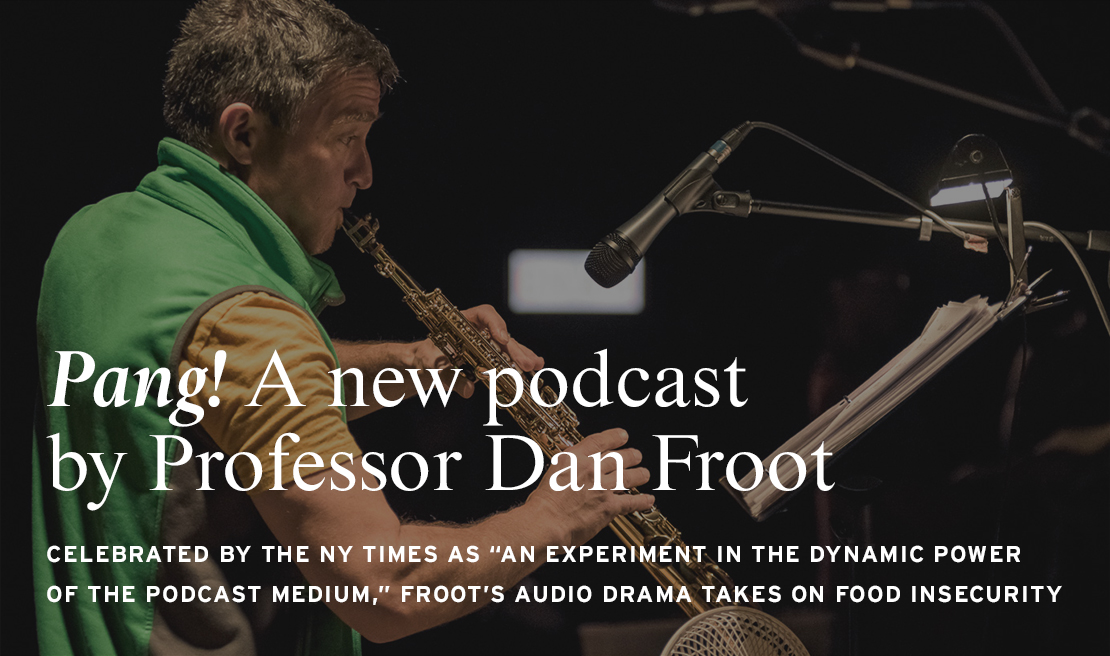
For nearly two decades, Department of World Arts and Cultures/Dance Professor and Chair Dan Froot has been focused on issues of food insecurity. What began as an exploration of hunger in Los Angeles has become a series of oral histories and theater productions sharing the stories of families living with food insecurity across the country. This summer, Professor Froot released the latest iteration of his creative work to much acclaim: an audio drama podcast, Pang!, which attemps to answer the question, "What does hunger sound like?" The podcast has been streamed in more than 25 countries and earned a spot on the New York Times' Podcast Playlist that Digs Deeper. Read on for Professor Froot's conversation with UCLA Arts about his work.
UCLA ARTS: How did Pang! begin for you?
DAN FROOT: Performance and food have always been connected for me. I have always considered cooking to be a performance and performance to be a kind of meal. My first performances in New York in the 1980s were meals that I cooked for the audience. In both cooking and performance you take disparate ingredients and perform a sort of alchemy on them. The result is this completely other thing that you offer for people to consume, and which is hopefully nourishing for them.

The UCLA School of the Arts and Architecture is hiring for a variety of student positions for the 2019–20 academic year. Build your resume. Build your portfolio. Build your connection with UCLA Arts. Apply today.
Open positions:
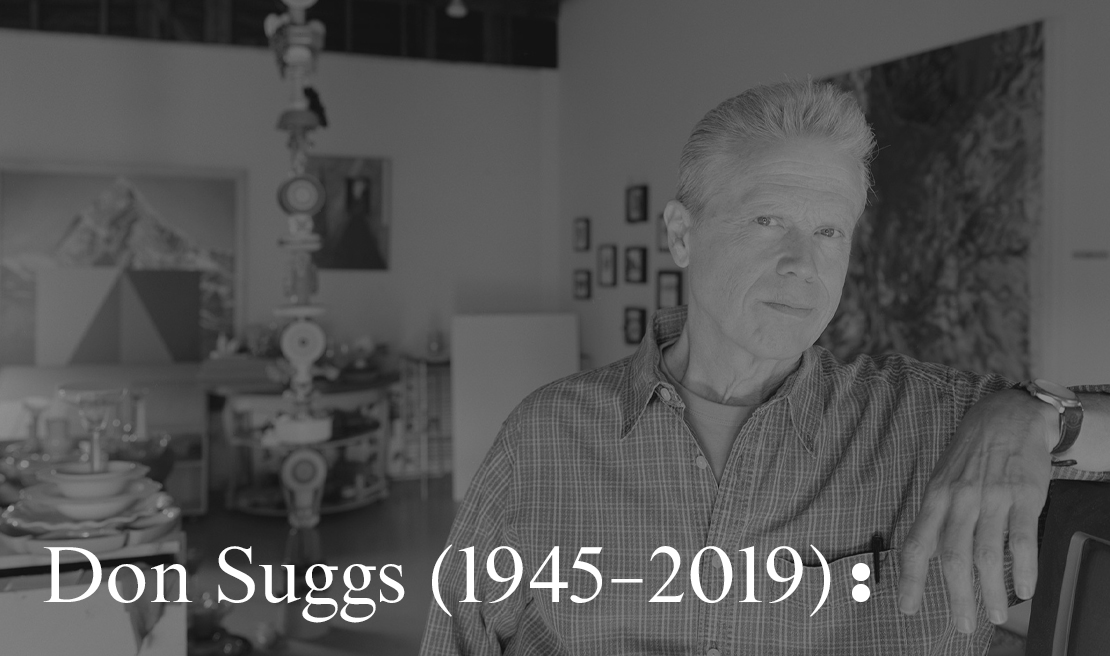
We are deeply saddened by the news that alumnus Don Suggs passed away on July 30, 2019. In addition to receiving his B.A., M.A., and M.F.A. from the UCLA Department of Art, Suggs taught painting and drawing in the department from 1983 to 2014 (31 years). He was an exceptionally gifted and inspirational teacher, regularly cited as among the best in any department at UCLA. His undergraduate classes in drawing were a mainstay of the department, where many students began their first serious work at young artists. Among his many contributions, Suggs offered a rigorous in-depth introduction to techniques and approaches to drawing, he organized the culminating senior exhibitions, and he served on numerous M.F.A. graduate committees.
"Don brought a formidable intellect and keen sense of humor to his interactions with students and colleagues," said Patty Wickman, professor in the UCLA Department of Art. "His dedication to teaching was felt by students at all levels who sought him out for his extensive knowledge of art history, theory and practice, and his sincere interest in their development as artists. His dedication to his students extended far beyond the classroom. He was in it for the long haul, attending every opening of every current and former student he had ever worked with. Don was also active and deeply admired in the Los Angeles art community both as an artist, known for his inventive, changing and formally and conceptually rigorous practice, and as a highly engaged and supportive colleague. Don's integrity as an artist, educator and person contributed significantly to the exceptional quality and prominence of UCLA's Department of Art. His loss will be deeply felt by many in our community."
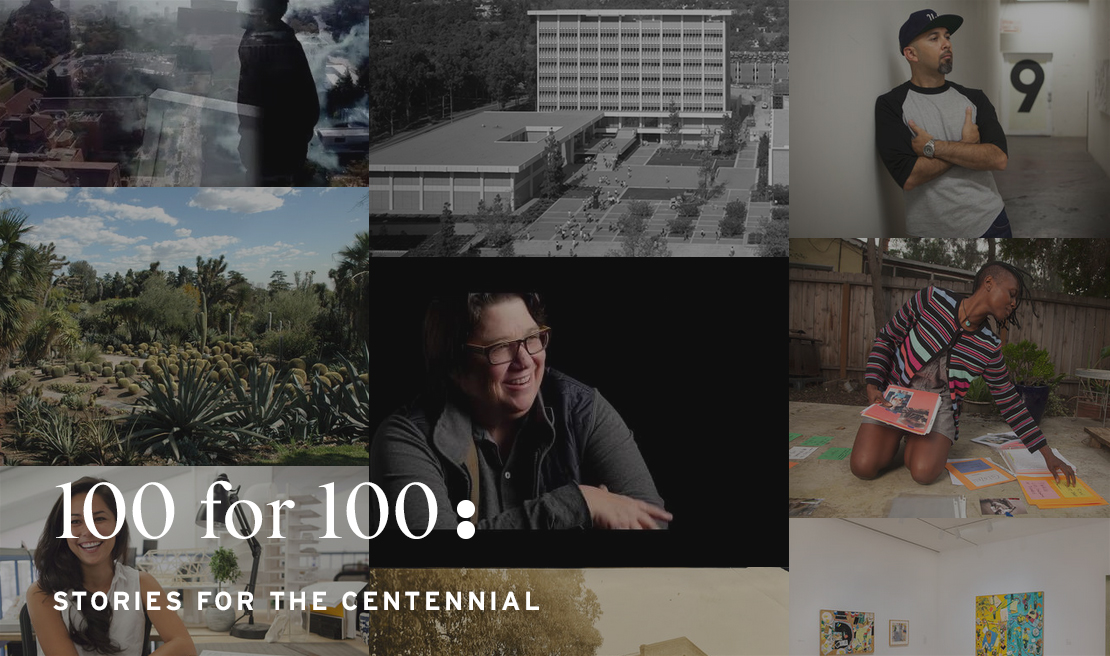
Celebrate UCLA's centennial by sharing your own story that reflects on the institution’s 100-year legacy by looking back at the past or forward into the future.
We invite you to share reflections on your time at UCLA, lessons learned at UCLA and how they have shaped your life and work, moments from UCLA’s history that have inspired or influenced you, and/or hopes for UCLA’s future.
Submissions could take any number of forms from brief comments, to short essays, to photographs, to drawings, to videos, to performances, etc., but should be formatted or documented with the end goal of digital distribution. Submissions can respond to a single moment, work, individual, project, exhibition, performance, or space relating to the arts and architecture at UCLA; a through-line that can be followed over time at the institution; or anything in between. Critique is welcomed – one could explore gaps or missteps throughout our institution’s history and share related hopes for our future.
Announcements
Register for 10 Questions: Centennial Edition
Attention students! In Fall 2019, the School of the Arts and Architecture will offer Arts&Arc100: 10 Questions. This Centennial Edition of the 10 Questions course will continue to explore essential questions, such as: What is Knowledge? What is Justice? What is Creativity? and What is Nature?; bringing together leading faculty and distinguished alumni voices from across the university. 10 Questions provides a platform for vibrant conversations that engage multiple disciplinary viewpoints, seeding greater understanding of the profoundly interdisciplinary nature of knowledge, while offering a robust framework in which to envision and activate the role that the university can play as it embarks on its next 100 years. Arts&Arc 100 is an upper division elective course open to all undergraduate School of the Arts & Architecture students as well as sophomores and above from across the university. Register now.
Read the latest stories about UCLA Arts students, faculty, and alumni
From campus news to faculty and alumni activities around the globe the UCLA Arts website is updated daily to aggregate the best news and stories about and written by the School of the Arts and Architecture community. Arts and Architecture community.
Read past editions of the UCLA Arts Newsletter.
JOIN THE CONVERSATION
Stay engaged. Follow us on Facebook, Twitter and Instagram. Use #UCLAarts to stay connected.
Subscribe to our mailing list to receive this quarterly newsletter directly to your inbox!