UCLA art student creates pieces melding ancient myths, technology
The UCLA Art|Sci Center is dedicated to pursuing and promoting the evolving “Third Culture” by facilitating the infinite potential of collaborations between (media) arts and (bio/nano) sciences. Through the UCLA School of the Arts and Architecture’s Design Media Arts Department and the California NanoSystems Institute (CNSI), the center supports visiting research scholars and artists-in-residence from around the world. Through various lectures, mixers, and symposia, artists and scientists are brought together in order to mesh these cultures and inspire individuals to think about art and science as interrelated and a very relevant synergism of society. The Art|Sci Center also hosts the Sci|Art NanoLab Summer Institute for high school students, introducing them to the vast possibilities in the field of art|science for the present and future generations.
"Sarah Rosalena Brady drew inspiration from both artificial intelligence and ancient sculptures for her upcoming exhibition.
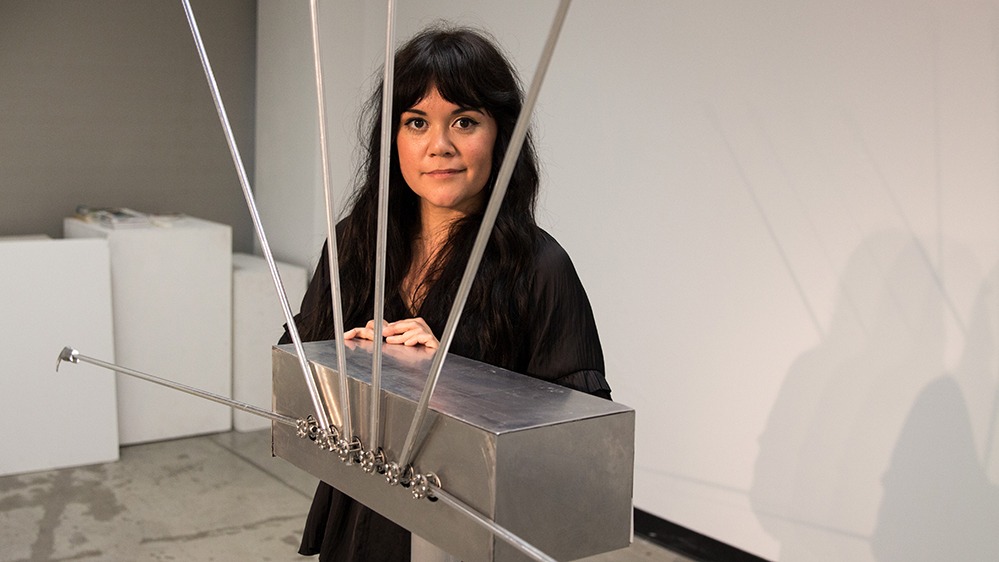
Sarah Rosalena Brady, a graduate student in design media arts, will debut her exhibition “Coyotes in Two Directions” on Thursday at the California NanoSystems Institute. (Jenna Nicole Smith/Daily Bruin) The design media arts graduate student will debut “Coyotes in Two Directions,” an art gallery featuring three technological works, Thursday at the California NanoSystems Institute at UCLA’s Art | Sci Center gallery. Brady’s kinetic art pieces, “The Animist,” “Coyotes in Two Directions” and “The Desert” incorporate aspects of hybrid creatures found in various myths from Southwest Native American philosophies, as she is of Native American descent. Brady said she hopes to merge science and culture by using modern technologies such as artificial intelligence and 3D scans to symbolize the inequalities of power structures throughout time in her exhibition.
“I’m really interested in thinking about characters that are powerful and significant in mythologies surrounding my background,” Brady said.
While brainstorming her various art projects, Brady said she focused primarily on the trickster, a mythological character that often takes the form of a deceiving shapeshifter. Brady said coyotes remind her of tricksters because of their shapeshifting survival skillswithin landscapes that have been changed by human colonization. The coyotes and tricksters represent adaption in threatened landscapes, Brady said.
“The definition for a trickster is this character that has weaved its way in and out of all these crazy power exchanges that go on in the world,” Brady said. “There are so many themes where colonization and power exchanges happen within this environment and I’m really interested in how hybrids, tricksters and shapeshifters can be this survival guide.”
In addition to the coyotes, Brady’s art also includes other animals such as eagles and rattlesnakes, as they represent strength and survival among long-standing systems of colonization. Brady used the 3D animal scans to create techno-hybrid forms, as mongrel forms are significant to Southwest Native American culture because they are seen as beacons of power. For example, Brady said she is fascinated by “Lion Man,” an over 30,000-year-old sculpture, featuring a human body with a lion’s head. Brady’s pieces “The Animist,” “Coyotes in Two Directions” and “The Desert” include 3D scans of eagle talons, coyote paws and rattlesnake tails, respectively."— Anushka Jain, Jun. 6, 2018


This post is an excerpt, read the full article on the Daily Bruin website.
Stay engaged. Use #UCLAarts to stay connected.


