Tyranny and resistance: Albert Camus' 1948 drama 'L’État de siège' carries new relevance
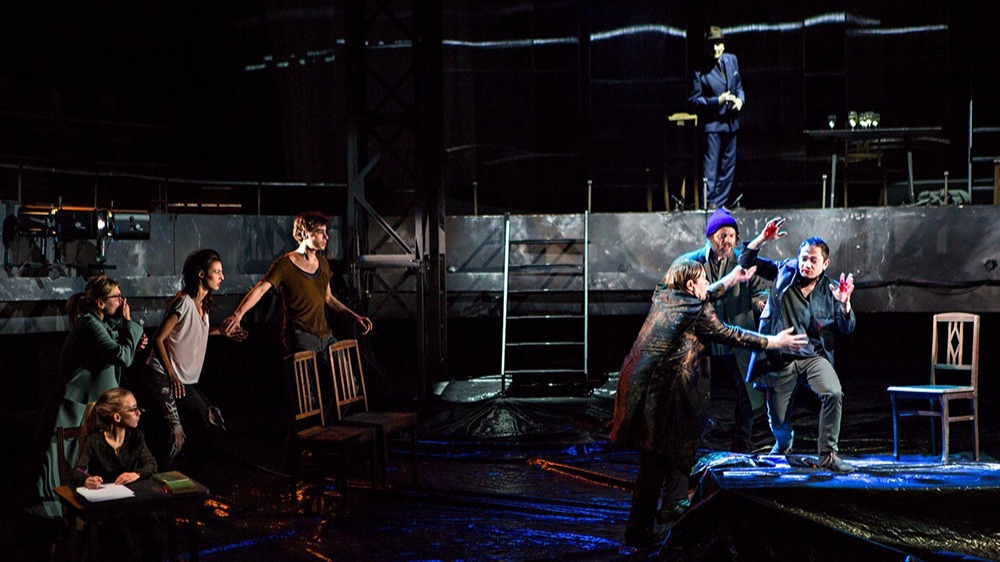
Center for the Art of Performance at UCLA (CAP UCLA) is dedicated to the advancement of contemporary performing arts: dance, music, spoken word, and theater; as well as emerging digital, collaborative, and cross-art platforms inspired by today's leading artists and creators. This presentation of “L’État de siège” (“The State of Siege”) by Théâtre de la Ville is a distorted reflection of a nightmarish future in which a city is reduced to silence and submission under the leadership of a character called La Peste (“The Plague”).
“L’État de siège” (“The State of Siege”), presented by the Center for the Art of Performance at UCLA at Royce Hall on Thursday and Friday, was a spectacular defeat for Camus when the play had its Paris premiere in 1948. This parable of resistance to a rising plague of authoritarianism was savaged by the French critics, who couldn’t help invidiously comparing the work to the author’s novel “The Plague.”
Camus put on a brave face. “Few plays have benefited from such a unanimous panning,” he remarked, “which is all the more regrettable because I still believe that ‘L’État de siège’ for all its faults may be the work I have written that resembles me most.”
The Algerian-born French author wasn’t alone in feeling this way. The distinguished critic Eric Bentley saw the original production and reported that he was moved by the play and impressed by the staging by Jean-Louis Barrault, who took on the role of the rebel hero (and Camus surrogate), Diego. Bentley praised the director for lifting the play from abstract argument into theatrical life: “Barrault brought to Camus’s only semidramatized idea his sense of color and visual form, of sound and rhythm, of actors as individual bodies and as bodies in groups, and made of it a musical-choreographic work.”
The new production from Paris’ Théâtre de la Ville, which brought to UCLA Eugène Ionesco's "Rhinoceros" in 2012, follows in Barrault’s bold footsteps. The play, about a Spanish town that gets invaded by the symbolic figure of the Plague (a crackling Serge Maggiani) and his grim-reaper Secretary (Valérie Dashwood), after a mysterious comet blazes a terrifying trail across the sky, is modernized to speak directly to our own fearful times. (The actors, adopting a modern carnivalesque air, mill about freely in the audience to connect what is happening onstage to the upheaval outside the theater.)
The staging by Emmanuel Demarcy-Mota is choreographed within an inch of its life. The scenic effects, as simple as they are wondrous, sustain the drama’s menacing velocity even when Camus goes off on one of his philosophical tirades. The multimedia flourishes ratchet up the havoc but aren’t allowed to upstage the helpless human figures scrambling for survival.
Performed in French with English supertitles, the production dizzyingly unfurls on a raked stage. Sirens, glaring spotlights and the scattered detritus of civilized life trace the movement of a society lurching from crisis to nightmare. A screen ominously flashes, “Punishment is coming.” The staging, incorporating plague doctor costumes, draws out the influence of the mad French theater visionary Antonin Artaud, who was himself obsessed with the plague as a theatrical metaphor. (Artaud’s interest was more metaphysical, but Camus, spurred by Barrault, wanted to break open his cerebral style.)
I still can’t get out of my mind the image of a tarp being pulled off stage and taking with it the fresh corpses that have piled up on the ground since Plague and his chilling accomplice (Dashwood plays this secretary of death as a terrifying vamp) have blown into town on an ill wind. These two murderous bureaucrats have pushed aside the fretful, self-preserving Governor (Pascal Vuillemot), who, like many a politician today, is a master of persevering the stagnant status quo until it’s too late and disaster opens the door to demagogues and despotism.
Camus as a playwright may not be for all ages, but the political questions he poses will need to be answered by every generation. How can we gain the courage to oppose tyranny? What can we do to preserve the human part of ourselves in the face of oppression? How can humanity, so skilled at dying, become better at living?"— Charles McNulty, Oct. 27, 2017

Read the full article at the Los Angels Times website.