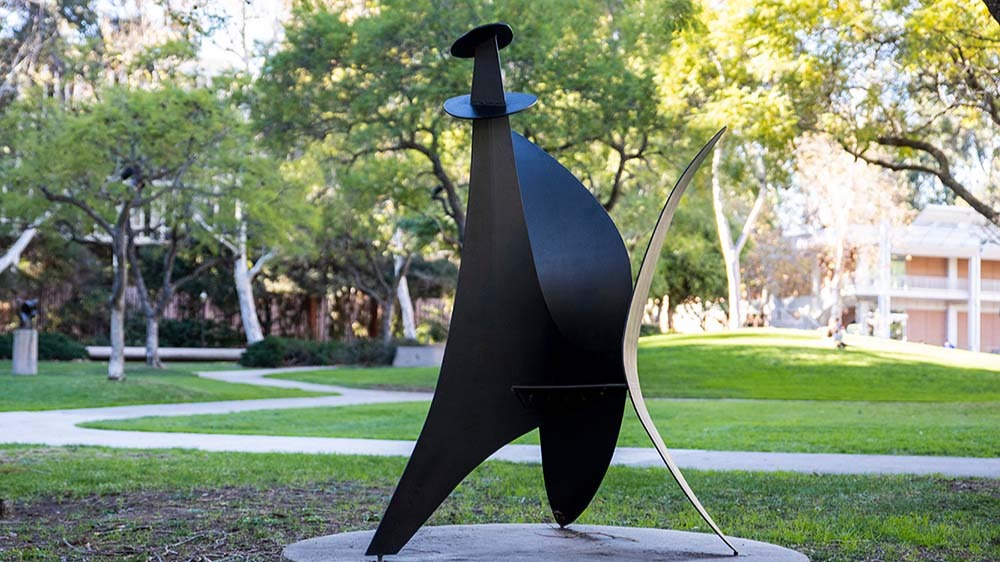
Tour the Garden: Alexander Calder’s Button Flower epitomizes community focus of outdoor sculpture
As chancellor from 1960 to 1968, Franklin D. Murphy conceived of and curated UCLA’s Franklin D. Murphy Sculpture Garden. The bucolic hills and surrounding pathways, completed by architect Ralph Cornell in 1967, serve as a community hangout and the backdrop for some of the finest sculptures of the 20th century. Follow columnist David Egan as he explores the world of the sculpture garden and leads a tour of five artistic gems on North Campus.
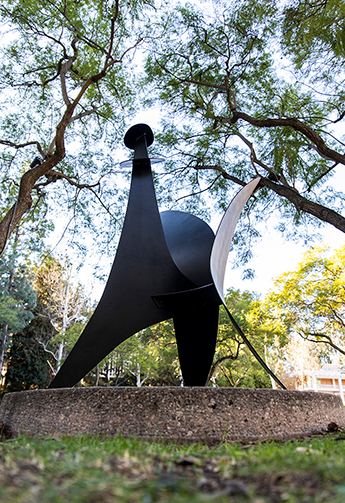
Alexander Calder's 1959 sculpture "Button Flower" is one of the many pieces in the Franklin D. Murphy Sculpture Garden familiar to the public art world. (Ashley Kenney/Photo editor) The Franklin D. Murphy Sculpture Garden belongs both to Bruins and the people of Los Angeles.
It is a public art locale on the campus of a public university, with a parking lot right off of Sunset Boulevard. Glenn Wharton, a professor of art history and conservation of material culture who has worked with the city of Los Angeles to conserve outdoor sculpture, said those who are interested in outdoor sculpture are familiar with the garden. With artists such as Alexander Calder, whose sculpture Button Flower is in the garden, Wharton said nearly every artist is a major figure of 20th century art and the garden is regarded highly in the public art world, he said.
“When public art works at its best, people are engaged with it,” Wharton said. “If it’s contemplative, … people just go there and break out in tears, whereas other sculptures can make us laugh and some have kinetic elements – they move, they splash. Artistic objects in the environment can inspire us and make us alive.”
Aesthetically, the sculpture garden can be understood in contrast with the public art at UC San Diego, Wharton said. At UCSD, he said curators select an environment on campus and commission a contemporary artist to design a sculpture specific to that site. Both this program and the sculpture garden have their merits, Wharton said. While UCLA offers a singular location to appreciate a collection of works, UCSD’s curators allow viewers to discover varied and adventuresome works of art, he said.
The attention paid to public art differs from person to person, Wharton said. For example, he said, a traditional monument of a man on horseback may be irrelevant to people who pass it daily, while others may take more notice of the work and its subject. Whether it is the Spanish War Veterans Memorial outside the Los Angeles National Cemetery on Wilshire Boulevard or the modernist works in the garden, outdoor sculpture is a category of art in its own right, he said. — David Egan, Jan. 31, 2022


This post is an excerpt. Read the full article on the Daily Bruin website.
Stay engaged. Use #UCLAarts to stay connected.


