'Tough times never last': Ladysmith Black Mambazo brings an uplifting message to UCLA
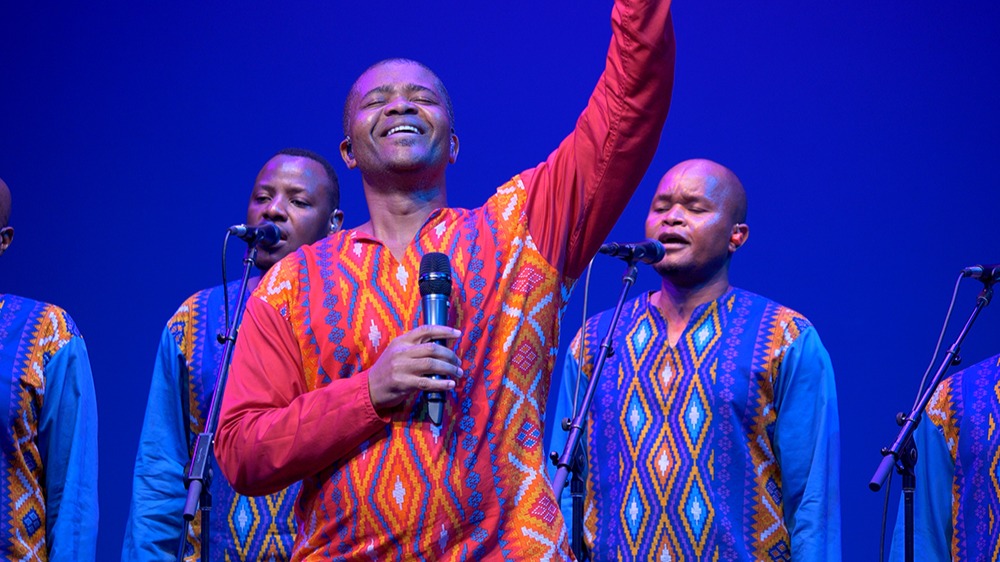
As performance venues across the country were shutting their doors to slow the spread of the novel coronavirus, UCLA’s Center for the Art of Performance decided that the show must go on. On March 16 Ladysmith Black Mambazo, the Grammy Award-winning South African choral group, delivered an incredible performance to an empty Royce Hall auditorium. Watch the performance on YouTube and read more about the experience of witnessing this unusual concert.
To the viewer, being "safer at home" and watching online, nothing would seem out of the ordinary. Ladysmith Black Mambazo took the stage at UCLA’s Royce Hall on March 16, and the South African choral group delivered gorgeous harmonies in a traditional Zulu style, with carefree stage banter that belied the dramatic news unfolding in real time.
The only hint that something was different came in between the songs. Rather than the typical roar of applause one might hear in an 1,800-seat auditorium, there was just a smattering of claps and whoops, as though only a dozen people were in the audience.
That’s because there were only a dozen people in the audience. The concert occurred just as performance venues across the country were shutting their doors to slow the spread of COVID-19. Kristy Edmunds, the Executive and Artistic Director of UCLA’s Center for the Art of Performance, decided that the show must go on.
Rather than cancel the concert outright, Edmunds arranged for a small crew to capture it for later distribution. A handful of UCLA staff members were also on hand to support the production.
We were scattered across the hall as Edmunds took to the stage, explaining that her decision to go on with the concert “was really about trying to say, ‘how do we offer some kind of continuity in a time that is totally, utterly, uncontinuity-oriented?’” She then told viewers at home to leave their cell phones turned on, a hint of just how unusual this concert was.

A choral sound that caught on
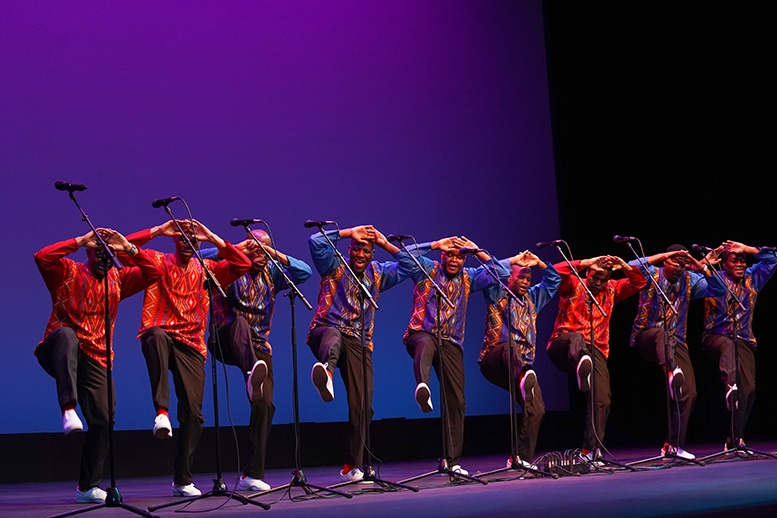
The nine men on stage performed without instruments, just their voices. They sang songs in English and Zulu that were uplifting and spiritual, in an a cappella style called isicathamiya. Joseph Shabalala founded the band in 1960. He told interviewers that he wanted to recreate the style of singing he’d heard in dreams. Shabalala eventually became an ordained minister with the Pentecostal Church of God of Prophecy. He died earlier this year, at the age of 78, after a long illness.
"The church was a place where black people in South Africa under apartheid had freedom. They could express themselves in church. Also, like gospel music here, singing in church, South Africa always produced great, great singers,” Tom Schnabel, the host of KCRW’s Rhythm Planet and a UCLA alumnus, said in an interview. Schnabel served as the Santa Monica public radio station’s first music director, and launched an African music show in 1980.
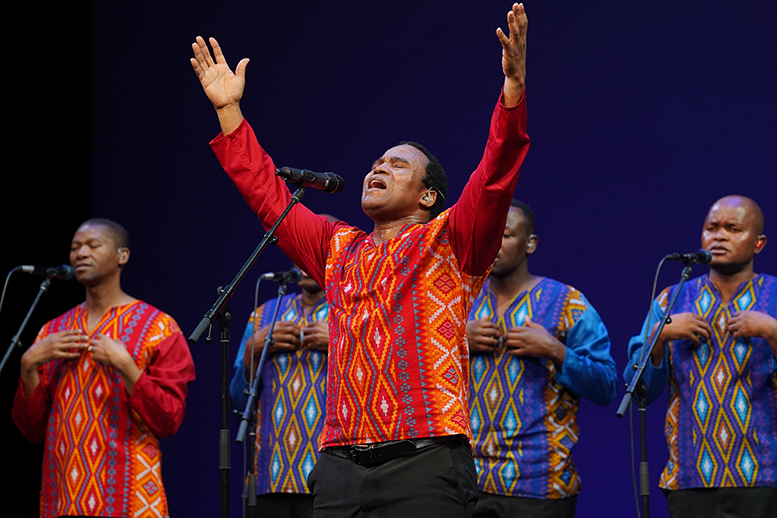
Schnabel thinks isicathamiya music gained popularity because all-vocal groups were less expensive to record in apartheid-era South Africa, and because few, if any, black churches could afford pipe organs.
Ladysmith Black Mambazo’s big international break came in 1986, when they performed alongside Paul Simon on his landmark album “Graceland.” The record catapulted not just the band—and not just South African music—but world music into the spotlight. A record deal with Warner Brothers lead to their own breakthrough album, “Shaka Zulu,” which Simon produced and which won the band the first of its five Grammy Awards.
From apartheid to COVID-19
“All the promoters, they said, no, we cannot put people
together because this was a state of emergency. They said
that people are not to be more than 20 in the same place.
It was so devastating because we were relying
on that tour that we will make money to support our families.”
—Albert Mazibuko, founding member of Ladysmith Black Mambazo
on his experience canceling concerts during the apartheid era in South Africa in 1979.
Before the concert I sat down with a founding member of Ladysmith Black Mambazo. Albert Mazibuko joined the band in 1969, when he was 21 years old, after having worked as a mechanic and a construction worker. He’s now 72. He’s been on countless tours with the band, which hits the road for an average of six months out of the year. The closest thing he can recall to the current ban on concerts was during the apartheid era, in 1979, when his band was on tour in South Africa.
“All the promoters, they said, no, we cannot put people together because this was a state of emergency. They said that people are not to be more than 20 in the same place. It was so devastating because we were relying on that tour that we will make money to support our families,” Mazibuko said.
The current pandemic forced the band to cut their U.S. tour short, flying back to South Africa the morning after their Royce Hall performance. It also led them to cancel some gigs in Europe and South Africa, including a 60th anniversary concert that was also going to serve as a memorial for Shabalala.
Finding ways to help artists
In an interview, CAP UCLA’s Kristy Edmunds expressed her worries about the impact of the pandemic on performers' livelihoods. A Canadian theater company that was set to perform for CAP UCLA was sent home and put into quarantine. Other artists may lose their visas. Edmunds has been in touch with other directors of performing arts institutions to see if they can help struggling artists with emergency relief.
“So it's about, how do you maintain that continuity of saying, we're all going to be back?” Edmunds said. She’s hopeful that in the meantime, artists will find ways of connecting with their audiences.
“Artists are starting to figure out some
pretty creative ways, even from their apartments,
to continue making their music and doing their plays
and making their dances. Artists always find
other avenues through which to do their work,
and there will be tons of innovation.”
— Kristy Edmunds, Executive and Artistic Director
of UCLA’s Center for the Art of Performance
“Artists are starting to figure out some pretty creative ways, even from their apartments, to continue making their music and doing their plays and making their dances," she said. “Artists always find other avenues through which to do their work, and there will be tons of innovation.”
Sitting in that near-empty Royce Hall, watching Ladysmith Black Mambazo join their voices in harmony, I was reminded of the incredible gift of watching talented musicians perform live. All that was missing was the audience members around me, lending their energy and enthusiasm to the event. Until we can all enjoy each other’s company in-person, experiencing live music digitally is the best we can hope for.
As Edmunds said, "the live encounter is one we value, and we will get back to those values.”
Or as the band sang on the track “Tough Times Never Last,” an apartheid-era message that feels just as relevant today, “tough times never last, but strong people do."
Story by Avishay Artsy
On this episode of the “Works In Progress” podcast by UCLA Arts, we hear from Albert Mazibuko, founding member of Ladysmith Black Mambazo; Tom Schnabel, the host of KCRW’s Rhythm Planet; and Kristy Edmunds, the executive and artistic director of UCLA’s Center for the Art of Performance.
KCRW and CAP UCLA proudly present an exclusive concert with South African vocalists Ladysmith Black Mambazo.
Stay engaged. Use #UCLAarts to stay connected.


