Touching the hearts and minds of our city’s youth
UCLA Arts engages middle and high school students in “10 Questions”
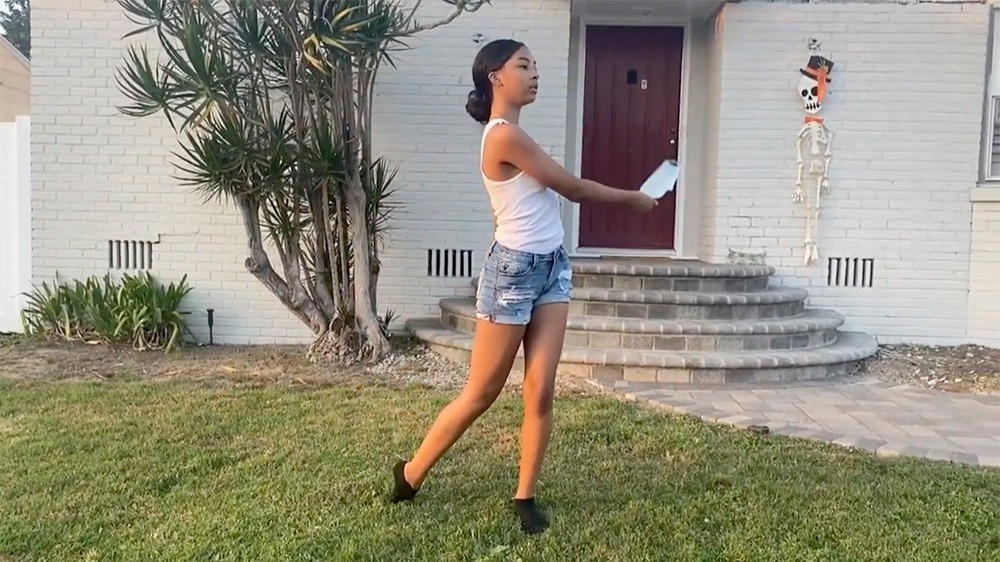
What does a 16-year-old theater student know about power? What can a seventh grade dance student teach us about hope?
As we learned at this fall’s “10 Questions: Reckoning,” an awful lot.
As the world struggles to cope with a pandemic and the United States grapples with its embedded racism and inequality, this fall the UCLA School of the Arts and Architecture presented “10 Questions: Reckoning,” the third iteration of its hybrid public program/academic class that brings together leading minds from across the university for interdisciplinary discussions about some of life’s essential questions.
Seeking to extend the reach and impact of this year’s program deeper into the community, the “10 Questions” team forged a partnership with the school’s Visual and Performing Arts Education, or VAPAE, program to engage middle and high school students from public schools across the city.
Students from each of the five participating schools, which hailed from one end of LA (Venice and Marina del Rey) to the other (Koreatown, Los Feliz, and East L.A.), generated their own classroom conversations and created artwork in response to one of the ten questions, handpicked for consideration by their respective teachers. The five schools responded to their questions by creating work in one of five art forms: visual arts, theater, dance, design/media arts and music. Working in close collaboration with Kevin Kane, the director of VAPAE, and VAPAE teaching artists, each cohort of students was then invited into the virtual classroom, where their work was featured as an integral part of the public program on Monday evenings.
Building on the vibrant conversations taking place amongst participating UCLA faculty, each week one or more of the enrolled UCLA students would join the middle and high school students in their classrooms to discuss the works they had created and to further the dialogue about the questions at hand.
“I can think of no better way to truly consider the import of these ideas than inviting a younger generation of artists to participate, engaging with university students and professors as they make their own work, from their own experience, in response to these essential questions,” Kane said. “After all, these young folks are the very ones that are not only grappling with these questions as part of this project, but who will actualize their own possibilities in order to shape our collective futures."
Engaging these young creative minds in a university-level course and exposing them to the rich possibilities of a college education added an especially meaningful dimension to “10 Questions” this fall. The program was able to tangibly build bridges not only across UCLA, but also between the university and the communities we serve, making the education we offer more visible and more accessible.
Please enjoy the work created by these students, followed by comments from their instructors:
"What is justice?"
UCLA Community School/AP Art Students
“There is no identifying factor that separates humans more from all other animals on our planet; Art. Art can be used to express a diverse range of human emotions such as love, loss, anger, and so much more. A work of art can be used as a political statement or simply for the beauty (or lack of) in creating it. The artist can express their imagination, conceptual ideas, or technical skill, with the intention of getting the viewer’s appreciation for its beauty or emotional power. Here at UCLA Community School, we hold social justice as an underlying motivation to propel our graduates to stand up to prejudice, speak out against discrimination, and take action against corruption. We encourage our students to make their voices heard and leave a mark in their community. From the political cartoon to controversial graffiti, art is employed to convey human discontent with injustice, it is therefore fitting that we ask our youth, the leaders of tomorrow, “What is Justice?”” – Anthony Matti, instructor
"What is power?"
Los Angeles County High School for the Arts (LACHSA)/10th Grade Shakespeare Class
“As a Shakespeare educator part of my job is to prove his relevance, especially now when it would be so easy to dismiss him to the dustbin of dead white playwrights from an imperialist land of colonizers. The trick is to excite the students with those moments when Shakespeare speaks truth to power, and we realize he was actually quite subversive. He was in the pocket of the monarchy and yet bravely asked onstage in front of everyone, what is power? Or as Shakespeare wrote, “Uneasy lies the head of the crown.” In our Sir Thomas More speech we examine 4 powers at work: the English protesters rioting against the influx of refugees and immigrants into London, the refugees themselves, and the plea for compassion from Thomas More himself. But, I think the greatest power of all is our students changing the world by breathing new life into a 400+ year old text with their own tongues. They own Shakespeare by pulling him out of the museum and mausoleum and living his message right now.” – Elizabeth Dennehy, instructor
"What is hope?"
Marina Del Rey Middle School Performing Arts Magnet/Company Dancers, Grades 7 and 8, Dance Composition Course
“There is nothing more powerful than the freedom to create. We use dance as a language for inspiring others, challenging perspectives and sharing stories of hope. My hope is to ignite a sense of self-discovery within each dancer, so they grow in curiosity, courage and confidence. Finding a voice through art is a pivotal moment for our young dancers. They commit to the importance of staying engaged with the process, while growing in passion. Just as art inspires human emotion, it can impact social and political action. The opportunity to hope is a powerful catalyst for change. It is also a powerful tool for self-preservation in an unprecedented time of social isolation. Marina Del Rey Rey Middle School Dance Company will dance a collection of movement stories, sharing our hope for ourselves and our world.” – Lindsey Farris, instructor
"What is resilience?"
Venice High School Media, Arts and Technology Academy, with VAPAE teaching artists Ago Visconti and Aya Fathallah
“Resilience to me means not just making it through the day during this time of crisis, but making sure to incorporate opportunities for creativity and self-reflection. Though my main responsibility is to provide instruction in reading and writing, collaborating with the UCLA VAPAE program educators to implement PhotoVoice in my 11th and 12th grade English classes has enabled me to ensure that my students enter the realm of creativity and self-exploration on their path to resiliency.” – Ruth Greene, instructor
"What is love?"
John Marshall High School songwriting composition class
“Artists are storytellers, and whether the story they tell was born of love or some other emotion – anger, jealousy, fear, loss – it seems all the stories end up circling back to love. However, in 15 years of teaching a songwriting class at John Marshall High, the lyrical subject of love is one I have intentionally avoided directly assigning. I have avoided it because to the teenage mind, love is too mysterious. Love may represent anxiety or tension or rejection, and dealing with those feelings may create another block to creating. That’s the last thing an Arts teacher wants. Some young songwriters have no problem with it and are drawn to the subject, but when assigning for lyrical content, I have stuck to the safe path: write a song about a place, write a song that doesn’t make sense, write a song utilizing 8 of these 10 literary devices, write a story song utilizing the Somebody-Wanted-But-So-Then strategy. Write a song about anything but love, I tell them and I can hear the kids relax. And then do you know what they do? They write a song about love. So, What is Love? I dunno, got me. I think humanity has been trying to answer that question for millennia. But if you ask me: What is Creativity? What is Art? I have an answer for you. I think creativity and art are love.” – Mike Finn, instructor