There’s more to Judy Baca than her ‘Great Wall of Los Angeles’ mural. The proof is at MOLAA
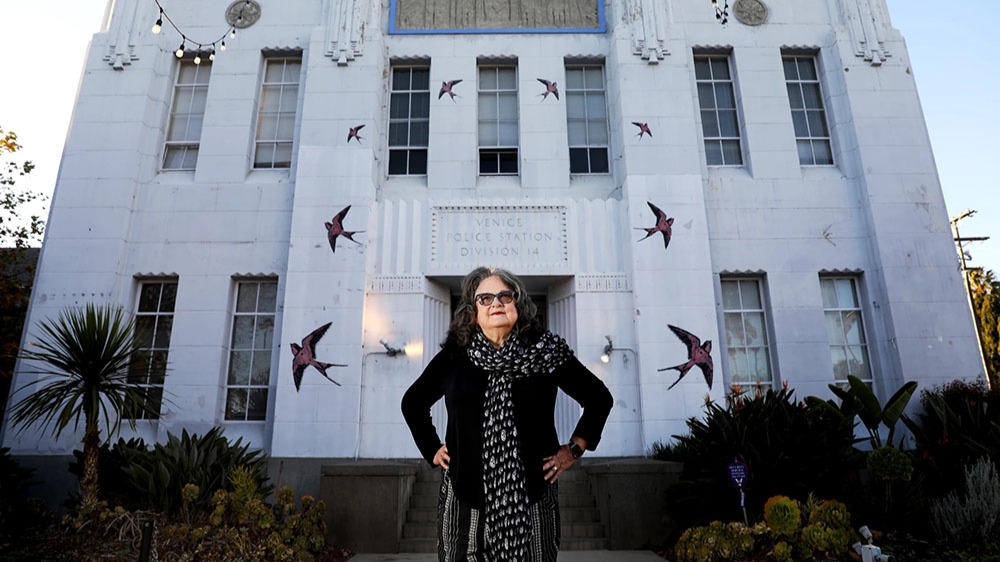
Judy Baca, professor in the Departments of World Arts and Cultures/Dance as well as Chicano/a Studies at UCLA has served as the Founder/Artistic Director of the Social and Public Art Resource Center (SPARC) in Venice, California since 1976. As a visual artist and one of the nation's leading muralists, Baca is best known for her large-scale public art works.
Judy Baca stands flanked by images she employed in an installation at her 1976 show at the Woman’s Building, one of a young clica member nicknamed “Flaca,” left, the other of the artist as a pachuca. (Gary Coronado / Los Angeles Times) There are few artists who can claim they have shaped the literal landscape of Los Angeles. Artist Judy Baca is one of them.
For more than 50 years, she has led workshops and projects that not only have added hundreds of murals to the city’s walls, they’ve employed at-risk youth and served as gang intervention programs. In the 1970s, she and artists Christina Schlesinger and Donna Deitch founded the Social and Public Art Resource Center, known as SPARC, an artistic hub that has served as a training ground for generations of artists.
That same decade, Baca launched a collaborative project to paint a half-mile-long mural in the Tujunga Flood Control Channel in North Hollywood. It told the history of California from prehistory to the 1950s — a project that, in retrospect, was prescient for the ways it presented the histories of migrants and Indigenous people. “The Great Wall of Los Angeles,” as the piece has come to be known, is now a veritable monument, figuring in the National Register of Historic Places.
Baca, 75, shows little sign of slowing down. She is working on expanding the mural thanks to a $5 million grant from the Andrew W. Mellon Foundation. And the Lucas Museum of Narrative Art recently acquired the archive related to “The Great Wall” project. On the pop culture front, Baca recently collaborated with Vans and the Museum of Contemporary Art on a special-edition sneaker inspired by one of her murals.
Currently, the artist is the subject of a retrospective at the Museum of Latin American Art (MOLAA) in Long Beach. “Judy Baca: Memorias de Nuestra Tierra, A Retrospective,” which gathers more than 110 works of art including paintings, sculptures, preparatory drawings and sketchbooks, was organized by independent curator Alessandra Moctezuma and MOLAA’s chief curator, Gabriela Urtiaga.
On a crisp November afternoon, Baca sat down in SPARC’s Venice headquarters — a 1920s jailhouse — to talk about the forces that have shaped her career. In this edited oral history, she talks about pachucas, monument design and the obscure all-Chicana exhibition from the 1970s that is just beginning to draw interest. — Carolina Miranda, Dec. 2, 2021


This post is an excerpt. Read the full article on the Los Angeles Times website.
Stay engaged. Use #UCLAarts to stay connected.


