The Psychological Cost of Boring Buildings

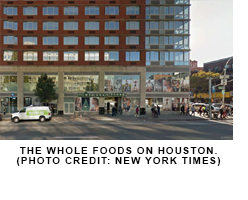
New Yorkers have long bemoaned their city being overrun by bland office towers and chain stores: Soon, it seems, every corner will either be a bank, a Walgreens, or a Starbucks. And there is indeed evidence that all cities are starting to look the same, which can hurt local growth and wages. But there could be more than an economic or nostalgic price to impersonal retail and high-rise construction: Boring architecture may take an emotional toll on the people forced to live in and around it.
A growing body of research in cognitive science illuminates the physical and mental toll bland cityscapes exact on residents. Generally, these researchers argue that humans are healthier when they live among variety — a cacophony of bars, bodegas, and independent shops — or work in well-designed, unique spaces, rather than unattractive, generic ones. In their book, Cognitive Architecture: Designing for How We Respond to the Built Environment, Tufts urban policy professor Justin Hollander and architect Ann Sussman review scientific data to help architects and urban planners understand how, exactly, we respond to our built surroundings. People, they argue, function best in intricate settings and crave variety, not “big, blank, boxy buildings.”
Indeed, that’s what Colin Ellard, a neuroscientist at the University of Waterloo and director of its Urban Realities Laboratory, has found in his own work. Five years ago, Ellard became interested in a particular building on East Houston Street — the gigantic Whole Foods “plopped into” a notoriously textured part of lower Manhattan. As described in his book, titled Places of the Heart: The Psychogeography of Everyday Life, Ellard partnered with the Guggenheim Museum’s urban think tank to analyze what happens when someone “turns out of a tiny, historic [knish] restaurant” and encounters a full city block with nothing but “the long, blank façade of the Whole Foods Market.”
In 2011, Ellard led small groups on carefully planned Lower East Side walks to measure the effect of the urban environment on their bodies and minds. Participants recorded their response to questions at each stopping point and wore sensors that measured skin conductance, an electrodermal response to emotional excitement. Passing the monolithic Whole Foods, people’s state of arousal reached a nadir in Ellard’s project. Physiologically, he explained, they were bored. In their descriptions of this particular place, they used words like bland, monotonous, andpassionless. In contrast, one block east of the Whole Foods on East Houston, at the other test site — a “lively sea of restaurants with lots of open doors and windows” — people’s bracelets measured high levels of physical excitement, and they listed words like lively, busy, and socializing. “The holy grail in urban design is to produce some kind of novelty or change every few seconds,” Ellard said. “Otherwise, we become cognitively disengaged.” The Whole Foods may have gentrified the neighborhood with more high-quality organic groceries, but the building itself stifled people. Its architecture blah-ness made their minds and bodies go meh.
And studies show that feeling meh can be more than a passing nuisance. For instance, psychologists Colleen Merrifield and James Danckert’s work suggests that even small doses of boredom can generate stress. People in their experiment watched three videos — one boring, one sad, and one interesting – while wearing electrodes to measure their physiological responses. Boredom, surprisingly, increased people’s heart rate and cortisol level more than sadness. Now take their findings and imagine the cumulative effects of living or working in the same oppressively dull environs day after day, said Ellard. — Jacoba Urist, Apr. 12

Read the full article at the New York Magazine, Science of Us blog.