The Other Side of the Wall: A New Generation of Latino Art
Alumni Rafa Esparaza (B.A. '11), Gala Porras-Kim (B.A. '07), and Yoshua Okón (M.F.A. '02) are featured in the New York Times article "The Other Side of the Wall: A New Generation of Latino Art" addressing the complexity and humanity of Latino Art.
"WHEN I WAS 22, living in Tucson, I visited my then-boyfriend who was staying in New York for the summer. I was a country mouse — a desert mouse, really — in awe of everything, head tipped up to see the sights.He was living in Brooklyn, in a huge building of not-exactly-legal artists’ lofts, and on our way out one morning, we found ourselves in the newly painted elevator with a Real New York Artist. Weary and angular with lank blond hair, elegantly sheathed in black, yet still casually paint-flecked: She was exactly how I’d imagined a Real Artist.
My boyfriend pointed out the fresh graffiti scratched in the beige paint, chuckling. ‘‘They got to it already.’’
‘‘Mmm, yes,’’ said the Real Artist, slow and sardonic. ‘‘Those who can’t find canvas find walls.’’ She stretched out this last word in a way that struck me as both ludicrous and terribly sophisticated.
WE HAVE BEEN TALKING about walls a lot lately. The chants at our president’s rallies (‘‘Build a wall!’’ ‘‘Lock her up!’’); the discussions about sanctuary cities; the argument over what counts as a wall and what is merely a fence — all this political rhetoric forces us to consider what walls keep in, what they keep out, whom they shelter, where they are permeable. And so we must consider, too, what art is hung — or scratched — upon them. These days, I think about walls in relation to a number of Latin American and Latino artists who are engaging with our current moment, and in doing so, are challenging what an art space is and who belongs in it.
ONE OF THE MOST MOVING works in the new Latino art canon is the Los Angeles-born Rafa Esparza’s ‘‘Figure Ground: Beyond the White Field,’’ 2017, which was exhibited at this year's Whitney Biennal. Esparza built a gallery within a gallery, a physical wall of rough, unplastered adobe made through traditional methods from the mud and water of the Los Angeles River. The result is extraordinary: a hushed, cool, earthen sanctuary that almost feels underground. It’s an art space, but it also felt, to me, like a holy one, reminiscent of a kiva.
Then there was Gala Porras-Kim’s sculpture ‘‘Reconstructed Southwest Artifact,’’ which incorporated a painted Native American potsherd purchased from eBay (no provenance given, ‘‘condition: used’’). Porras-Kim’s art, like Esparza’s, is a kind of running commentary on erasure and appropriation and value — monetary and otherwise. Just as Esparza brings soil and river water and traditional labor into the rarefied walls of a museum, Porras-Kim examines how context changes an object’s meaning. For a show at the Hammer Museum in L.A. last year, she took obscure ethnographic objects from the collection of the Fowler Museumat U.C.L.A., all of which had been categorized as ‘‘unidentified’’ — including textile scraps and broken pottery — things that had effectively been deemed originless and valueless, divorced from their history and the history of those who made them. Placing these fragments on display in a contemporary art show asked the viewer to consider the forgotten lives of the people who made them, and offered a sly commentary on the very organizing principle of museums everywhere: What gets to be displayed by an institution, and why?
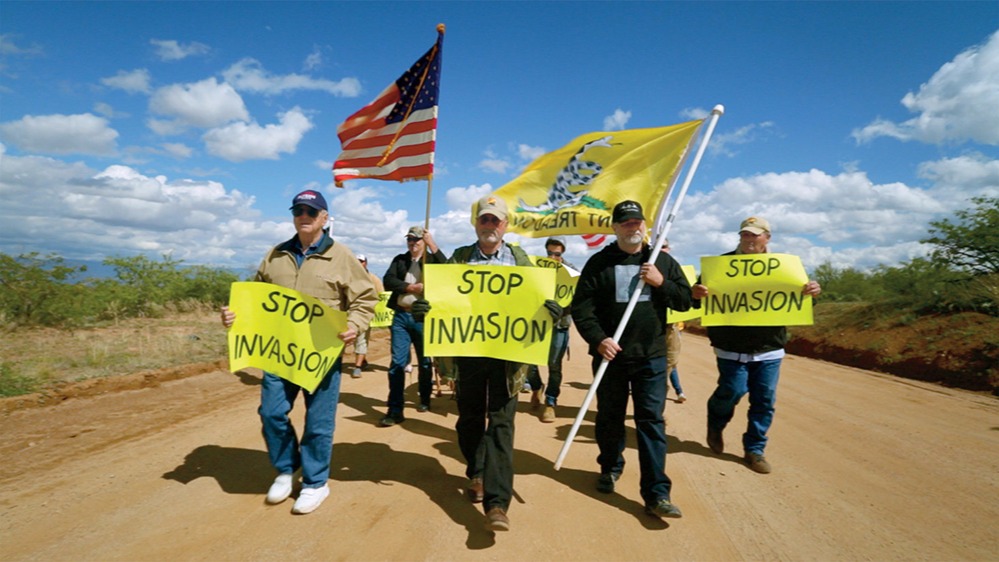
Yoshua Okón, born in Mexico, where he currently lives, and educated at U.C.L.A., has made a quasi-fictional documentary video about Oracle, Ariz., the location of the largest-ever protest against child immigrants from Central America. The video includes a re-enactment of the protest, staged by members of an organization called Arizona Border Protectors, alongside footage of nine immigrant children performing the U.S. Marines’ Hymn. (The video will screen as part of Pacific Standard Time.)
But though the experiences of Latinos are diverse, the narratives that dominate popular culture tend to be lazy: harrowing journeys across the border; undocumented criminals robbing and raping; children torn from their parents’ arms by ICE agents; drugs flooding northward. And then there are the stock characters: the wicked coyote, the ruthless trafficker, the bright-eyed abuelita with her folk wisdom and unshakable Catholicism, the hardworking and/or exploited housekeeper or fieldworker who is either taking jobs from Real Americans or doing jobs Real Americans won’t do.
These stories mask the complexity and humanity of actual people and become their own kind of wall, obscuring truth, demonizing or romanticizing entire populations."— Kristen Valdez Quade, Aug. 17, 2017

Read the full article at the New York Times website.