The Monumental Impact of a Judy Baca Mural in Los Angeles
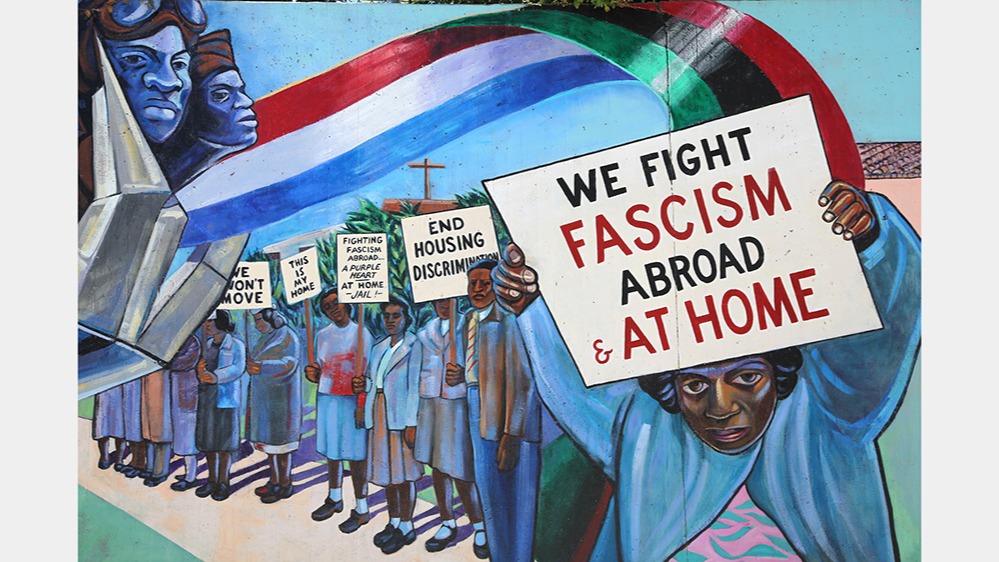
Judy Baca, professor in the Departments of World Arts and Cultures/Dance as well as Chicano/a Studies at UCLA has served as the Founder/Artistic Director of the Social and Public Art Resource Center (SPARC) in Venice, California since 1976. As a visual artist and one of the nation's leading muralists, Baca is best known for her large-scale public art works.
 |
 |
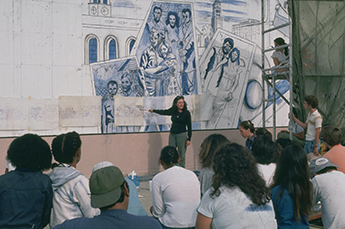
| Judy Baca and the artist team for “The Great Wall” in 1970s. | |
"In 1976, Judy Baca began working on “The Great Wall of Los Angeles,” a monumental mural depicting the story of Los Angeles through the lens of interracial harmony. Spreading over 2,700 feet of wall space in the Tujunga Wash of the San Fernando Valley, “The Great Wall” spans pre-historic California to the 1950s, showing a range of historical events, including the Zoot Suit Riots, the fight against the covenant laws in South Central LA, and the internment of Japanese-Americans. Collaboratively created with local artists, community members, and more than 400 youth during the summers between 1976 and 1983, “The Great Wall” and its nonprofit arm, the Social and Public Art Resource Center (SPARC), inspired hundreds of mural projects and educational initiatives across the region. No other organization has had a bigger impact on community mural painting in Southern California — particularly as it relates to Chicanx and Latinx communities — than SPARC.
Over 45 years after its first coat of paint, “The Great Wall” is getting overdue recognition with a $5 million grant from the Andrew W. Mellon Foundation’s Monuments Project. The Lucas Museum of Narrative Art also recently acquired The History of California Archive, a collection of hundreds of drawings by Baca and her team showing the creation of “The Great Wall.” Though working for decades, SPARC and its significance is finally coming to the fore.
“The work has become timely, but it has always been important,” Judy Baca explained in a phone interview. “More people are beginning to recognize it and need it and are calling for it.”"—Rachel Heidenry, May 2, 2021

This post is an excerpt. Read the full article on the Hyperallergic website.
Stay engaged. Use #UCLAarts to stay connected.


