The Latin American Women Artists Who Fought Patriarchy with Their Bodies
'Radical Women: Latin American Art, 1960–1985' on view at the Hammer Museum at UCLA
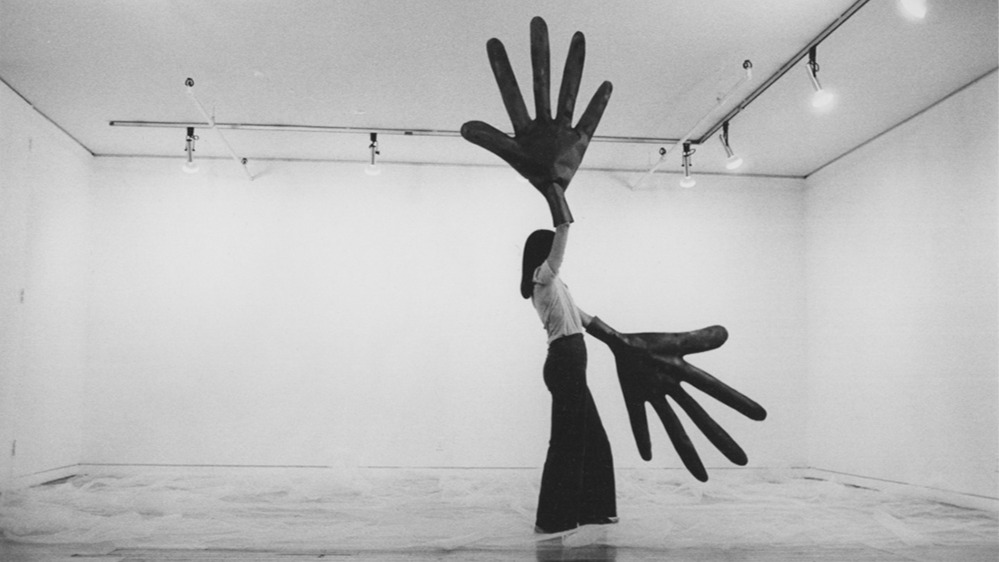
In a way that no other exhibition has done previously, the Hammer Museum's Radical Women: Latin American Art, 1960–1985 gives visibility to the artistic practices of women artists working in Latin America and US-born women artists of Latino heritage between 1960 and 1985—a key period in Latin American history and in the development of contemporary art. Fifteen countries are represented in the exhibition by more than one hundred artists, with 260 works in photography, video, and other experimental mediums.
"In the decades following 1960, the dictatorships and authoritarian regimes dominating most of Latin America reinforced the dependent role of women, while institutionalizing inequality. Within this context, the human body took center stage for many female artists. Their experimental works—often favoring video, photography, and performance—introduced a shift in representations of the female form, while questioning patriarchal structures and regional politics.
Despite this, few of these artists would have referred to their work as “feminist.” Instead of a desire to advocate for women, their sensibilities were heavily shaped by the revolutionary struggle and the widespread resistance of their respective countries—even if their works did reflect a repertoire of issues addressed by feminism, such as motherhood, civil rights, and sexual violence.
“Many of these artists were active in left-wing movements,” explains Cecilia Fajardo-Hill, co-curator of the exhibition “Radical Women: Latin American Art, 1960–1985” at the Hammer Museum in Los Angeles. “But for them, the rights of women were secondary, and the Left considered that feminism was bourgeois and imperialistic.”
“Radical Women” is part of “Pacific Standard Time: LA / LA,” the city-wide celebration of Latin American and Latinx art. Featuring over 100 artists from 15 countries, the show was born out of an ambition to provide a more complex history of the region. Curators Fajardo-Hill and Andrea Giunta have examined the notion of the political body through highlighting the works of familiar artists like Lygia Pape, Ana Mendieta, and Beatriz González, as well as a host of unclassifiable, lesser-known names, like the Cuban-born Zilia Sánchez, the Colombian sculptor Feliza Bursztyn, and the New York-born Puerto Rican photographer Sophie Rivera.
“The works of these women contribute to making visible the potentiality of the body, and how you can reframe the notion of the body,” says Giunta, gesturing to photographic works by Mendieta from 1972. In the pictures, the Cuban-born artist is seen pressing different parts of her body against a glass pane, morphing the canonical idea of the feminine body into grotesque or unnatural states. “It has to do with emancipation,” Giunta continues, “and the reconceptualization of the body, which is a political process.”
At a time when Latin America is facing an increasing rate of femicide, and the United States are observing some of the most repressive immigration policies in decades, the teachings of these artists are critical."— Benoît Loiseau, Sep. 21, 2017

Read the full article at the Artsy website.