The Feminist Self-Defense Practice That Could Give the Climate Crisis a Beatdown
It's Time to Train Ourselves to Transform Our Fear and Anger into Action

Janet O’Shea is a professor of dance studies in the UCLA Department of World Arts and Cultures/Dance. Her research and teaching focus on the politics of physical practice in the context of dance, martial arts, and activism.
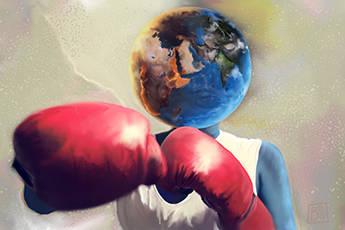
Illustration by Be Boggs. The climate breakdown, which so many of us assumed lay far in the future, is upon us now.
Extreme weather conditions abound—drought, wildfires, super storms, floods. A recent and terrifying report from the United Nations’ Intergovernmental Panel on Climate Change suggests that more of the same is inevitable, and that the window to avoid the most horrific outcomes is rapidly closing. Only by reducing emissions by 45 percent by 2030 and reaching net-zero emissions by 2050 can we limit the temperature rise to 1.5 Celsius, the panel concluded. Even that best case scenario involves devastation—such as an Arctic region that sees a month every year without sea ice—and damage that is irreversible. Still, world leaders ignore pleas for action.
In this situation it makes sense to be scared—and to take a cue from empowerment self-defense (ESD), a feminist self-defense practice that pays close attention to the relationships among fear, anger, and action. By harnessing the power of fear, ESD shows a path forward for climate activism, too.
It’s worth thinking about the benefits of fear. In the home, in public spaces, and on a global scale, fear is an emotional and cognitive response that expresses itself through physical states: hair standing on end, a tightness in the chest, an accelerated heart rate, a queasy feeling. These signals appear as the brain picks up on sensory cues that the conscious mind might miss. Together, they form what we call our intuition, and they fuel self-protection and survival. Fear helps us figure out which threats to respond to and how quickly, and what obstacles are mere annoyances that we can safely ignore.
And yet, modern society teaches us to second guess our fears, to allow our minds to slip into denial in the face of potential danger. So it’s no wonder that some politicians, journalists, and scientists urge restraint in how we talk about the climate crisis. Scientific reticence has, until recently, encouraged climate researchers to speak in the bland language of parts per million, and of change rather than breakdown, allowing scientific skepticism to blur into climate denial. Journalists have adopted neutral-sounding terms for ecological catastrophe such as “global warming” rather than “global heating,” and “climate change” rather than “climate crisis.” Even some climate activists suggest that fear can only motivate people in destructive ways.
In fact, a healthy dose of fear might motivate us to work harder—and empowerment self-defense shows how and why. For instance, ESD teaches us to confront denial, a common response to interpersonal violence (and to environmental breakdown). When a person encounters a stranger’s violence—a grab, a slap, a shove to the ground—the defender often spends precious response time thinking “this can’t be happening.” Many of us, especially those of us raised as girls, are taught that our safety is someone else’s responsibility and that a bystander or an expert will intervene and save us.
Empowerment self-defense confronts this kind of withdrawal directly, replacing the denialist statement “this isn’t happening” with a question: “What’s going on?” ESD students practice actively enlisting the support of bystanders, through specific instructions or requests. These strategies replace a dependence on others with the ability to actively engage them, acknowledging fear and confronting it head-on. — Janet O'Shea, Sept. 22, 2021


This post is an excerpt. Read the full article on the Zocalo website.
Stay engaged. Use #UCLAarts to stay connected.


