“The Embrace” is a different kind of memorial
Rebeca Méndez collaborates on design of Tucson mass shooting memorial
On Wednesday, pro-Trump supporters marched through Washington D.C. and stormed the Capitol building, just as Congress was meeting to formally certify the outcome of the 2020 presidential election. The insurrection left five people dead and a world in shock. Many are asking, is this what America has become?
The attack also comes the same week that Tucson, Arizona is marking the ten-year anniversary of a shooting rampage outside a supermarket that killed six people and injured thirteen, including then-U.S. Rep. Gabrielle Giffords. The attack took place at a “Congress on Your Corner” event, days after Rep. Giffords had won a contentious re-election race.
On Friday, a permanent memorial to honor the victims and survivors of the Jan. 8, 2011 attack was dedicated in a small ceremony. Rebeca Méndez, professor and chair of the UCLA Department of Design Media Arts, worked with the architecture firm Chee Salette to design that memorial.
The memorial includes a series of symbols that Méndez and a team of UCLA students created to depict the victims, survivors and first responders, and to tell a larger history of Tucson and southern Arizona.
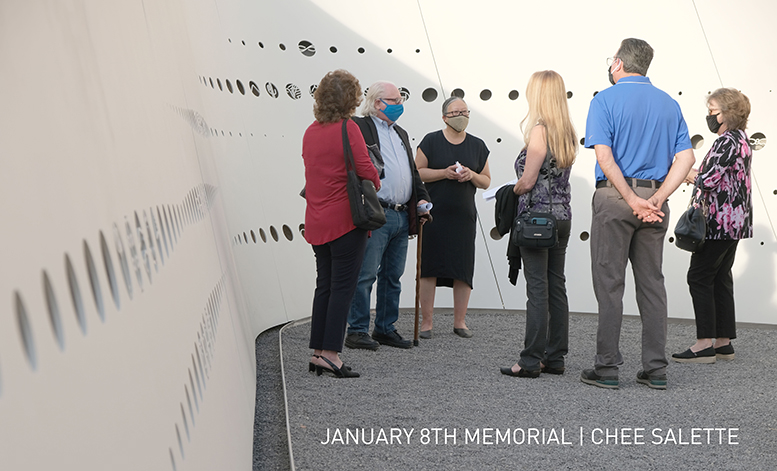 Visitors gather inside the Jan. 8 Memorial in Tucson. Image courtesy Chee Salette.
In the immediate aftermath of the Tucson attack, impromptu memorials quickly grew at the site of the shooting, the hospital, and Giffords' Congressional office.
"One of the things that happened absolutely immediately is the community coming together, wanting to support each other, wanting to make something good come out of this," said Pam Simon, a community outreach coordinator for Rep. Giffords’ Congressional office who was seriously wounded in the shooting. "The community demanded a place to mourn."
Tucsonans placed flags, candles, stuffed animals, notes, and paper chains on the memorials. The attack spurred nationwide calls for anti-gun violence legislation.
In February 2012, the Jan. 8 Memorial Foundation was formally established to provide strategic planning and financial support for a permanent memorial in downtown’s El Presidio Park, next to the historic Pima County Courthouse. A design competition was held, and in 2015 the architecture firm Chee Salette was selected, with visual artist Rebeca Méndez, to design the memorial.
“I felt that this could be a good moment to be able to put a lot of energy towards creating something for peace in this world, and a different way of relating to each other," Méndez said.
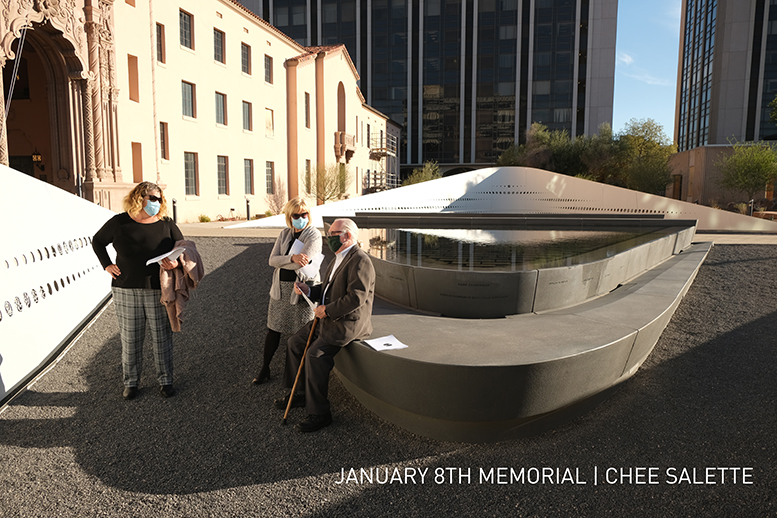 Visitors rest on the reflecting pool at the Jan. 8 Memorial. Image courtesy Chee Salette.
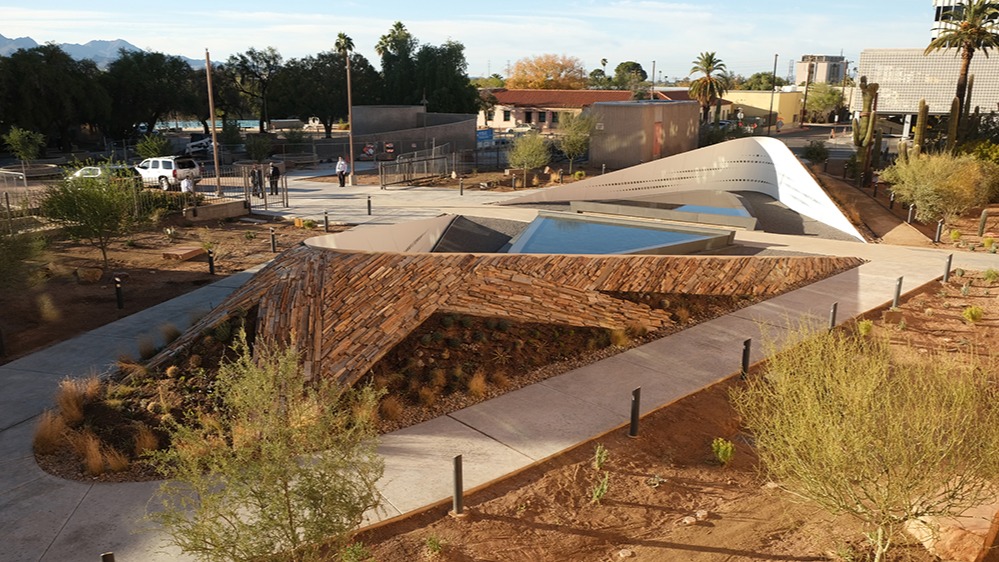
The memorial, called “The Embrace,” consists of two V-shaped embankments that from above resemble arms poised in an embrace, or a figure eight, connoting the date of the shooting, as well as broken links in a chain.
The outer walls are clad in stone and native plants, reflecting the surrounding desert and mountains. The inner walls grow in size as visitors descend a ramp toward each apex, creating a kind of chapel-like space that is open to the sky, with a reflecting pool in the center.
"The foundation wanted it to be a place of discourse. So we knew we had to make space, rather than just simply a wall with names," said Tina Chee, architect, landscape architect and design principal at Chee Salette.
In order to create a memorial that would tell “a kind of history of resilience," per Méndez, the design focuses not only on the 2011 attack, but also on stories of violence culled from centuries of Tucson’s history. The monument aims to peel back layers of history, from Native American dwellings and the Spanish conquest to Mexican and then American occupation of the land.
“Every time the new civilization or culture that was taking over was erasing the traces of what was there before,” said architect Marc Salette, the project manager for the Jan. 8 Memorial. "We felt that we had an opportunity with this project not to recreate what was lost, but at least to remember it and frame the event of January 8th, which was a single day in the history of Tucson, and the few days that followed, into the larger context of the history of the city as a whole.”
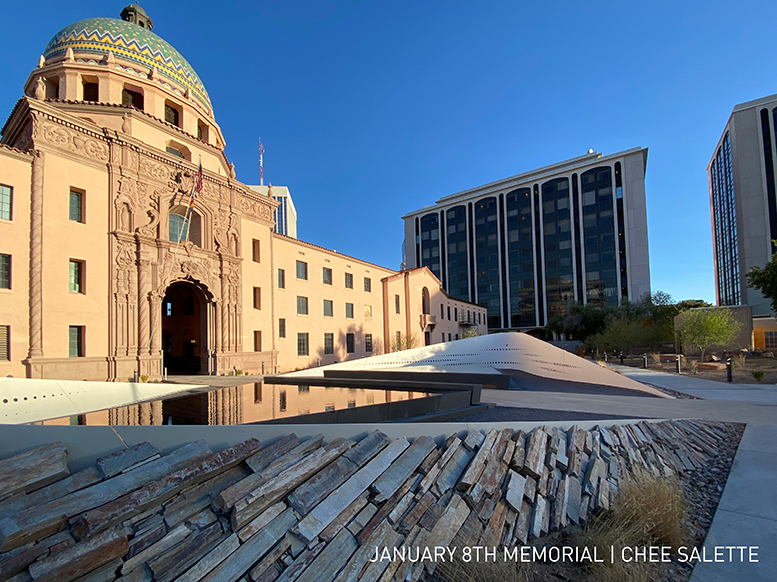 The Jan. 8 Memorial stands in front of the Pima County Courthouse, a civic center in the heart of Tucson. Image courtesy Chee Salette.
The research and community engagement process included interviews with the survivors and family members of the victims, along with city leaders, community organizers, elders from local tribal nations, high school students, and many others. Méndez also researched historic monuments, such as Mayan and Egyptian pyramids, Stonehenge, and "all the ways in which we leave something behind to be understood later on, millennia later, by new generations," she said.
The design team also studied memorials for the Vietnam War, the Korean War and the Franklin D. Roosevelt Four Freedoms State Park in New York.
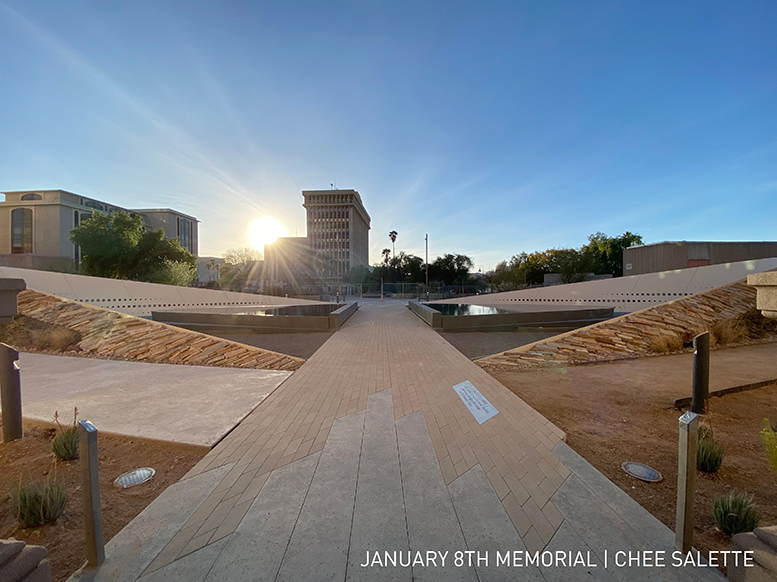 The view from the Pima County Courthouse onto the Jan. 8 Memorial. Image courtesy Chee Salette.
Local historian Jackie Kain helped incorporate stories from the people, landscape, and history of southeast Arizona.
"It became very clear that this was an important event in the life of Tucson,” Kain said. "This happened in a strip mall in front of the Safeway on a Saturday at 10 in the morning, when people were there to... talk to their congressperson, and it's just pure democracy, and this horrible event took place. And so, everybody, regardless of political persuasion, was touched by this. It was a true violation. Everybody knew somebody who was affected by it.”
Rather than tuck the memorial away in a corner of the park, the design team decided to place it in front of the entrance to the courthouse.
“We could have retreated to the quietest corner of that park and try to create this sanctuary,” Salette said. “We did the opposite. We placed it on a very important pedestrian path that people use on a daily basis. And so that was a very important decision: to create a different type of memorial, one that would be part of the everyday civic life of Tucson."
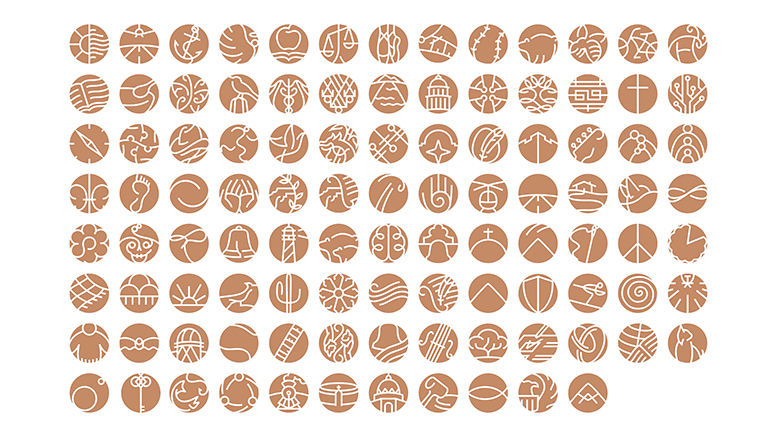 The symbolic language created by visual artist Rebeca Méndez for the Jan. 8 Memorial. Image courtesy Rebeca Méndez Studio.
The names of the victims, survivors, and first responders are carved into the reflecting pool walls. Méndez and a team of UCLA students also developed a kind of symbolic language to depict them. The symbols are informed by prehistoric petroglyphs of animal and human forms created by the Hohokam people in the mountains near Tucson.
On each inner wall of the memorial are 33 circles or “voids,” signifying the 33 shots fired in the attack. The dots grow in size as they move towards the center. These circles include simple drawings that reflect the lives of the victims and survivors.
These symbols are cut out of steel panels and cast shadows that change as the day progresses. At night the circles are lit from behind. Visitors will be encouraged to create rubbings of the symbols to take home with them.
The circles for each person form a “constellation,” says Méndez, that tells a bigger story about their values and interests. For example, Pam Simon's symbols include an apple and a book, because she was a public-school teacher and active in the teacher’s union; interlocking puzzle pieces, because she connected people; a dove, because she became a peace activist after the shooting; a mesquite tree, because it provides shelter for other life; and a mother bear, because of her work with the anti-gun violence group Moms Demand Action.
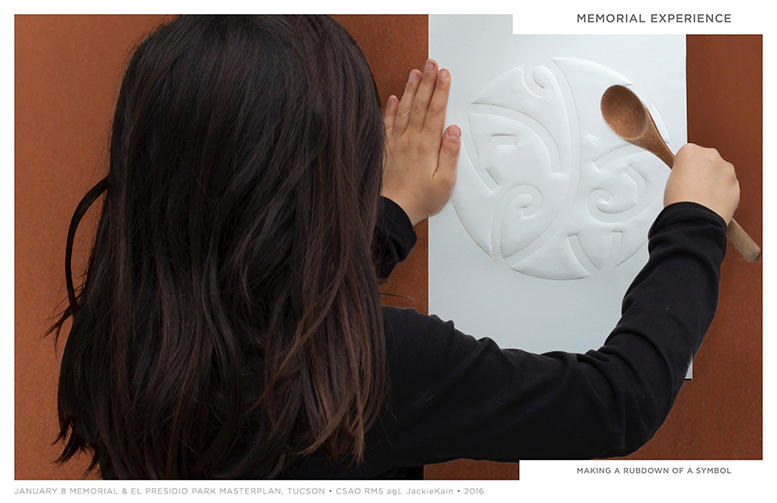 A child makes a rubbing of one of the symbols designed by Rebeca Méndez for the Jan. 8 Memorial. Image courtesy Rebeca Méndez Studio.
Nine-year-old Christina-Taylor Green, the youngest victim of the attack, is represented by a constellation that includes a butterfly, which was the last drawing she made in school; a bobcat, her father’s nickname for her; an angel, because she became known after her death as the “angel of Tucson”; and other symbols of her interests, including ballet shoes, a book, and a baseball.
Another 32 symbols appear on bollards placed in a circle around the memorial that are also lit up at night. These represent the first responders of the mass shooting, and the history of Tucson and southern Arizona. Some symbols represent the surrounding landscape, such as Saguaro National Park, Sentinel Peak, and the Santa Cruz River.
The Pima County Courthouse will include a museum that explains the meaning behind the monument and its symbols. In addition, Méndez said, there are plans for a printed book and an augmented-reality smartphone app that will provide more context.
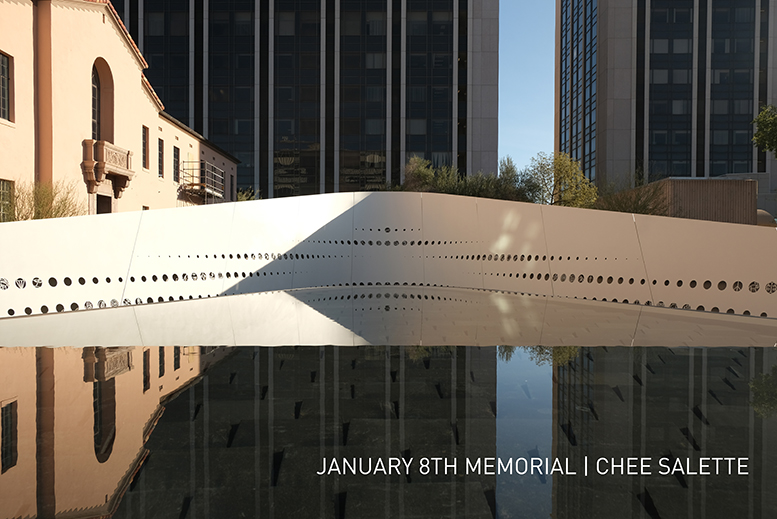 The reflecting pool and inner memorial offer a place of contemplation and reflection where visitors can honor the victims and survivors of the Jan. 8 attack. Image courtesy Chee Salette.
This memorial’s dedication is now occurring amidst the backdrop of Wednesday’s events at the Capitol, the mass movement for racial and social justice, and a larger conversation that's happening in America now about how historic events should be memorialized. Méndez says she hopes to never again see a "conquistador on a horse" that celebrates colonialism.
"This memorial... marks clearly that we are members of a community, and that this community exists within a place and a history,” Méndez said.
Pending legislation in Congress would make “The Embrace” a national memorial. The move would put the memorial under the management of the National Park Service.
Because of coronavirus restrictions, the memorial will remain closed to the public until at least February.
"We can't wait to see, when COVID is over and the memorial is officially open, how that will transform Tusconans and bring this community together, despite this tragedy," Chee said.
The hope is that the memorial will become a gathering place for locals, a destination for visitors, and, says Méndez, a reminder to Tucson about how the city united in the wake of violence.
"In the days following the shooting, there was such an outpouring of grief and outrage over the senseless massacre, that really was transformed into this solidarity and togetherness that the people were feeling in Tucson,” Méndez said.
“Creating this foundation and the memorial has offered the Tucsonans some solace and strength to overcome this devastation."
Story by Avishay Artsy
Read more about Professor Rebeca Méndez
Stay engaged. Use #UCLAarts to stay connected.


