The Crushing Weight of the Comfortable: Rodney McMillian
Department of Art Professor Rodney McMillian's artistic practice embodies a wide range of media and techniques. An overarching concern in his work is the relationship between language, aesthetics and content. His exhibition, Rodney McMillian: Body Politic is on view at Vielmetter Los Angeles until Dec. 5, 2020.
"Examining the institutions that uphold US society and tradition by reverse-engineering their physical vestiges, Rodney McMillian—artist and professor of sculpture at the University of California, Los Angeles—exposes the seams of the American Dream.
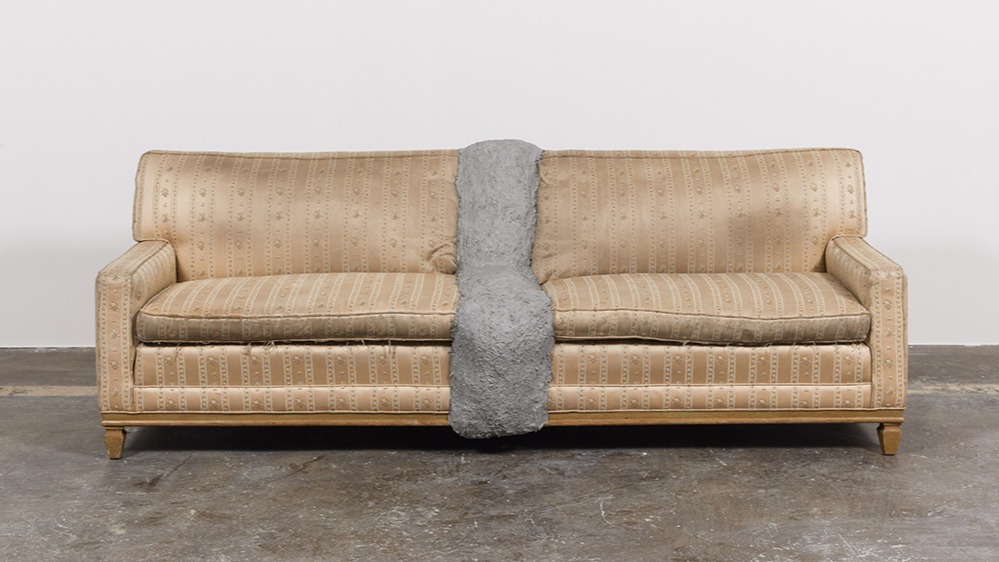
Rodney McMillian, From Asterisks in Dockery, 2012. Courtesy: the artist and Vielmetter Los Angeles. Photo: Brian Forrest

The PELLO armchair, an IKEA mainstay, has a streamlined, Scandi-beige wood frame that gives just enough in its bends to transition from desk chair to armchair, home office to living room. Its lightweight versatility is how it has found its way into the first, second, and maybe third apartments of nearly everyone you know (perhaps even yours). To see it so neatly and precisely impaled, then, for McMillian’s Untitled (2009)—a seemingly solid, thick black pole protruding through its seat and towering two meters above it—is unsettling in its stillness. The cardboard tube, covered in thick swipes of pigment so as to resemble asphalt, is smashed into the ground, yet hardly disrupts the PELLO’s upright and sensible posture. The chair would make an uncanny complement to Couch (2012), a long, vintage sofa upholstered in satiny wheat stripes, seemingly sawed in two and clumsily glued back together by a tidy river of poured and dried cement. Both the remodeled PELLO and the sofa seem otherwise mostly unharmed, only showing the slightest fraying from their restructuring.
Design elements of this implausibly appointed home might also include the artist’s “post-consumer” Landscape series of abstract paintings, made by pouring swirls of paint onto “canvases” that are actually thrift-store or passed-down bedding, swaths of linoleum, or pieces of wall-to-wall carpet. None of these standard objects of the typical parlor’s entertainment-area décor—whether from IKEA or a secondhand store—escape the artist’s dissecting of the institutionalization of the comfortable, middle-class residence."— Jennifer Piejko, Oct. 15, 2020

This post is an excerpt. Read the full article on the Mousse Magazine website.
Stay engaged. Use #UCLAarts to stay connected.


