"The Charlie Munger windowless dorm is the building of our moment"
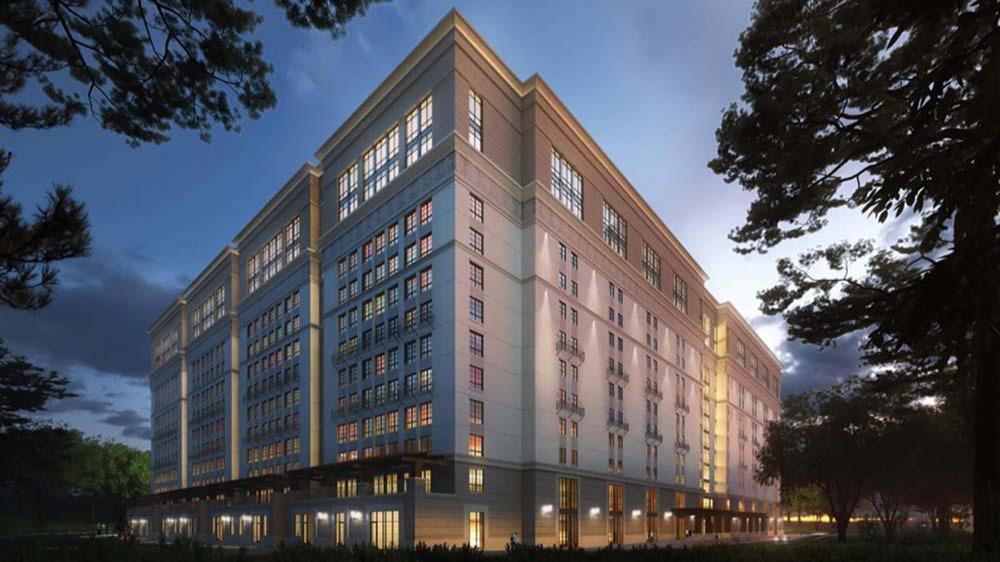
The controversial Munger Hall at University of California Santa Barbara represents the university's capitulation to "the whims of old white men" and will lead to another Greta Thunberg moment, argues UCLA architecture professor and cityLAB director Dana Cuff.
A typical residential floor plan at Munger Hall Architecture has the capacity to coalesce historical eras by reflecting society at a key moment in time, telling us the story of our shared existence. In 1981, an uproar sprang from the winning competition entry for the Vietnam War Memorial by Maya Lin, a young Asian woman still a graduate student.
In the early 1970s, the demolition of nearly 3,000 units of public housing at Pruitt-Igoe designed by Minoru Yamasaki symbolized the end of modernist utopian aspirations, and with them, the idea of warehousing poor families of color. One step further back, when public housing programs were advanced by the federal government in the 1930s and '40s, public debate raged. In each of these moments, social and political conditions reached a flashpoint that was clarified by architecture.
A building or monument mirrors back to architects and the general public an intelligible translation of swirling complexities otherwise hard to grasp. When that happens, the debate around the architecture is a debate about our shared existence. Alas, the Charlie Munger windowless dorm at the University of California Santa Barbara (UCSB) is attracting so much attention because it is the building of our moment.
What was confusing or invisible now seems apparent, and what we see is surely not the world we want to live in but one we seem resigned to accept. Despite all our contemporary divisiveness, from political partisanship to architecture’s incoherent response to climate change and homelessness, the UCSB-Munger building is bringing us all back together. The real question is: in response, will we collectively rise up or give up?
The grossly scaled, concrete, semi-classically decorated, Costco-capped, 4,500-bed dormitory architecturally captures, all at once, the grim realities of our impoverished public sphere, the bloated powers of industry kings and the punishing inequities that face students even in the best public university in the nation.
Repercussions from California’s taxpayer revolt of 1978 mean only 8.3 per cent of the UC budget now comes from the state. In 2012, rising student tuition exceeded the state contribution for the first time in history. Even further cuts to the state budget are sending UC to look for revenues like out-of-state tuition, but also income from residential services, including dormitory rents. — Dana Cuff, Nov. 18, 2021


This post is an excerpt. Read the full article on the Dezeen website.
HEADER IMAGE: A rendering of Munger Hall at UC Santa Barbara. Named for billionaire Charlie Munger, each residential floor of the 11-story building will house over 500 students.
Stay engaged. Use #UCLAarts to stay connected.


