"The act of surviving is enough"
Art professor Rodney McMillian explores race, class, and history in his work
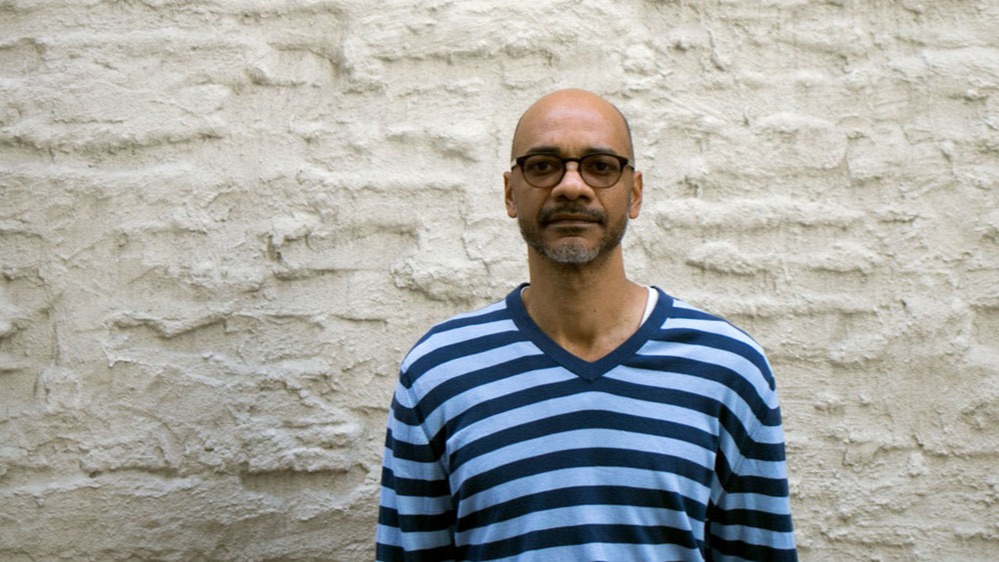
Department of Art Professor Rodney McMillian's practice embodies a wide range of media and technique, and often confronts racial and socioeconomic injustice. McMillian’s most recent show at Vielmetter Los Angeles, Rodney McMillian: Body Politic, explores the body’s symbolic meaning and the relationship between politics and aesthetics.
“There needs to be a deep rooting out – of the racism, of the inequalities, of the brutality – that is plaguing this land," McMillian said.
In this interview with the UCLA Arts podcast Works In Progress, McMillian discusses this nation's racial reckoning, his use of color and materials, and how music and science fiction inspire his work.
The Body Politic exhibition included monochrome sculptures that loosely depict body parts made of chicken wire and black fabric. One snake-like loop, Untitled (entrails), hung from steel butcher's hooks mounted into the gallery's ceiling.
“I wanted to make it specific to how our bodies, or how Black bodies, had been used for commerce, and for medical commerce, and for purposes other than the wellbeing of ourselves," McMillian said.
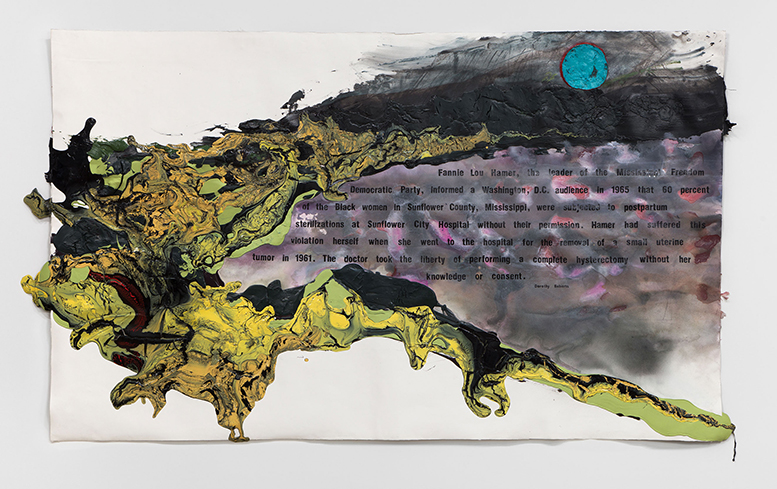
Rodney McMillian, Mississippi Appendectomy, 2020. Courtesy of the artist and Vielmetter Los Angeles. Photo credit: Brica Wilcox
Vividly-colored drawings use mixed media and text to narrate a history of the violence against Black bodies in the names of science and slavery. One drawing, Mississippi Appendectomy, borrows its name from a phrase used by civil rights activist Fannie Lou Hamer to describe involuntary sterilizations and hysterectomies on Black women in the South in the 1960s.
“In some ways I'm making this work because I'm trying to make sense of it as well. I'm not shocked by the history in the sense that I know that it exists. But the way that it rests or lives in me is always shocking. The reality of the brutality is so cellular," he said. “And so the shock that I live with, with that history, that's something that I'm constantly processing."
There’s also a monumental work, The White House Painting II, that stretches 44 feet across. The white vinyl structure against a black sky is hand-stitched together and droops off the wall. The piece was made from the remnants of The White House Painting made for his Booth Prize exhibition in Austin, TX.
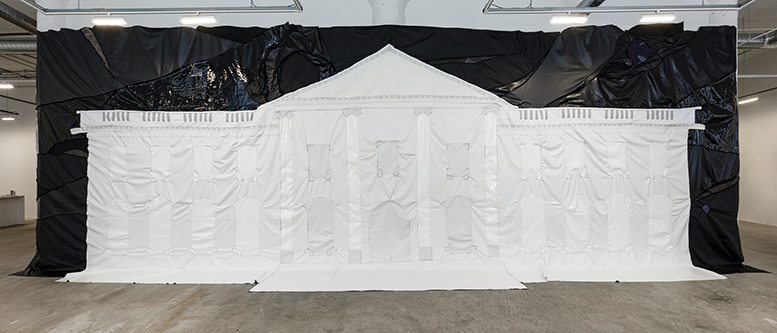
Rodney McMillian, White House II, 2018-2020. Courtesy of the artist and Vielmetter Los Angeles. Photo credit: Jeff Mclane
When asked how artists can help advance the discussion for racial justice and reckoning, McMillian said, "the act of surviving is enough. And the act of speaking one's truth in whatever form that they have, or that they choose in which to speak, is wonderful."
McMillian was born in Columbia, South Carolina, and raised in a working-class African-American family. His father was a bus driver, and his mother was an Equal Employment Opportunity Commission officer for Richland County. He recalls volunteering for local political campaigns and attending election night watch parties.
“My interest in issues around race and class concerns and policy and things like that, were things that were just around me. And they were also things that I actively studied.”

Rodney McMillian, speaking with an MFA candidate. Photo courtesy UCLA
McMillian earned a BA in Foreign Affairs from the University of Virginia, with a focus on politics in African countries. He went on to study art at the School of the Art Institute of Chicago and the Skowhegan School of Painting and Sculpture, and received a Master of Fine Arts degree from the California Institute of the Arts in 2002. There, he took up multiple mediums, including sculpture, painting, film and installation art.
“In grad school I made a concerted effort to try to broaden what was possible for me in terms of how I could communicate in art," McMillian said.
He was also influenced by the late musician and performer Prince, who could famously play many instruments.
“[Prince] wrote and produced and it seemed like it enabled him to be in control of the message he wanted to send. And so I guess for myself, that's what I was seeking.”
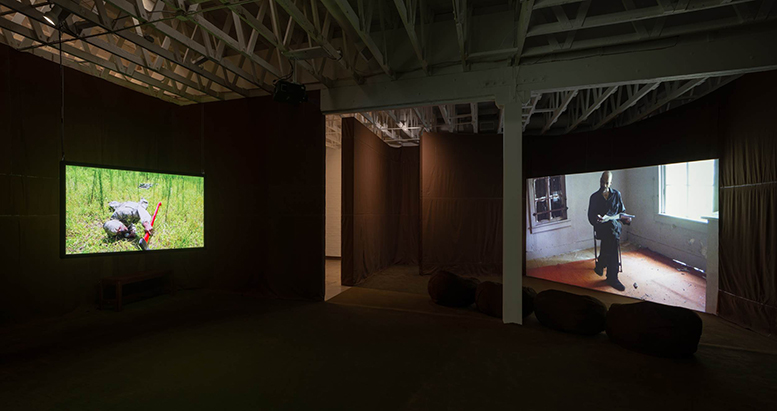
Installation view, Rodney McMillian, Brown: videos from The Black Show at The Underground Museum. Courtesy of The Underground Museum. Photos by Zak Kelley.
In 2019, his solo exhibition at the Underground Museum in Los Angeles, Brown: videos from The Black Show, featured several video works originally presented in his 2016 solo exhibition The Black Show at the ICA Philadelphia. Many of the videos were created in his home state of South Carolina, while others were filmed around Dockery Farms, an infamous plantation in Mississippi where some claim the Delta Blues was birthed.
McMillian's characters in the films wore costumes and delivered song lyrics, political sermons and children’s stories. He set the films in a lush but hostile Southern landscape of moonlit fields and buzzing swamps.
The first West Coast presentation of McMillian’s opera, Hanging With Clarence, was staged at the Bethlehem Baptist Church in Compton. His monumental installation In This Land was on view as part of the New Work series at the San Francisco Museum of Modern Art in early 2019. He received the Contemporary Austin’s first Suzanne Deal Booth Art Prize in 2016, and the resulting solo exhibition Against a Civic Death was on view in 2018.
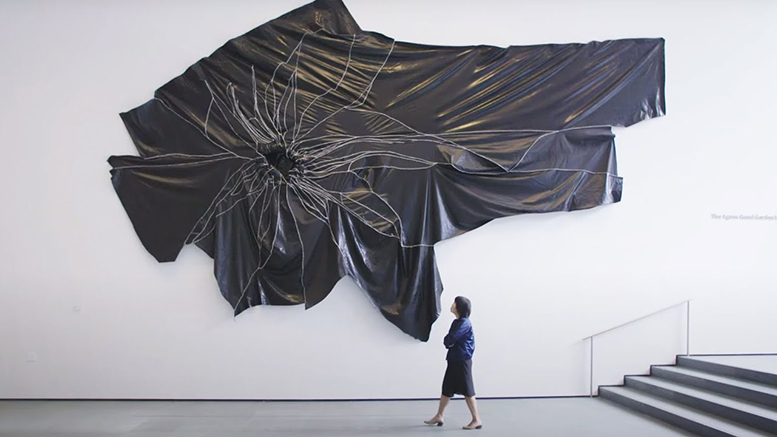
Rodney McMillian, Succulent, 2010. Photo courtesy Museum of Modern Art
His 2010 work in black vinyl, titled Succulent, is prominently installed in the Agnes Gund Garden Lobby at the Museum of Modern Art in New York. McMillian has described it as a “portal to another world,” a nod to his interest in science fiction writers like Octavia Butler and Samuel R. Delaney.
A selection of McMillian’s video works that address the political histories of the United States was on view in September 2020 in the solo exhibition Rodney McMillian: Historically Hostile at the Blaffer Art Museum in Houston.
McMillian presented a solo exhibition of recent paintings, Recirculating Goods, at Petzel Gallery in New York in 2020. He painted with latex on afghans or crocheted objects bought at thrift stores and antique shops, sometimes with the price tags still attached. The pieces question how class and ideals have informed American landscape painting, and how handmade objects move through the economy.
Story by Avishay Artsy
Stay engaged. Use #UCLAarts to stay connected.


