The 25 Works of Art That Define the Contemporary Age
Artists and curators name UCLA Arts faculty and alumni on a list of the era’s essential artworks
"On a recent afternoon in June, T Magazine assembled two curators and three artists — David Breslin, the director of the collection at the Whitney Museum of American Art; the American conceptual artist Martha Rosler; Kelly Taxter, a curator of contemporary art at the Jewish Museum; the Thai conceptual artist Rirkrit Tiravanija; and the American artist Torey Thornton — at the New York Times building to discuss what they considered to be the 25 works of art made after 1970 that define the contemporary age, by anyone, anywhere. The assignment was intentionally wide in its range: What qualifies as “contemporary”? Was this an artwork that had a personal significance, or was its meaning widely understood? Was its influence broadly recognized by critics? Or museums? Or other artists? Originally, each of the participants was asked to nominate 10 artworks — the idea being that everyone would then rank each list to generate a master list that would be debated upon meeting.Unsurprisingly, the system fell apart. It was impossible, some argued, to rank art. It was also impossible to select just 10. (Rosler, in fact, objected to the whole premise, though she brought her own list to the discussion in the end.) And yet, to everyone’s surprise, there was a significant amount of overlap: works by David Hammons, Dara Birnbaum, Felix Gonzalez-Torres, Danh Vo, Cady Noland, Kara Walker, Mike Kelley, Barbara Kruger and Arthur Jafa were cited multiple times. Had the group, perhaps, stumbled upon some form of agreement? Did their selections reflect our values, priorities and a unified idea of what matters today? Did focusing on artworks, rather than artists, allow for a different framework?
Naturally, when re-evaluating the canon of the last five decades, there were notable omissions. The group failed to name many artists who most certainly had an impact on how we view art today: Bigger names of recent Museum of Modern Art retrospectives, internationally acclaimed artists and high earners on the secondary market were largely excluded. Few paintings were singled out; land art was almost entirely absent, as were, to name just a few more categories, works on paper, sculpture, photography, fiber arts and outsider art.
It’s important to emphasize that no consensus emerged from the meeting. Rather, this list of works is merely what has been culled from the conversation, each chosen because it appeared on a panelist’s original submission of 10 (in two instances, two different works by the same artist were nominated, which were considered jointly). The below is not definitive, nor is it comprehensive. Had this meeting happened on a different day, with a different group, the results would have been different. Some pieces were debated heavily; others were fleetingly passed over, as if the group intuitively understood why they had been brought up; a few were spoken of with appreciation and wonder. What came out of the conversation was more of a sensibility than a declaration. This list — which is ordered chronologically, from oldest work to most recent — is who we circled around, who we defended, who we questioned, and who we, perhaps most of all, wish might be remembered. — Thessaly La Force
This conversation has been edited and condensed to include only the two UCLA Arts faculty members and one UCLA Arts alum featured in the article. The artwork summaries are by Zoë Lescaze.
Judy Chicago, Miriam Schapiro and the CalArts Feminist Art Program, “Womanhouse,” 1972 “Womanhouse” existed for just one month, and few material traces of the groundbreaking art project — room-size installations in a derelict Hollywood mansion — survive. The collaborative project, conceived by the art historian Paula Harper and led by Judy Chicago (b. Chicago, 1939) and Miriam Schapiro (b. Toronto, 1923; d. 2015), brought together students and artists who put on some of the earliest feminist performances and produced painting, craft and sculpture in one radical context. Working brutally long hours without running water or heat, the artists and students renovated the dilapidated building to house numerous installations and showcase six performances. Chicago’s “Menstruation Bathroom” confronted visitors with a wastebasket overflowing with tampons painted to look as if soaked with blood. Faith Wilding crocheted a large weblike shelter for “Womb Room” — somewhere between a cocoon and a yurt — out of grasses, branches and weeds. Taken as a whole, the works created a new paradigm for female artists interested in women’s collective history and their relationships to domesticity, sex and gender.
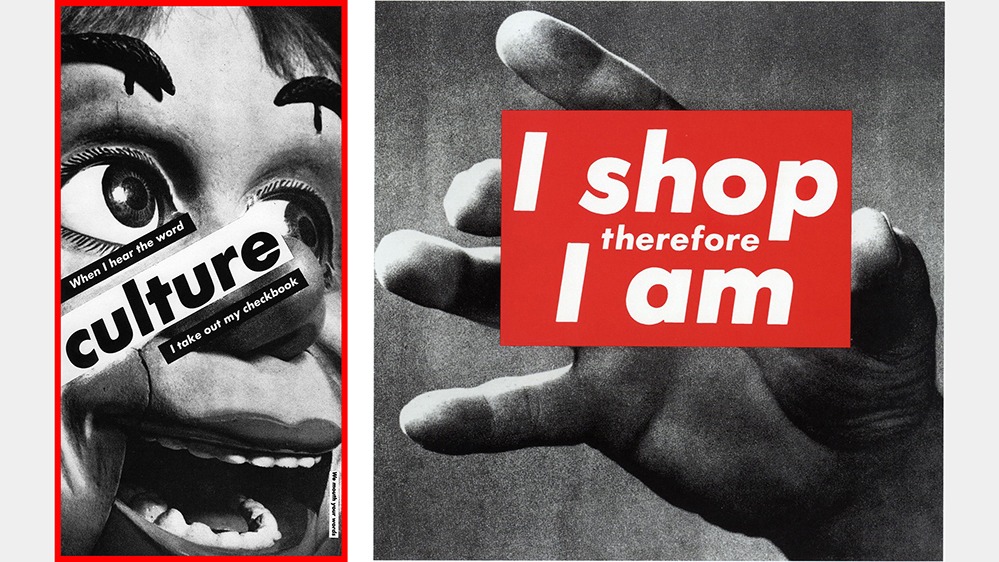
Judy Chicago, Miriam Schapiro and the CalArts Feminist Art Program, “Womanhouse,” 1972 Barbara Kruger, “Untitled (When I Hear the Word Culture, I Take Out My Checkbook),” 1985; “Untitled (I Shop Therefore I Am),” 1987 Barbara Kruger (b. Newark, 1945) briefly studied at the Parsons School of Design in 1965, but her real education was in the world of magazines. She dropped out early on to work at Mademoiselle as an assistant to the art director, rapidly became head designer, and then switched to freelance, conceiving layouts for House & Garden, Vogue and Aperture, among other publications. Through these projects, Kruger learned how to command the viewer’s attention and manipulate desire. A close reader of Roland Barthes and other theorists focused on media, culture and the power of images, Kruger brought her professional life and philosophical leanings together in the early 1980s with her iconic works: agitprop images of terse, satirical slogans in white or black Futura Bold Oblique type on close-cropped images primarily from old magazines. They confront gender roles and sexuality, corporate greed and religion. Several of the most well-known indict consumerism, including 1985’s “Untitled (When I Hear the Word Culture, I Take Out My Checkbook),” in which the words slash across the face of a ventriloquist’s dummy, and “Untitled (I Shop Therefore I Am),” from 1987.
Barbara Kruger’s “Untitled (When I hear the word culture, I take out my check book)” (1985); “Untitled (I Shop Therefore I Am)” (1987). Courtesy of Barbara Kruger Catherine Opie, “Self-Portrait/Cutting,” 1993 Catherine Opie, “Self-Portrait/Cutting,” 1993 image image Catherine Opie’s “Self-Portrait/Cutting” (1993). Courtesy of Regen Projects, Los Angeles, and Lehmann Maupin, New York, Hong Kong and Seoul image In her photograph “Self-Portrait/Cutting,” Catherine Opie (b. Sandusky, Ohio, 1961) faces away from the viewer, confronting us with her bare back, on which a house — the kind a child might draw — and two stick figures in skirts have been carved. The figures hold hands, completing the idyllic domestic dream, which, at the time was just that — a dream — for lesbian couples. This work and others responded to the national firestorm surrounding “obscenity” in art. In 1989, Senators Alfonse D’Amato and Jesse Helms had denounced “Piss Christ,” a photograph depicting a crucifix submerged in urine by Andres Serrano, which was part of a traveling exhibition that had received funding from the National Endowment for the Arts. A few weeks later, the Corcoran Gallery of Art in Washington, D.C. opted to cancel a show featuring homoerotic and sadomasochistic photographs by Robert Mapplethorpe, whose exhibition at the Institute of Contemporary Art at the University of Pennsylvania had also received federal funding. In 1990, the N.E.A. denied funding to four artists because of their explicit themes of frank sexuality, trauma or subjugation. (In 1998, the Supreme Court ruled that the N.E.A.’s statute was valid and did not result in discrimination against the artists, nor did it suppress their expression.) By creating and exhibiting these works when she did, Opie openly defied those looking to shame queer communities and censor their visibility in art. “She is an insider and an outsider,” wrote the Times art critic Holland Cotter on the occasion of Opie’s 2008 Guggenheim midcareer retrospective. “[Opie is] a documentarian and a provocateur; a classicist and a maverick; a trekker and a stay-at-home; a lesbian feminist mother who resists the gay mainstream; an American — birthplace: Sandusky, Ohio — who has serious arguments with her country and culture.”
Catherine Opie’s “Self-Portrait/Cutting” (1993). Courtesy of Regen Projects, Los Angeles, and Lehmann Maupin, New York, Hong Kong and Seoul


This post is an excerpt. Read the full article on the New York Times T Magazine website.
Stay engaged. Use #UCLAarts to stay connected.


