Susan Aparicio M.F.A. '22 Illuminates Memory Through Her Art
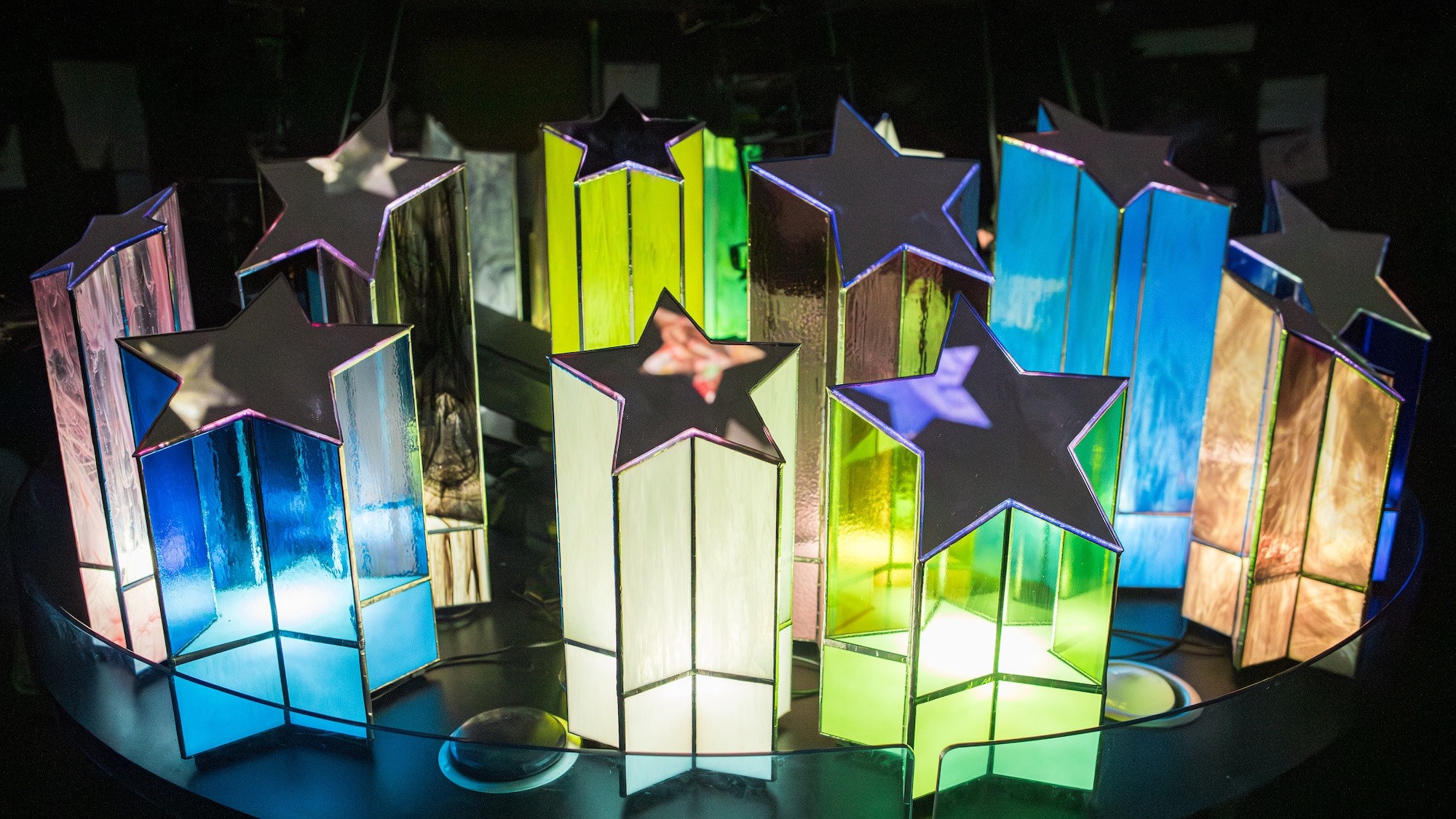
UCLA Arts alum Susan Aparicio M.F.A. ’22 is a visual artist from Southeast L.A. working across stained glass, experimental video, and site-specific installation. Her practice fuses the vibrancy of pop culture and Latinidad—a term that acknowledges the shared attributes of Latin American peoples without reducing those similarities to a single identity. Aparicio earned her M.F.A. from UCLA’s Department of Art in 2022, following dual B.A. degrees in Studio Art and Cognitive Science from the University of Virginia in 2018.
Aparicio recently exhibited at Junior High Los Angeles in Fantasma, a two-person exhibition alongside Monica Juarez. Both artists turned to childhood and nostalgia as sites of play and unease. Aparicio reimagined family photographs as connect-the-dots chain drawings, where figures and icons are both present and missing altogether.
This fall, Aparicio returned to UCLA to debut Millions of Dreams Ago at the UCLA Planetarium, with support from Los Angeles Nomadic Division (LAND). The multimedia installation brought together stained-glass sculpture and video: a series of star-shaped stained-glass forms reflected projected footage onto the planetarium’s domed ceiling, creating a constellation of moving images. The star-shaped projections featured digitized home recordings of Aparicio’s family made between 1995 and 2005—a period when her family, newly arrived from Mexico and Central America, were beginning their lives in Los Angeles.
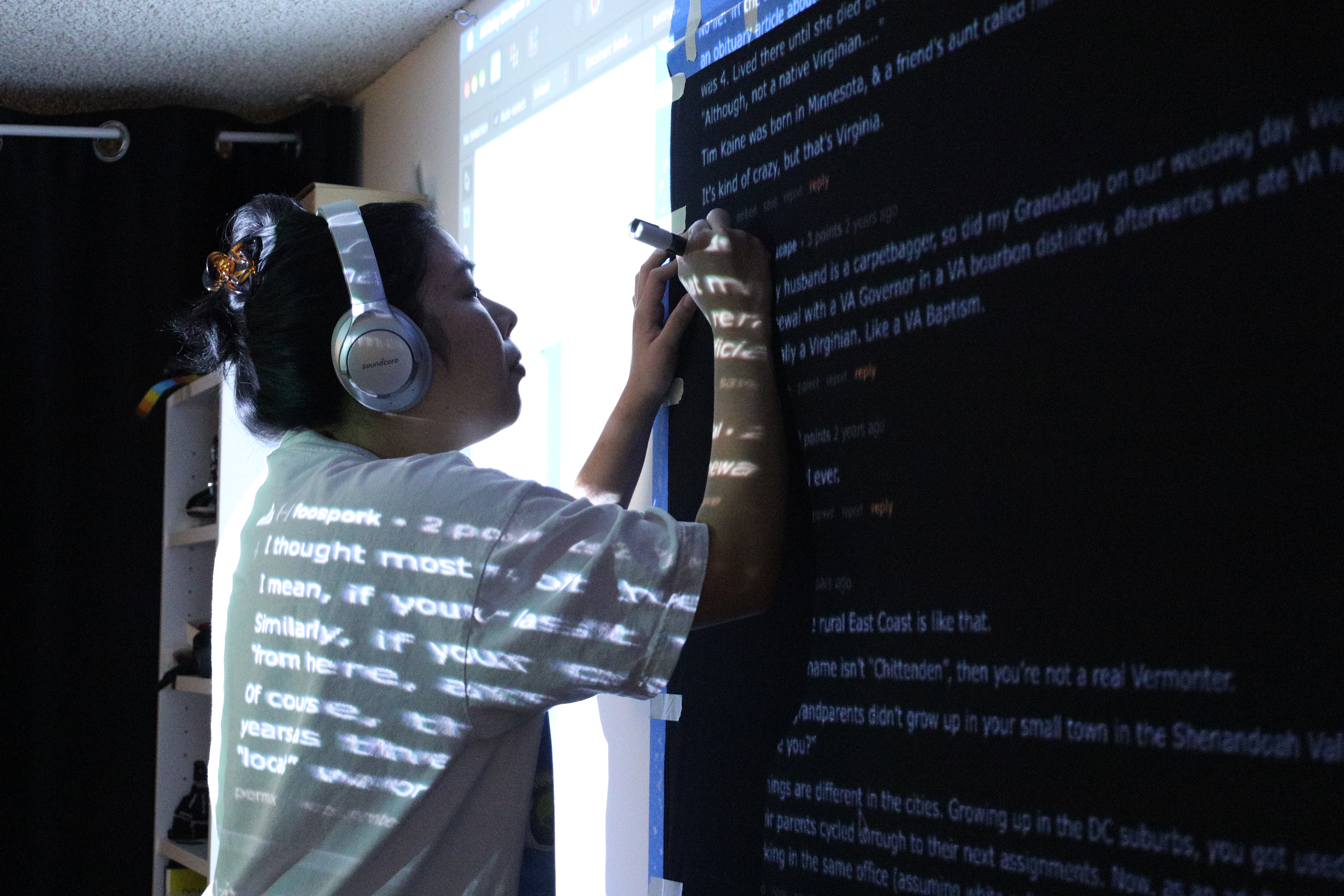
Susan Aparicio at work. (Photo by Peter Gunnarson)
What initially drew you to the UCLA School of the Arts and Architecture (UCLA Arts)?
I was drawn to UCLA’s interdisciplinary practice and values around experimentation across mediums in a studio setting. I wanted to push my installation practices in new ways, and the program made my ideas achievable, with support of a studio space, facilities, and a great cohort of artists and mentors. The M.F.A. art program at UCLA is also extremely tightknit, which helped us become deeply familiar with each other’s artistic practices, as well as have plenty of one-on-one time with faculty. I also grew up in southeast L.A., and it felt like an exciting opportunity to explore my practice close to home and family.
Looking back, what experiences at UCLA Arts most shaped your creative practice?
One of the impactful classes I took was called Living Objects, taught by Gabrielle Civil, which connected objects with culture, character, and storytelling. I’ve related this to my own interest in objecthood and how I recreate personal objects in glass.
In terms of professors, Vishal Jugdeo helped hone my installation practice, especially in experimenting with different forms of video work. Andrea Fraser also helped with my practice conceptually, using lessons from her psychoanalysis class and mixing that with perspectives of being an artist and human. It was also valuable to have feedback from so many fantastic visiting faculty from a wide range of professional artistic backgrounds. For example, rafa esparza ‘11 was critical to expanding my glass practice, and Sondra Perry helped me develop my video work.
My installation Cosmology of a Brown Sky was my first work that incorporated glass in an installation setting, which has informed how I scale my glass works to fill room-scale spaces.
Which skills or lessons from UCLA Arts have proven most valuable in your professional life?
In addition to the technical and artistic skills mentioned previously, UCLA Arts gave me a rich set of teaching experiences. It was valuable instructing undergraduate students on both technical skills and also artistic concepts, such as how to engage in a conversation with each other about their work. These teaching skills have been helpful in my continued teaching practice and giving instruction to a variety of levels of technical and artistic experience.
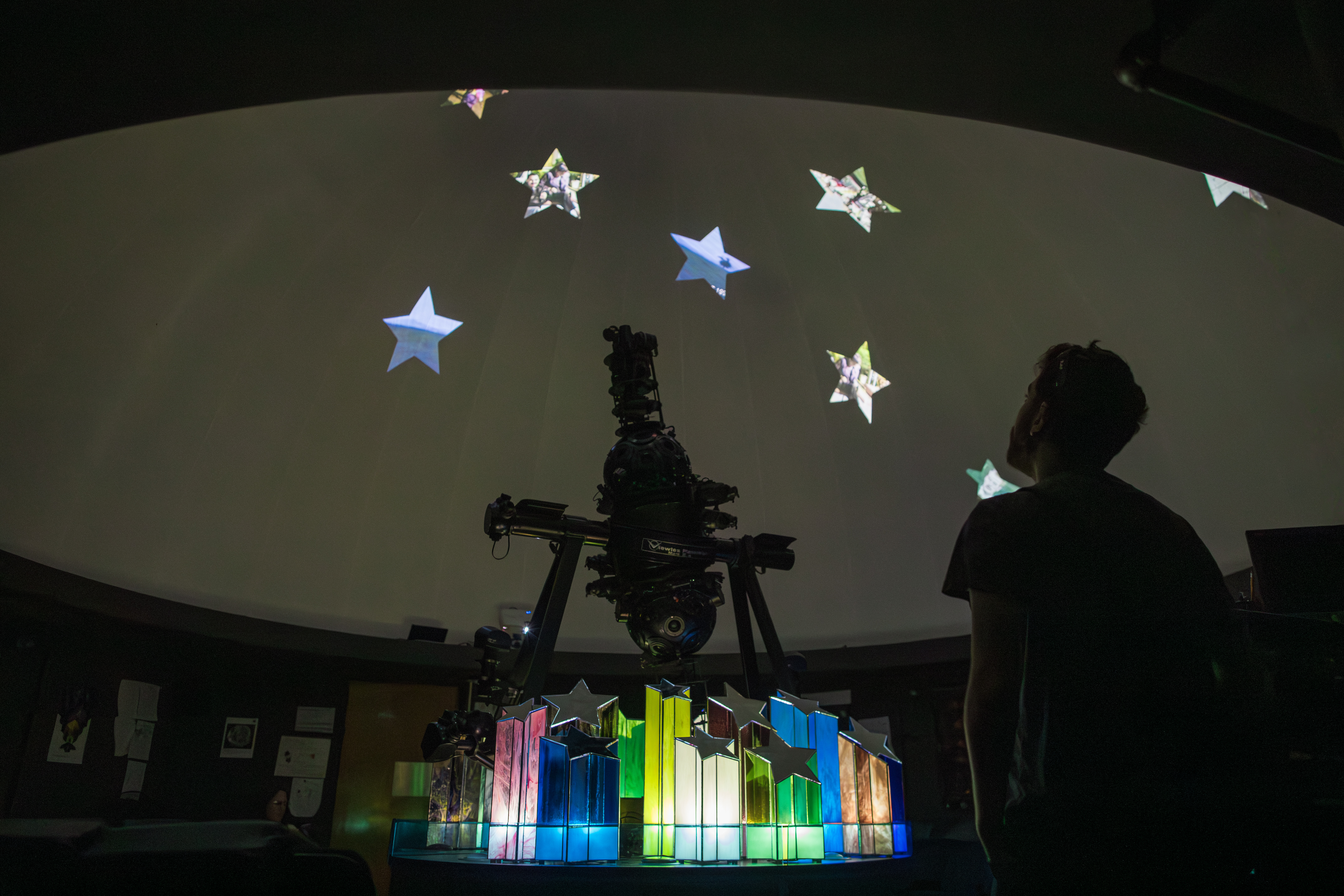
Millions of Dreams Ago was exhibited at the UCLA Planetarium on Sept. 13 and Oct. 11, 2025. (Photo by Gina Clyne)
Tell me about the development of Millions of Dreams Ago. When and how did you arrive at the idea? If you had any expectations, how did you hope viewers would react to the installation? How does this installation fit into your larger artistic practice?
I was inspired by the poetics of stars and being connected to the universe; how stars have a life cycle that mimics our own, and how that can be related to our time on earth and existing through light in the form of video and digital media. I imagined the specific point in time of the 2000s being preserved and reflected in starlight in a similar way to how humans tell stories through constellations. Here, the constellations are displaying a family memory. And how we see the light from stars as they were tens, hundreds, or even millions of years in the past.
I wasn’t sure how viewers would react, but a lot of viewers connected with their own families and memories of growing up. Given the challenges and uncertainties in the current moment, I think it triggered feelings of nostalgia and longing for joys in the past.
This installation is the synthesis of both my mediums of glass and video work, and how they can combine together in a space uniquely suited to highlighting both materials. It’s also related to my study of existence and objects around nostalgia and preserving culture of a specific point in time. This also connects to my practice of working with my family and home footage to explore our family culture and memory.
What kind of research went into developing this unique installation? I’m curious to learn more about the public discussion with your partner and collaborator, Peter Gunnarson, Robotics Researcher at the NASA Jet Propulsion Laboratory, and Leonardo Clarke, Astrophysics Ph.D. candidate at UCLA.
The biggest challenge was finding the right planetarium space to host the installation. I will be forever grateful to Leonardo and the Astronomy department at UCLA for not only allowing us to present the work there, but also being generous in giving us the time to test and install the work to best utilize such a unique space.
The design process for the installation required a strong technological foundation collaborating with Peter, involving 3D modeling and simulations to determine the angles of the projectors and star mirror surfaces so that the star reflections would fall across the entire planetarium dome. Unlike most art installations, the planetarium is a fully 360 degree experience, being viewable from any angle, which necessitated extensive planning and testing to make sure the lighting, projections, and star sculptures all worked together from any view. This “scientific” approach to designing the work felt suitable to being inside the planetarium and the Math Sciences building.
The public discussion involved Peter talking about his engineering and robotics background, and Leonardo discussing the use of the planetarium in educational ways. We talked about how this work uses the planetarium also in an educational way but instead about family stories and histories. The discussion was a good opportunity for people from an artistic background to ask questions to professional scientists and create a space for a shared wonder of the cosmos, with the curiosity about constellations and our futures in outer space, from both a societal and scientific perspective.
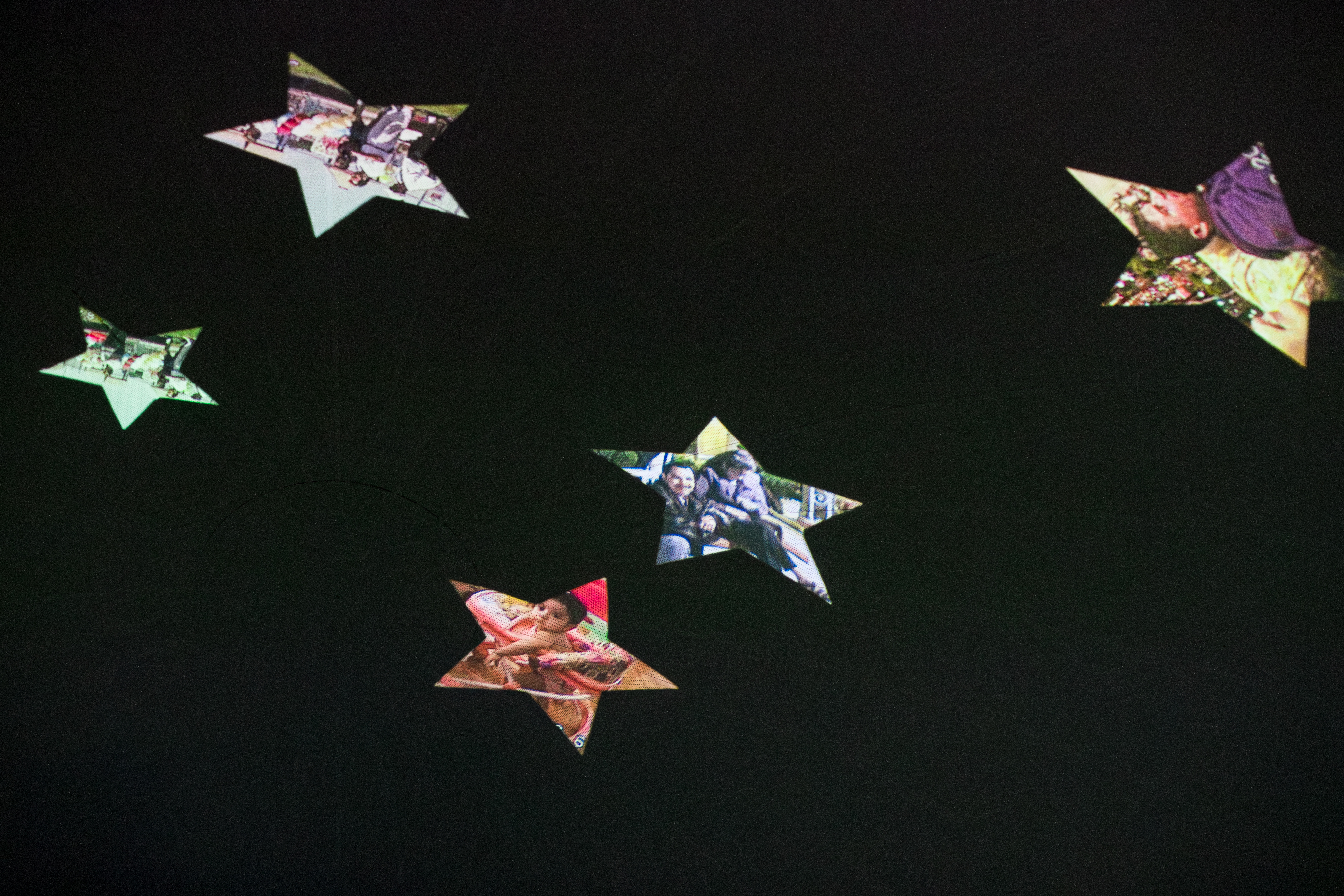
Aparicio's family footage was projected onto the planetarium’s domed ceiling, creating a constellation of moving images. (Photo by Gina Clyne)
What was it like to bring together the worlds of science and art with this installation? Is this a practice you hope to continue and develop?
I like that we can find a lot of symbolism in the scientific world, especially in the cosmological world. It’s inspirational to think of ideas like stellar remnants, or the unknown of outer space, as being the seed for conceptual artistic ideas. My practice continues to find inspiration in the beauty of stars and the skies. More generally, I think my work has an interest in the unknown and the beyond, and reflecting on our existence in different forms.
What advice would you give current UCLA Arts students who are preparing to launch their careers?
One thing that a UCLA art professor told me early on is that there are many different art worlds, even within a single city: DIY art, commercial art, artist-run spaces, non-profits, community-based spaces, high-end gallery art, and more. And so a big part of launching a career is finding an audience and community, and building your practice in the kind of art world you want to participate in. My advice would be to hone in on what you want out of your practice, and who you want to share it with.
Why is an education in the arts and architecture—and the pursuit of creative practice—so important today, perhaps more than ever?
I think it has always been important to have space for free expression and reflection of the times we are living in, and to always be evaluating the world and our place in it. Now, it’s especially important to create honest and open spaces for feeling and joy and anger, and for that to be a shared experience. Creating shared experiences bridges the different realities experienced by different people and cultures, and sharing a diversity of art and perspectives is important to forge a greater connection as we risk becoming increasingly fragmented as a society.
Header image: Close-up of stars in Aparicio's installation Millions of Dreams Ago. (Photo by Gina Clyne)
Stay engaged. Use #UCLAarts to stay connected.


