Studio Visit: Kim Truong
On a busy afternoon in between crits in December 2014, Kim Truong, UCLA Department of Art graduate s
Born in Hanoi, Vietnam, Kim spent her childhood in a country torn by war and unrest. With the end of the war, she became one of many Chinese-Vietnamese immigrants expelled from their homeland while awaiting asylum in Hong Kong's displaced person camps. Kim arrived with her family in the U.S. in late 1980.
Through her work with clay she understands the role and impact that her childhood experiences have played in the formation of her identity, personality and overall perspective on life. Her work has also provided her a means for processing her experiences, as she attempts to reconcile the clashing aspects of her Asian and American backgrounds while claiming ownership of who she is in her own right. After completing her education she plans to continue developing her art.
Julie Bills: Tell us about your background and how you found yourself at UCLA.
Kim Truong: I started my B.A. at Cal State LA after high school. I took art classes that I was curious about but didn't work on my GE courses, then dropped out. It took ten years before I was able to go back. After finishing my B.A., I went to Cal State Long Beach to learn ceramics and develop a portfolio to apply for grad school.
JB: Why UCLA?
KT: Because of the university’s resources and faculty. This is a program that is teaching me to think critically and strategically about the work that I am making.
JB: How does it teach you to think?
KT: What's nice about this program is that there are so many different voices. I grew up in an environment where I didn't know how an artist behaves; I didn't know what they look like. I remember as a little girl I always used to ask my mom, "Mom who are these people that did these paintings?" She would say, "Oh, those are different kinds of people." She was talking to me in Vietnamese. This was her way of saying, "That's not something you need to be concerning yourself with because we are not in that environment." At UCLA, I can be around all kinds of artists and thinkers.
JB: Where did you grow up?
KT: I have been in LA County since I was 12 years old but my family is originally from Vietnam.
JB: What was it like to grow up in Vietnam during the war?
KT: I was young, so I don't remember much. My mom and dad never really wanted to talk about it, but recently my mom and I talked about some of my childhood experiences. I told her that I have memories of a beautiful cave and travelling through the countryside. We lived in the city.
JB: Which city?
KT: Hanoi. I said to her, "I remember travelling through the countryside and seeing an ox for the first time. Was that my imagination or did that happen?" She said, "Oh yes, that was in 1972 when the U.S. was bombing Hanoi.” I looked up our U.S. military history, the final incident was “The Christmas Bombings” also known as “Operation Linebacker II.” My mom said we traveled to Quảng Bình Province to hide in a large cave during the bombing. When it was over, we came home. I looked up this cave. It is called Phong Nha Cave. It is now considered a national park, and is the largest cave in the world. There are U.S. tours that take visitors to the cave now.
JB: When you're reading these perspectives on the Vietnam War from the U.S. side, what feels foreign and what feels identifiable? Do you consider yourself a U.S. or Vietnamese national?
KT: When I first came here and people asked me, "Are you Vietnamese? Are you Chinese?" I thought, "I am Vietnamese and I am Chinese." When I'm around Vietnamese people, I really don't feel that I belong. When I'm around Chinese people, I don't feel that I belong either. In terms of identity, I see myself as a Chinese person born in Vietnam, but more American than anything else, now.
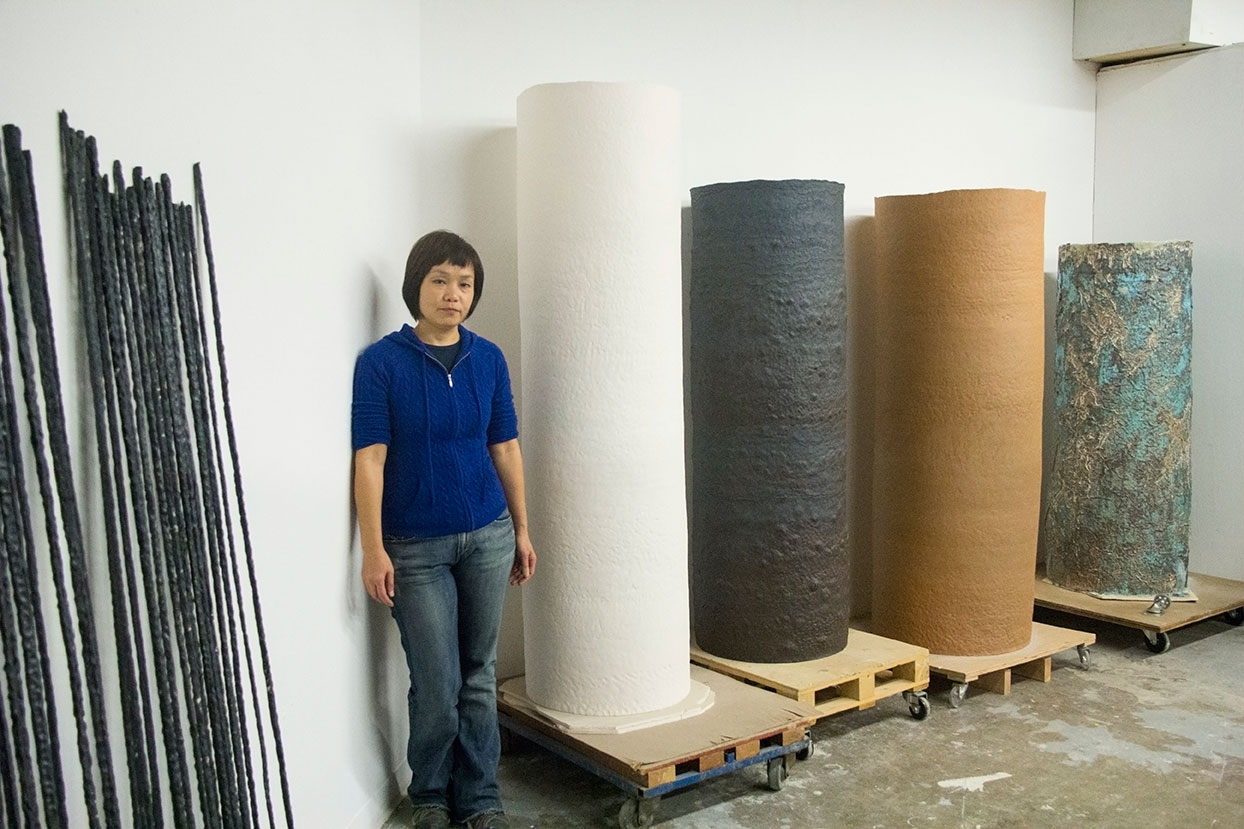
JB: Let's talk about what we're seeing in your studio. Tell us about these cylinders.
KT: These cylinders are human scale and I'm constructing a language.
JB: Experiential language?
KT: Yeah.
I think that leaving home to live with my dad's relatives to learn Mandarin was a language shift. When I was living in Hong Kong, learning Cantonese, that was another shift. There were shifts from Vietnamese to Mandarin, and then to Cantonese. Then I came over here and started learning English. I never really grasped the foundation of these languages. I don't know if I really understand English all that well either [laughs]. Making objects for me is a way to build a language.
JB: Are you communicating something specific through these, or are you offering this “language” as a tool for people to express themselves?
KT: I am not communicating something specific but it is a window into human relationships. My background, my history, informs the work. That's not necessarily what the work is about. One good thing about shifting identity and shifting languages is that, as old as I am, I'm still open to ideas and I'm open to different perspectives that other people bring up instead of just closing up and saying, "That's it." I hope to provide the spectator experiences that are different than they came with and that their engagement with the work generates subjectivities in thoughts and sentiments.
JB: Do you view all of these as one piece?
KT: Each object is like an alphabet. When combined, they could be a word, a sentence or a paragraph and so on.
JB: You sound like a poet, selecting each word independently for a specific artistic end and then viewing the poem as a total work.
KT: Right, so it is individual but then a smaller group and then a bigger group, and so on.
JB: Sounds like semiotics; iterations of a language analyzed on a structural level.
KT: I came across some interesting ways to organize my thoughts from Steven Pinker, a well-known experimental psychologist and linguist. He talks about language and their structures and relationships.
JB: What's next for you?
KT: Completing this work. I am going to try and finish writing my thesis before I make more. I want to make two more cylinders, so I would have five.
I have one last quarter after my thesis show, I TA that quarter, and I'm going to make some new work. I have been looking into ways of making them without using the kilns. There are different types of plasters that I would like to try, although it will never have the same sense of permanence as this work. I think that when I'm forced to change my environment, usually something interesting comes out of that. I always try to make the best out of what I have. I'm kind of looking forward to that too.
Julie Bills is an art consultant and writer living and working in Los Angeles, CA.