Students from across U.S. test programming skills, creativity at LA Hacks
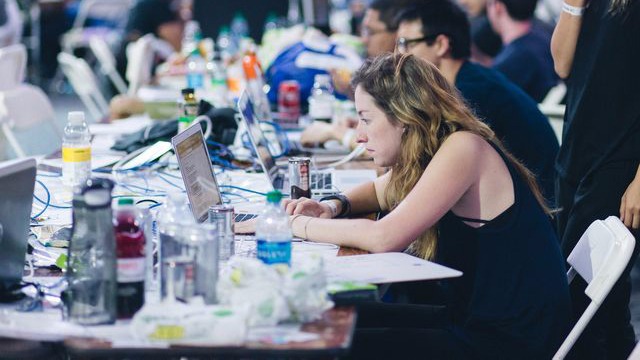
Student programmers worked intensely around the clock throughout this past weekend at Pauley Pavilion and competed in a range of categories at the third annual LA Hacks.
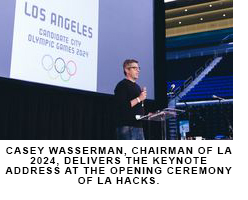
More than 1,000 high school and college students from across the United States descended last weekend on UCLA’s Pauley Pavilion to plug into LA Hacks, a collaborative computer programming event organized by two UCLA student groups and sponsored by LA 2024, the organization leading L.A.’s bid to host the 2024 Olympics.
Beginning on Friday and ending Sunday, student programmers worked around the clock on software and hardware to work on projects in a range of categories, including sports entertainment and fitness, at an event that offered prizes to the winners. This was the third annual LA Hacks, organized by Bruin Entrepreneurs and Sigma Eta Pi, two student groups for entrepreneurs at UCLA.
Throughout the weekend, students from universities all over California as well as institutions in Zurich and Toronto, attended tech workshops; an exclusive screening of HBO’s “Silicon Valley” with appearances by cast members Josh Brener and Amanda Crew; tech talks; and panel discussions featuring U.S. Olympians and tech industry leaders, among others.
“As an Olympic superfan with a keen interest in seeing the games engage my generation, it was a privilege to partner with LA 2024 for LA Hacks 2016,” said UCLA junior Ashvin Vinodh, a computer science major and the executive director of LA Hacks. “LA Hacks is all about providing students with the resources they need to push their minds to the limit and build something amazing.”
Jason Spielman, a UCLA junior majoring in design media arts, served as chief of design at the event. "It's always really inspiring to see the remarkable innovations that everyone is able to create in only 36 [hours]. This year, it felt like many of the hackers focused on building things that make our community and world a better place, which was really awesome to see. A few of the top 10 included a mobile application to help the blind understand their surroundings and a smart water meter that monitors water flow to encourage water conservation." — May 2, 2016

Read the full article at the UCLA Newsroom website.