Student Spotlight: Peijing Mou
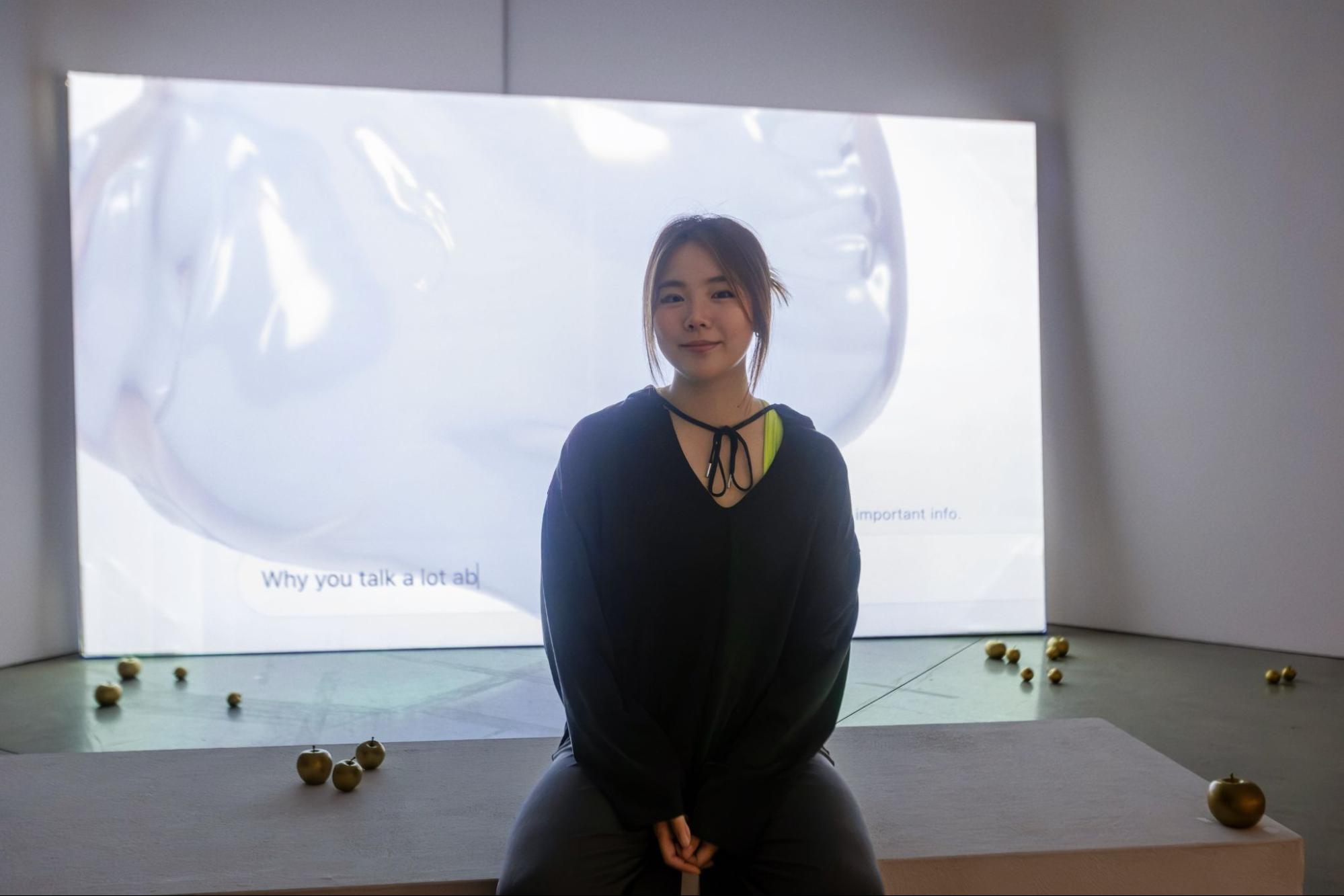
Peijing Mou has been keeping busy.
In 2026, she was a finalist for the Lumen Prize and won a graduate student award in the ACM SIGGRAPH Digital Arts Speculative Futures Competition. In September, she presented at the Ars Electronica Festival’s Expanded Conference in Austria. And next week, she’s presenting her project (Un)Natural Language at the International Symposium on Electronic Art in Dubai.
Mou is currently pursuing an M.F.A. in Design Media Arts, having come to UCLA from City University of Hong Kong, where she studied media arts. After graduating, she began exploring the relationship between machine learning and ecology. For Mou, resisting ecological violence embedded in social development is of the utmost importance.
“It’s ridiculous that [people see] the mountains, sea, and animals as resources,” said Mou, who characterizes her work as addressing “threatened ecologies.” This perspective is central to Trout Telephone, an art installation that challenges the idea that the natural world exists merely for human exploitation.
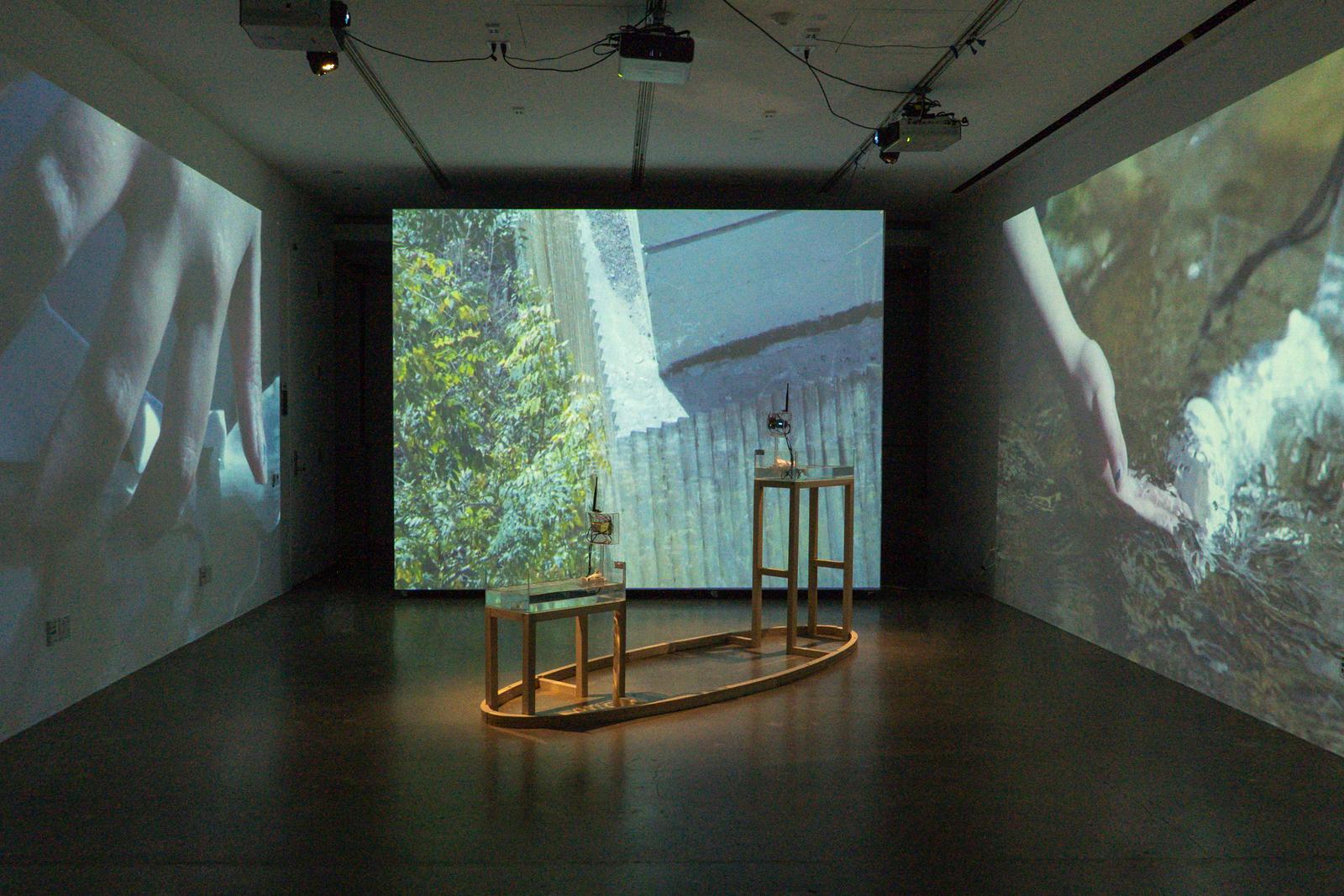
Installation view of Trout Telephone. (Courtesy of the artist)
For millennia, trout have inhabited the Arroyo Seco watershed, which stretches from the San Gabriel Mountains to downtown Los Angeles. Since 1920, Devil’s Gate Dam, on the border of Pasadena and La Cañada Flintridge, has interrupted trout migration between the river and the sea.
Visualizing this separation, the work places two mechanical trout in separate, self-contained pools, one upstream and the other downstream. The sculptures are linked through a telematic network that creates a call-and-response system between the two fish. A trained artificial intelligence model detects one trout’s presence in real time and transmits that information to its counterpart, causing the servo-driven sculpture to swim in an ultimately futile attempt to reach the other.
“Trout living in the city can sense clean water, which is where they want to spawn. They have migration patterns in their genes, but they cannot do it anymore,” said Mou. “It’s a huge sadness.”
What began as a research project in 2023, (Un)Natural Language is a computational system that examines how words shape ecological narratives. Using a custom-labeled dataset and a machine-learning model, it analyzes government water-related project documents to detect potential environmental threats hidden in bureaucratic language. In doing so, it identifies and visualizes environmentally harmful patterns of discourse.
“Through research, I became acutely aware of greenwashing language used in public documents and how this language influences peoples’ thinking,” said Mou. “I started thinking about whether I could develop a language model that detects problematic language, like pro-growth and ecologically dominating, so people can become aware of how companies use these narratives.”
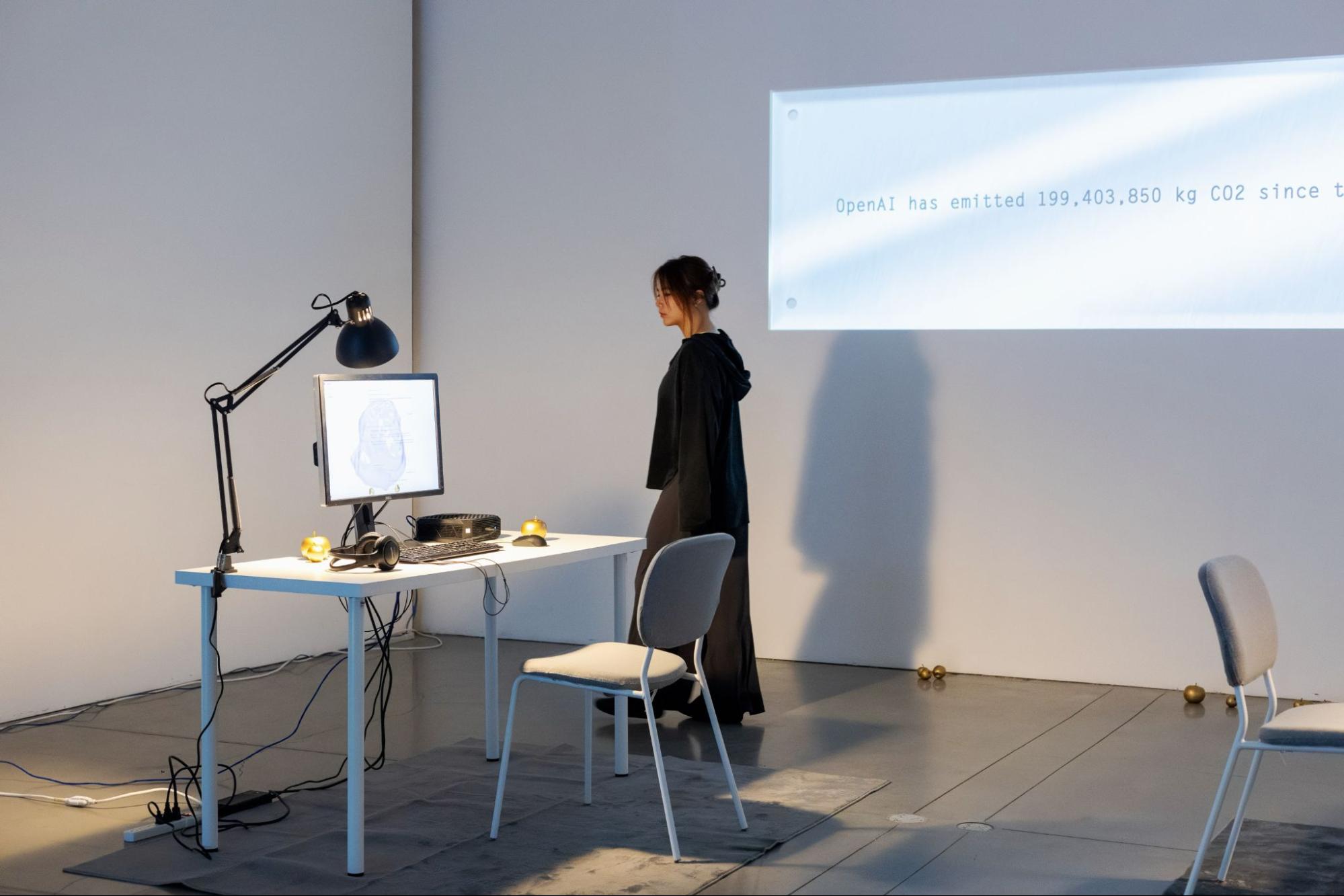
Mou looking at her installation Eris Eris in UCLA’s New Wight Gallery. (Nate Chang / UCLA Arts)
Her latest project, Eris Eris, was developed at UCLA and recently exhibited at the New Wight Gallery in Broad Art Center. The project emerged from research into protests against data centers in Alaska. The installation examines the environmental costs of artificial intelligence through a browser extension that disrupts users’ interactions with ChatGPT—a fitting approach, given that Eris is the Greek goddess of strife and discord.
“Right now, we use AI every single day, but the ecological price for each request is expensive,” said Mou.
With every prompt, the web extension reminds users of the environmental impact of their requests. “Are you sure you need to use AI for this?” it might ask. Eventually, the goddess herself appears as a floating head, rendering the clean interface unusable.
“I want to remind users of AI’s impact on the physical world,” said Mou, “to sabotage the relationship between user and AI, and to disrupt OpenAI’s operations.”
The installation also tracks the amount of carbon dioxide emitted by ChatGPT parent company OpenAI since the exhibition’s opening. According to Mou’s tally, by closing day, OpenAI had emitted more than 199,000,000 kilograms of carbon dioxide—an astonishing number given the exhibition’s one-week run.
It should come as no surprise that Mou’s work has garnered so much attention: it’s thought-provoking, while also bringing humor to critical inquiry. Ultimately, Mou wants to remind us that the digital world remains inseparable from the natural one. And with technology continuing to evolve at an exponential rate, she’s not running out of targets anytime soon.
Header image: Peijing Mou poses in front of her installation in UCLA’s New Wight Gallery. (Nate Chang / UCLA Arts)
Stay engaged. Use #UCLAarts to stay connected.


