Student-created video game to raise questions about relationship between art, AI
The UCLA Department of Design Media Arts offers a comprehensive, multidisciplinary approach to media creation that fosters individual exploration and innovative thinking. DMA is committed to educating conscientious creators by emphasizing production within the contexts of history and theory. Two undergraduate students in Design Media Arts have collaborated on an upcoming video game that will question whether artificial intelligence can create works of art.
"Players of an upcoming video game can encounter a humanoid robot in a virtual art factory.Currently untitled, the game is a collaboration between Jingjie Chen and Jumo Yang, fourth-year and third-year design media arts students, respectively. Chen and Yang met in design media arts associate professor Eddo Stern’s world building class, and at the end of which they decided to design a game together as an independent study project under Stern’s guidance. Chen said the team is currently developing the factory space for the 3D game and hopes to create a narrative with themes that underscore a possible relationship between art and technology.
“We want to raise the question (of) whether art is a privilege of … humans, or can robots and artificial intelligence make art and appreciate art?” Chen said.
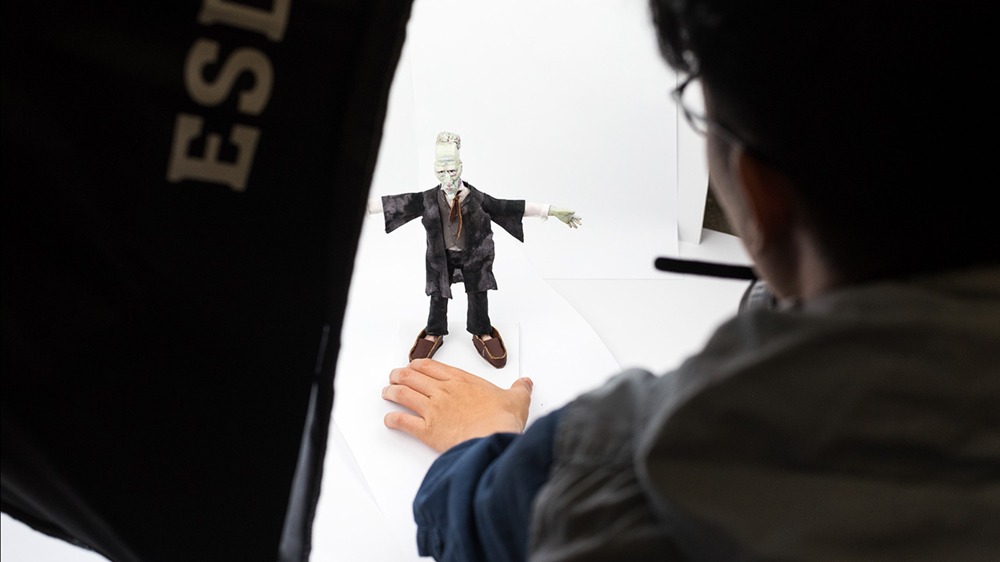
To create the game, the team utilized photogrammetry, a technique in which handmade sets or objects are built, scanned and formatted into a 3D model on a computer, Chen said. The students were drawn to the handmade aspect of the craft after discovering games like “Harold Halibut,” which utilized photogrammetry, she said.
“We were always working in digital for all of our projects, and we think there’s something precious about the imperfections of handmade stuff. … There’s some things that can’t be replicated in 3D modeling,” Chen said. “Since our theme is about machines making art and people making art, this whole process (in which) we handmade something and the machine helped us to make some (models is) a collaboration between people and machines.”
Before making sets by hand, such as that of the factory, the pair had to figure out how to preserve the imperfect aesthetic of handmade objects even after they have been scanned into a 3D model, Stern said. In order to retain the aesthetic, he said the two decided to deliberately make their sets flawed by, for instance, leaving tape on objects when they are scanned.
At a certain point in the game, players will encounter the factory owner, a robot disguised as a human. In the conceptualization stages, Yang said he and Chen conceived the robot to be a famous art dealer who owns the abandoned factory and wants to change people’s taste in art. By playing the game, players will learn why the robot is interested in art and why he wants to change the culture behind it, he said.
Although the game approaches the question of whether artificial intelligence can create art, Chen said she does not plan to propose an answer in the game. By interacting with the factory and the virtual environment while following along with the game’s narrative, players will be encouraged to start thinking about the topics without necessarily considering an answer, she added."— Anushka Jain, Jun. 6, 2018

This post is an excerpt, read the full article on the Daily Bruin website.
Stay engaged. Use #UCLAarts to stay connected.


