‘Stones to Stains: The Drawings of Victor Hugo’ Review: A Writer’s Other, Haunting Talent
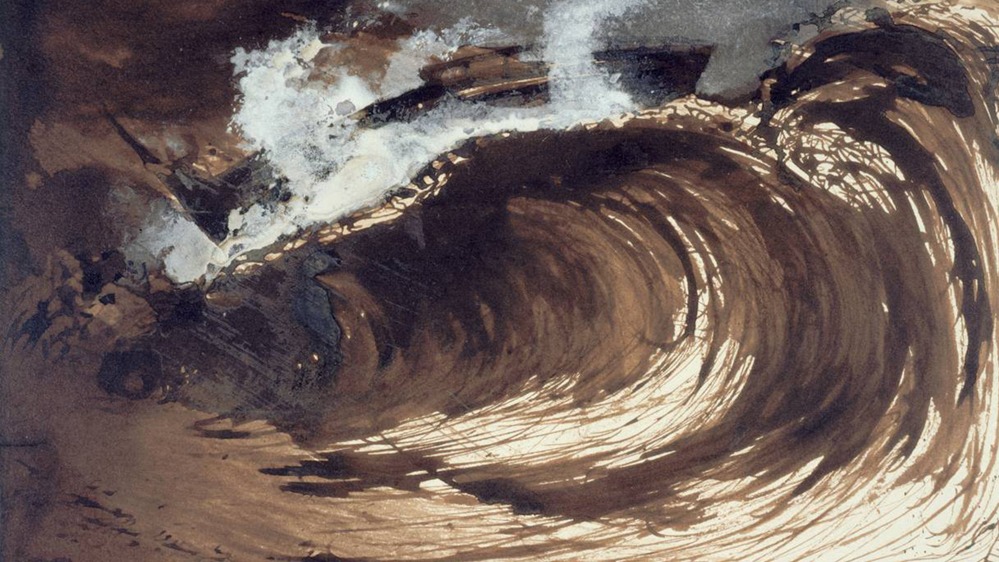
"For those of us of a certain age, the name Victor Hugo (1802-1885) conjures a vision of the cruel Inspector Javert pursuing a beleaguered Jean Valjean through the sewers of Paris in the novel “Les Misérables,” which we were required to read in high school. Hugo was also a politician and an artist, and “Stones to Stains: The Drawings of Victor Hugo,” the startling, poetic exhibition at the Hammer Museum—including over 70 of his drawings and prints, plus some ancillary photographs—demonstrates that he was a great artist.
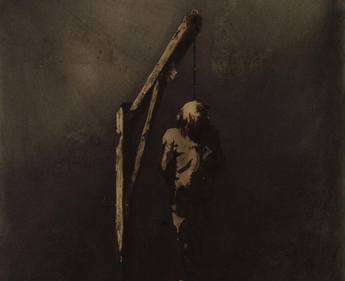
Victor Hugo’s ‘Ecce Lex (Hanged Man)’ (1854) PHOTO: MAISONS DE VICTOR HUGO, PARIS/GUERNESEY/ROGER-VIOLLET Hugo was elected as a writer to the Académie Française in 1841; seven years later, as a politician, he was elected a deputy from Paris to the Constituent Assembly. In short order, he became a leader in the unsuccessful resistance to Louis-Napoléon’s coup d’état, which led to his formal expulsion from the country in 1852. He and his family (Hugo’s marital life was complicated) spent the next 18 years in exile in the Channel Islands. Hugo had an opportunity to return to France in 1859 but, because he still disapproved of the government, didn’t come back to his country until he returned, “triumphantly,” in 1870.
Although Hugo tinkered with drawing prior to his exile (at least six works in the show predate it), only on Jersey and Guernsey did his draftsmanship come into its own. The “stones” of the show’s title are at once protective and destructive, alluding to books as well as tombs and dungeons; “stains” are the principle physical vehicle for Hugo’s proto-abstract Romanticism—a kind of combination of Caspar David Friedrich and Robert Motherwell. Whorls and fogs of dark-brown ink surround snippets of realism—castles, moons, boats, heads—in an imaginary world that’s both dreamy (“Medieval Fortress,” 1863) and menacing (“Ecce Lex [Hanged Man]” 1854), nocturnal (“The Casquets Lighthouse,” 1866) and daytime (“The Town of Vianden Seen Through a Spider Web,” 1871).
If Hugo’s aesthetic and psychological treatment of his subjects isn’t astonishing enough, his command of a variety of media is equally impressive. In “Landscape With Two Derelict Castles” (1847), he uses ink, crayon, graphite and shellac rather seamlessly. In “Taches-planètes” (1864-69) Hugo employs some solvents and gum arabic, and then, in a presciently avant-garde approach to his media, soaks, blots and folds the paper to get a cosmic effect that’s almost entirely abstract. (One work in the show, “Abstract Composition,” 1864-69, is obviously—and miraculously—totally abstract from the git-go.) Elsewhere, Hugo uses cutouts and collage, frottage (i.e., rubbing) with matches and sticks and the ends of his pen handles, and a “pyrographed” wooden frame. (In Cub Scouts, we called that woodburning.)
Hugo drew with a deceptively solid sense of composition, an eye for crucial details, and a deft, lovely touch with ink that can be mentioned in the same breath with Rembrandt’s. There’s no record of Hugo having attended an art school and, though he did consent to having some prints made, bound and offered for sale (unsuccessfully, as it turned out), he mostly held his drawings close to his vest while he was alive. They weren’t publicly exhibited until 1888, three years after his death. During his banishment from France, however, Hugo left behind some works for others to see in the apartment of a friend, Paul Meurice. About them, the critic Théophile Gautier said, “He excels at combining, in his somber and fierce fantasies, the effects of chiaroscuro of Goya and the terrifying architecture of Piranesi.” —Peter Plagens, October 29, 2018


This post is an excerpt. Read the full article on the Wall Street Journal website.
Stay engaged. Use #UCLAarts to stay connected.


