Staff Spotlight: Jason Corbett
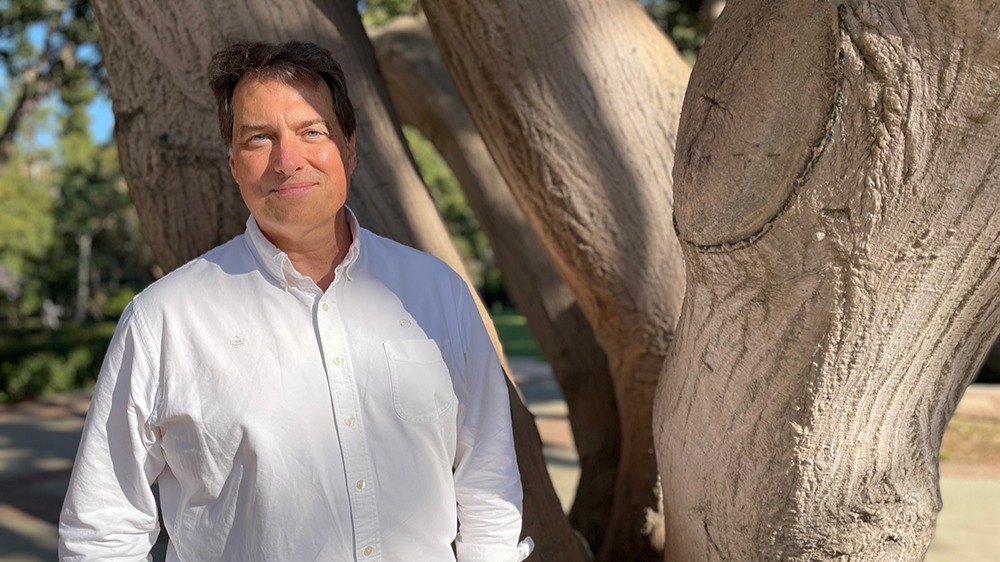
Get to know the people who help lead the school in this series of interviews with UCLA Arts staff members. Want to nominate a staff member for the series? Email communications@arts.ucla.edu.
Jason Corbett is UCLA Arts’ outgoing Director of Operations. After 31 years of service to the university, including nearly 14 years at the School of the Arts and Architecture, Jason retired on June 29, 2021. Jason joined the Dean’s Office in late 2010 after serving as Management Services Officer (MSO) for the Department of Design Media Arts for 3 years. Prior to joining the school, Jason served as MSO in the Department of Geography and at the Dodd Humanities Group.
As a senior member of the Dean’s Office, Jason has played a critical role overseeing major renovation and facilities projects, researching and analyzing programmatic, equipment and infrastructure requirements, and developing project planning guides for major improvements. He was instrumental throughout the UCLA Margo Leavin Graduate Arts Studios capital project, and has been part of the team that is leading the UCLA Nimoy Theatre capital project. Jason has provided coordination and leadership for numerous special projects and programs, including the school’s annual commencement ceremony, and has worked closely with students and faculty providing guidance and support for their research and creative activities, including exhibitions, lectures, and performances.
Jason’s leadership, optimism, and experience has guided the school through the COVID-19 pandemic. He has served on numerous campus-wide committees and ensured that the priorities of our students, faculty, and staff have been considered throughout the response and recovery stages of campus planning.
In June, with his retirement just around the corner, we caught up with Jason and asked him to share some thoughts about his time at UCLA.
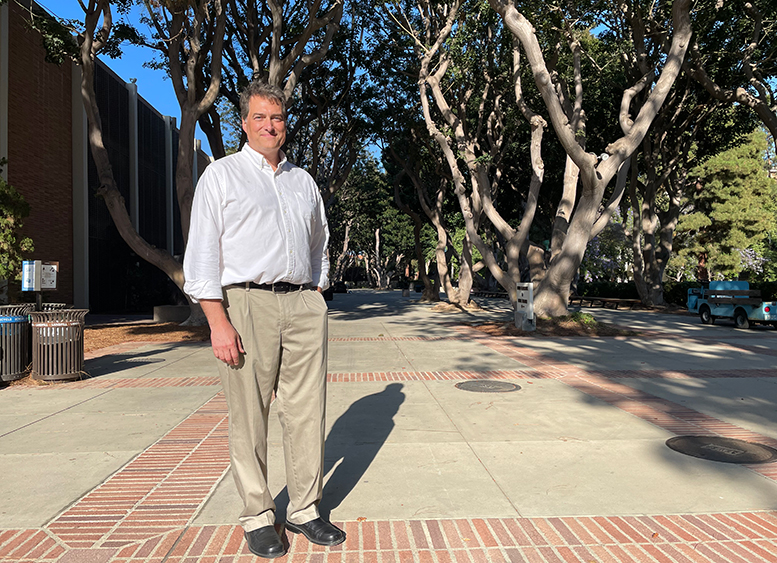
Jason Corbett stands in the UCLA Franklin D. Murphy Sculpture Garden. Photo by Avishay Artsy.
What brought you to UCLA?
I graduated from college into a full-fledged recession in 1981. It was difficult to find work, even for people who knew what they wanted to do, which certainly wasn’t me. I was someone with a degree in filmmaking who didn’t want to go into the film business, and my lingering indecision about what to pursue eventually led me to work for five years as an underwriter in the mortgage banking industry. (Banking…egads! What was I thinking?) Then one day, as a result of a connection through my alma mater’s alumni network, I was fortunate to meet an academic administrator at Cal State Northridge. The lengthy conversation we had led me to consider a career in university administration, which brought me to UCLA in 1988.
What drove you to work at an art and architecture school?
Well, to be honest, I was simply looking for a new position on campus at the time and discovered that there was an opening for a department manager in World Arts and Cultures/Dance. I read up on the department and was truly impressed by the kinds of things they were doing. So, I applied for the position, had a very positive interview, and ended up being one of the finalists.
Unfortunately, World Arts and Cultures/Dance hired someone else.
Happily, though, the school’s Associate Dean for Administration, Pat Baxter, called me up a couple of days later and asked if I’d be interested in applying for the manager’s position in the Department of Design Media Arts. Apparently, they were having some difficulty finding a suitable candidate, and Pat thought my experience might prove to be a good match for the department and for its new faculty chair. It turned out to be a happy marriage, and I thoroughly enjoyed my three years with DMA. It also gave me a chance to learn more about the remarkable things that the faculty, students, and staff in our other departments were doing, which ended up serving me well when I eventually became the school’s operations director.
What are some highlights from your time at UCLA, and what will you take with you?
There’s a peculiar kind of emotional mix that settles over the campus as spring quarter finals week concludes and we gear up for commencement: a kind of exhausted calm combined with an excited anticipation. I will always remember that walk through the Sculpture Garden from Broad Art Center to Dickson Court on my way to set up our school’s commencement ceremony. Invariably, it’s sunny and hot that afternoon (the blessedly cool relief of June gloom mysteriously seems to vanish on the day of our event), and it’s always a scramble to get everything ready in time for our late afternoon celebration. Months of preparation and planning have all been distilled into a heart-stopping 90 minutes of music, speeches, laughter, and tears. It goes by so quickly that you wonder if all the fuss was worth it – until you see parents positively beaming as their child becomes the first member of their family to graduate from college; grandparents hugging their graduate and grateful that they’ve lived to see this day; little kids running pell-mell for the refreshments at the end of the ceremony.
However, without exception, the two most memorable moments from my time at UCLA are the day I first met my future wife (we worked together for a short time in the same Gayley Center office that was leased by a small unit within the Graduate School of Education), and watching the birth of our son at the old UCLA hospital on campus.
What's something that's totally changed since you began working at UCLA?
There’s no doubt that the use of computers in all aspects of university life – academics, research, and administration – has completely transformed the way in which we all conduct our work. Simply put, there was an era before computers and an era after computers.
I can still recall a time when an older faculty member approached me one day in the early-1990s and asked if there was still a typing pool somewhere on campus. For those too young to know what a typing pool is, this was a collection of staff members (historically comprised predominantly of women) whose primary job was to type up the handwritten notes of faculty members (many of whom had never learned how to type) in preparation for lectures or the submission of research papers for publication.
Needless to say, the faculty member looked rather crestfallen when I informed him that the typing pool had gone the way of the dinosaurs several years earlier.
Speaking of typewriters, many colleagues across the school and campus may not know that you are an avid collector of old typewriters. Can you tell us a little about this passion and where it might take you in retirement?
Back in 2007, my young son asked for an old mechanical typewriter for his birthday, so I began to search on eBay for something suitable. We ended up buying him a 1930s Smith Corona typewriter from one of the last typewriter shops in West Los Angeles, but my online search got me hooked on learning more about these mechanical marvels.
Over the intervening years, I’ve purchased numerous machines from online sellers, at flea markets, and in thrift shops. One of my favorite typewriters is a gleaming black Royal Model 10 that was built around 1937. This standard-sized typewriter was designed to sit on an office desk. It’s built like a tank (weighing just a few pounds less!), and striking its glass-topped keys produces a wonderfully mellow staccato tappety-tap on the paper as it hugs the rubber platen. Each typewriter has its own distinctive touch and sound, so it’s easy to understand why people who enjoy using typewriters will often spend months searching for just the right machine that suits their particular sensibilities.
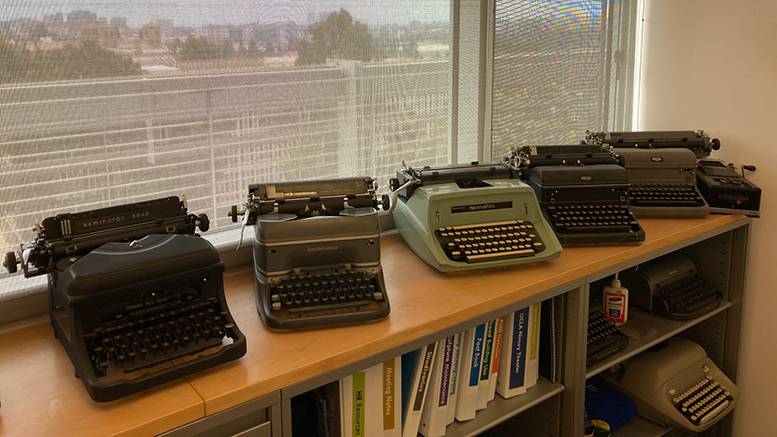
Just a few of the typewriters in Jason’s collection. Photo by Jason Corbett.
There are more than 2,000 individual parts that go into a mechanical typewriter, and the machines that were manufactured up to the early 1950s were comprised mostly of steel. Thus, with proper care, these precision instruments will likely still be working properly during the lives of our great grandchildren. I doubt there will be many iPhones or tablets produced today that will be able to make the same claim.
I expect to be spending many hours in the coming years hunched over a grease-stained table repairing and restoring my collection. The nice thing about working on a mechanical device is that you know immediately if your efforts have been successful or not – it’s the very definition of instant gratification!
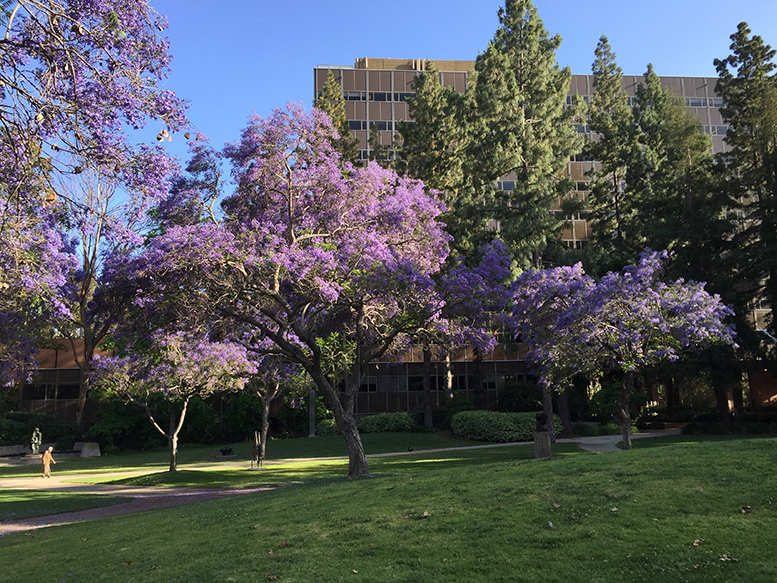
Jacarandas in bloom in the UCLA Franklin D. Murphy Sculpture Garden. Photo by Jason Corbett.
What's your favorite place to visit on campus?
When my son was applying to colleges, we visited numerous institutions throughout the east coast. Each campus had its own distinctive look and feel, and I couldn’t help comparing the overall quality of the landscaping to what we have at UCLA. I have to say that our campus is arguably the most beautiful that I’ve ever seen.
My particular favorite spot would have to be the Sculpture Garden in mid-June. The sycamore trees are full and green (in fact, I’m always surprised to see these trees when their leaves aren’t yellow-brown), and the jacarandas are in the full splendor of their violet bloom, which somehow seem to glow even more spectacularly on a gray, overcast June gloom day.
Stay engaged. Use #UCLAarts to stay connected.


