SITI Company and Ann Hamilton set sail for Virginia Woolf's 'To the Lighthouse'
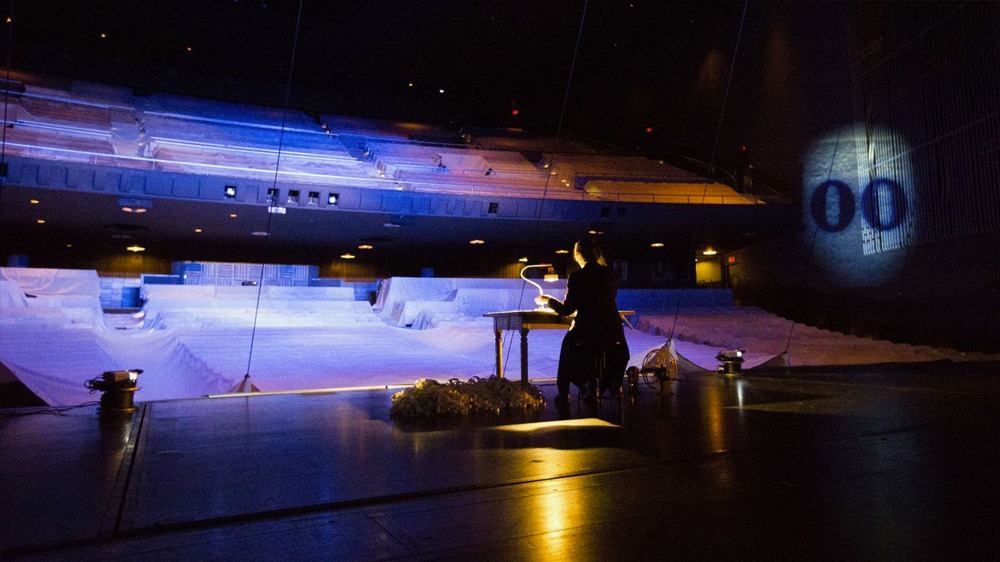
the theater is a blank page, a much-heralded collaboration between the Saratoga International Theater Institute (SITI) Company and celebrated visual artist Ann Hamilton, presented at Royce Hall by the Center for the Art of Performance at UCLA. This immersive performance installation utilizes the entirety of the theater, as the audience is led through the balconies, to the production shops, into the wings and finally onto the stage itself. With text drawn directly from Virginia Woolf’s 1927 novel To the Lighthouse, the novel’s evocative language and inventive narrative make it a fertile point of departure for artists of different disciplines to find deep kinship in a collaboration addressing the experience of reading and being read to. the theater is a blank page will be at Royce Hall April 28–May 12. Find more information and purchase tickets here.
"The solitary act of reading becomes a shared activity in “the theater is a blank page,” a graceful collaboration between visual artist Ann Hamilton and SITI Company, director Anne Bogart’s avant-garde troupe.
At the center of this immersive performance installation, an interdisciplinary offering presented by UCLA’s Center for the Art of Performance, is Virginia Woolf’s “To the Lighthouse.” Theatergoers, divided into small groups (attendance is limited to 90 people overall) are guided to different parts of Royce Hall, where Woolf’s 1927 novel, one of the glories of literary modernism, is summoned in a theatrical séance.
Hamilton constructs different spaces through the scenic manipulation of simple materials such as white fabric, brooms and shredded paper. Brian H. Scott’s hypnotic lighting, inspired by the book’s island setting, creates effects that merge sea and sky. Darron L. West’s soundscape complements the Neptune-like environment with an ocean of strange sounds and sweet melodies.
Bogart, who co-directed with Hamilton, orchestrates these scenes with her usual geometric care. But the spirit of the production is relaxed and communal. At the start of the piece, we watch from the topmost seats in the mezzanine (most of the rows are covered in sheets) as ensemble members slowly prepare the stage.
We are witnesses, in effect, to the act of creation, a central theme of “To the Lighthouse.” The relationship of chaos, the reality we inhabit, to form, the imposition of order and meaning through creative vision, is explored in the book through the minds of the characters — artists and intellectuals and those who love them — gathered at Mr. and Mrs. Ramsay’s vacation home in the Hebrides.
Theatrical performance, a more ephemeral art than literature, crystalizes Woolf’s idea that the nobility of artistic expression doesn’t lie in its enduring revelation. (“The very stone one kicks with one’s book will outlast Shakespeare,” thinks Mr. Ramsay, the philosopher husband and father perennially troubled by the impermanence of his intellectual achievements.)"— Charles McNulty, Apr. 30, 2018

This post is an excerpt, read the full article on the Los Angeles Times website.
Stay engaged. Use #UCLAarts to stay connected.


