Searching for the LA-based pioneers of internet art
The UCLA Arts Conditional Studio is building an archive of Los Angeles-based internet artists
Internet art is a broad term for the work of artists who use the internet as their canvas. Think of Flash animation, psychedelic glitch art, computer-generated art, GIFs, and many other examples. The internet has been around for five decades now, and internet art is falling victim to broken links, expired domains, and unsupported file types.
"I believe we're in a crisis right now, where so much work is disappearing and will never be seen again. We want to be in communication with these artists while they're still with us,” said Casey Reas, co-founder of the UCLA Arts Conditional Studio with Lauren Lee McCarthy and Chandler McWilliams, all professors in the Department of Design Media Arts.
The UCLA Arts Conditional Studio is launching an initiative to collect internet art made by LA-based artists and preserve it for future generations. “Art and the Internet in LA 1969+” will explore the history of artists in Los Angeles who have worked with, responded to, and transformed the internet.
Their beginning point is November 21, 1969, when UCLA professor Leonard Kleinrock established the first permanent ARPANET link from his laboratory to Stanford University. It continues through the emergence of the World Wide Web to the ubiquitous influence of the internet today.
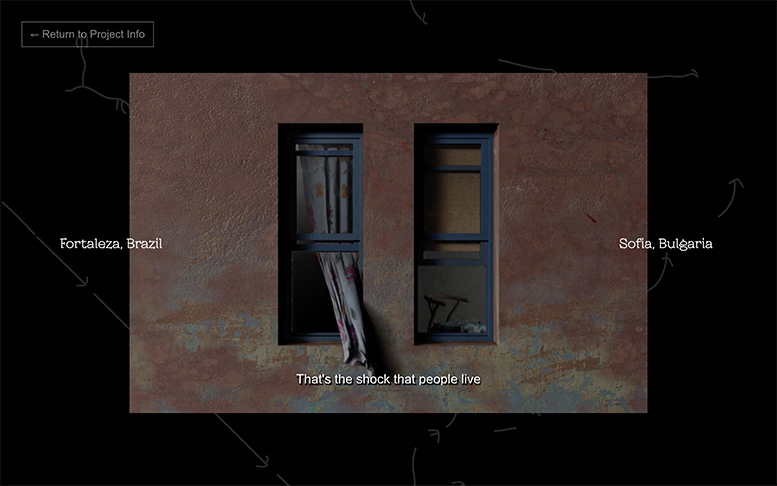
Still from “Acts in Translation,” a web installation by Dalena Tran, from the 2020 UCLA Design Media Arts M.F.A. thesis exhibition “NEARREST NEIGHBOR.”
“I think that there's more known about the history of artists working on the internet in Europe and on the East Coast. And I think that history in Los Angeles hasn't been told," Reas said. “We do know that people were making internet cafes here in Los Angeles around the time of the 1984 Olympics. And there were some very interesting community initiatives happening with the internet, pre-Web. But really before that it's still unknown."
Reas, McCarthy and McWilliams are leading the project with Jheanelle Brown, the community and project coordinator, and Gelare Khoshgozaran, the primary researcher.
The mission of the Conditional Studio, McWilliams explains, is to discuss “the overlap between art and technology, and technology and politics and society, and try to collect and organize some of our different practices and the department's broader thinking about how all of those concerns intersect and overlap.”
The group’s definition of internet art is expansive, ranging from a website or app, to text, audio, video or images transmitted over the internet, to something embedded in blockchain. It could even be the physical manifestation of a project that began on the internet.
“I think what differentiates it from just taking a piece of work and uploading it and putting it online, is that in some way, the piece itself is influenced by the fact that it was made with, or on, or for the internet," McCarthy said.
"We're not just tracing the history of art, but we're tracing a history of the internet and how it's been shaped by artists. Internet art is not just responding to the internet and making art about that. But actually, through these interventions and these works, the way that we understand the internet or the way that the internet functions has been shaped by a lot of them."
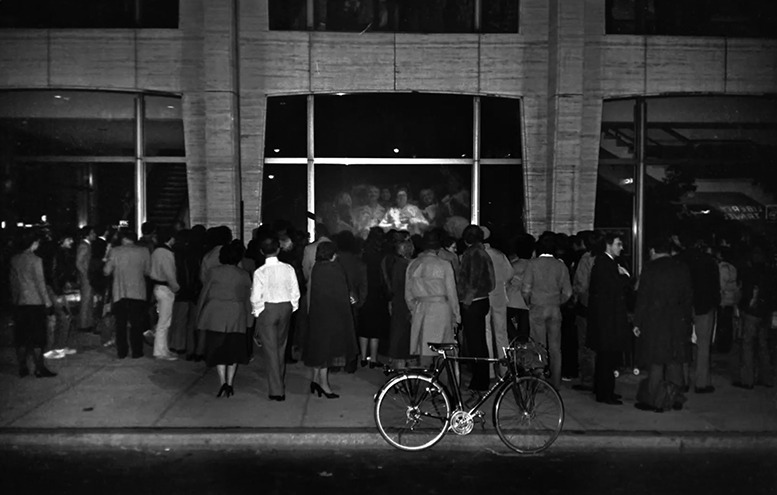
Image from "Hole In Space," a "Public Communication Sculpture" created in 1980 by Kit Galloway and Sherrie Rabinowitz that allowed a group of people outside the Lincoln Center for the Performing Arts in New York City, and "The Broadway" department store in Century City, to talk to each other in real time.
While the internet is often seen as being placeless, McCarthy says focusing on Los Angeles-based artists will reveal how specific social, political, environmental and cultural context still shapes artistic work.
“I think that the internet is inherently physical. The infrastructure of the internet is physical, and it defines the architecture of our buildings and our cities, and undersea cables across oceans draw political and economic boundaries. And then there's the environmental impact and consequences of the internet that affect us all on a large scale," said McCarthy.
Focusing on LA, she said “was a really intentional gesture to say that the internet or internet art cannot be separated from an understanding of the physicality where it actually resides."
The project aims to share information about artists and artworks that have been overlooked by institutions, and ignored through systemic racism and other forms of marginalization. An online research portal will allow artists and community members to contribute information about artworks and make connections between them through keyword tagging. The project team will then collaborate with local curators and communities to identify key themes and select pieces for inclusion in the final exhibition.
“It’s a unique and important experiment to try and uncover specific things that have been obscured in Los Angeles with regards to communities of artists, more grassroots organizations, collectives or crews," Brown said.
“With the invention of the internet in LA, there has been a certain narrative, and this is also a chance to expand that. And that's also where the work around outreach and community building comes. It's not only the actual work itself. It's also a kind of social exercise and a social practice.”
The final product will be a fully-accessible online archive that will allow visitors to discover projects and artists, and make connections between the artists. The group has received a research grant from the Getty Foundation, and is planning a physical exhibition as part of the Pacific Standard Time initiative in 2024. There’s also the thought of translating the archive into a physical printed catalog.
Story by Avishay Artsy
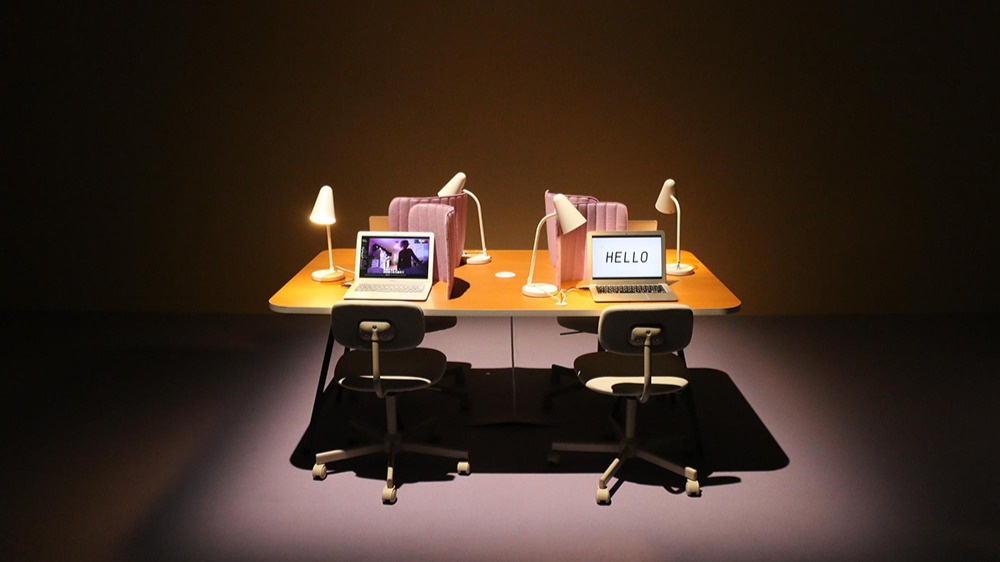
HEADER IMAGE: Image from "SOMEONE" by Lauren Lee McCarthy, professor of design media arts. Image credit: Yifan Zhang / Zhiyang Gao
Stay engaged. Use #UCLAarts to stay connected.


