Rodney McMillian: Body Politic
Review of Rodney McMillian's new exhibition at Vielmetter Los Angeles
"In the fall of 1977, medical students at Howard University prepared to dissect the anonymous corpse of a Black man that had been sent to them through a lottery administered by the District of Columbia’s Medical Examiner’s Office. This man was Casper Yeagin, a 68-year-old mechanic who had vanished on September 11, much to the distress of his sister, Pearlie Smith, and his niece, Minnie Champ. From the moment of his death (of still unknown causes), Yeagin’s body was treated callously by the police and medical personnel: law enforcement never filed Smith and Champ’s missing persons report, and Yeagin was deposited at Howard as a specimen despite the fact that his pants pocket contained the phone number of a nephew.
Rodney McMillian’s new show at Vielmetter Los Angeles, Body Politic, springs from such histories of the medical exploitation of Black people in the United States. His bright paintings and huge black sculptures of body parts, which together assess American Abstract Expressionism, are inspired by the groundbreaking work of scholars Dorothy Roberts and Harriet A. Washington. The former wrote about the eugenic controls of Black people and the latter authored the 2006 book Medical Apartheid, which sets forth the above story about Mr. Yeagin and also documents research conducted on Black prisoners.
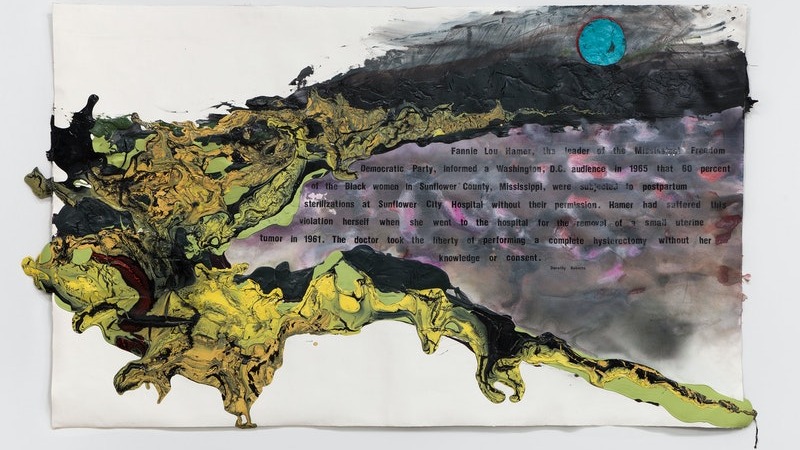
McMillian delves into these human rights offenses by smearing his paintings full of rich, vibrant colors reminiscent of Mark Rothko and Hans Hofmann, and layering over these phantasmagorias with text. In Anatomical Acquisitions (2020), we see a slop of green layered at the bottom of a canvas. It is topped with a long, mottled clump of red and blue, suggestive of a liver or heart. A blood-red blotch stigmatizes the canvas’s upper left corner and is in turn surmounted by a veiny haze of red splatters. Inscribed over this crime scene is a quote taken from Washington’s book, where the author reveals that in c. 1831 the South Carolina Medical College asserted that Black enclaves offered hospitals 'great opportunities for the acquisition of anatomical knowledge.' McMillian extends this merger of abstraction with medical historiography in Mississippi Appendectomy (2020), an explosive ink and acrylic work that targets the 1920s–’30s practice of forcibly sterilizing Black women. Mississippi Appendectomy consists of a green, black, and yellow blot, evoking Jackson Pollock’s poured works, but also infected and torn flesh. Hovering within this wound is a bruise of purple, grey, and orange, wherein McMillian quotes the findings of Fannie Lou Hamer, the civil and voting rights activist, who reported that 'in 1965…60 percent of the Black women in Sunflower County, Mississippi were subject to postpartum sterilizations…without their permission.'”— Brooklyn Rail, Nov. 2020

This post is an excerpt. Read the full article on the Brooklyn Rail website.
Stay engaged. Use #UCLAarts to stay connected.


