Rina Banerjee and the art of contagion
The artist Rina Banerjee, whose retrospective at the Fowler was cut short by COVID-19, has long grappled with issues of contagion and cross-border movement.
As the novel coronavirus pandemic spread across the planet, world leaders reacted by closing borders and restricting travel. Immigrants, whether from Asia or Europe, were blamed for bringing the virus into the United States.
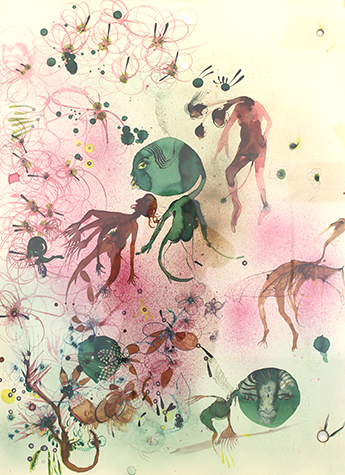
Rina Banerjee (b. 1963), Bacteria: In combat 540 wild beasts in green fury took refuge in curdled milk, kindled friendship with nomads skimmed butter as treasure absconded with proteins warmed milk until certain odor blew more ora, 2012. Acrylic on watercolor paper, 30 x 22 in. Courtesy Ota Fine Arts, Shanghai/Singapore/Tokyo. © Rina Banerjee. Image courtesy Ota Fine Arts (OFA), Shanghai/ Singapore/Tokyo. Such rhetoric has become commonplace, unfortunately. President Trump, in his campaign speeches, complained about Mexican immigrants bringing disease into the United States. The same arguments have been employed to justify keeping refugees and asylum seekers outside national boundaries.
The theme of trans-border migration and cross-border dialogue is at the heart of artist Rina Banerjee's work. Banerjee makes carefully-crafted sculptures and installations that combine objects ranging from African jewelry, Japanese and Korean fabrics, and Italian Murano glass. These pieces stand in for the people, objects and ideas that also move across borders.
Banerjee was born in India, immigrated to London as a young child, and at the age of seven moved with her family to the East Coast of the U.S. She studied engineering in college but left a career in science to study art. Banerjee currently lives and works in New York City.
Her work examines the formation of identity that draws from multiple cultures and ways of thinking, and looks at overlapping themes of gender and sexuality; climate change and the natural world; immigration and identity; colonialism and globalism.
Her 20-year-retrospective at the Fowler, Rina Banerjee: Make Me a Summary of the World, includes large-scale installations as well as drawings and videos. The exhibition was planned to be on view until the end of May, but the novel coronoavirus pandemic shuttered the museum. Nevertheless, Banerjee spoke to UCLA Arts about her work and its relevance to this historic moment.
UCLA Arts: Do you think that this current moment that we're in might impact your work? Do you think we'll see some ideas that you're thinking about during this period of quarantine and social isolation make its way into some of the sculptures that you're working on?
Rina Banerjee: Well, my work has always been interested in understanding global interactions, specifically how we're socialized not to be global, not to embrace it, not to mix. We're socialized towards racism, sexism, that is all in the work and also a kind of aversion - almost as if it's biological rather than manmade - for difference. And so my work has always been interested in disease, specifically, from its very beginning.
I have in my work this vein of ideas that really think about our aversion for difference in terms of disease itself. So in 2000 I made a work called “Infectious Migrations,” which is about our disgust for AIDS in that timeframe that I was working. So I really incorporated illness and especially contagious diseases to really consider as a way of understanding our responses to difference.
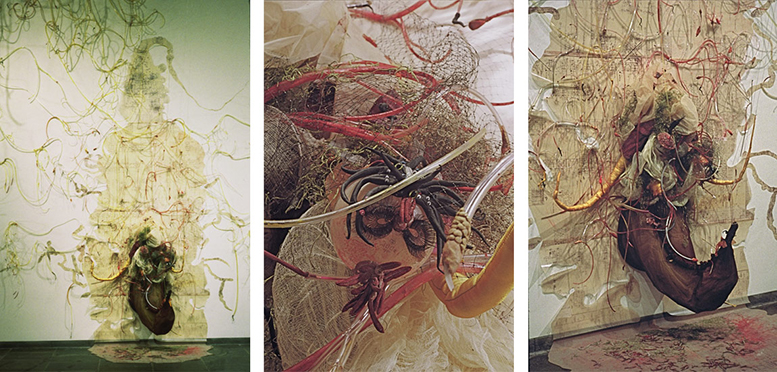
Rina Banerjee / Infectious migrations, 1999 / Incense sticks, kumkum, vaseline, turmeric, Indian blouse gauze, fake fingernails and eyelashes, chalk, foam, feathers, fabric, Spanish moss, light bulbs, wax, Silly Putty, quilting pins, plastic tubing, latex and rubber gloves, acrylic and dry pigment Dimensions variable / Whitney Biennial, Whitney Museum of American Art, 2000Looking at that piece, is that apparent in any way? Or are there elements within that piece that you think really speak to that?
All my work has an aesthetic that is different from, I would say, what you would anticipate in minimalism or definitely within the sensibility of what we challenge as artwork. It really is much more messier and it has this use of textiles, which we don't think of as contemporary art. We’re really looking at hard surfaces, as well as materials, when thinking about what is art. So these are unconventional materials. Our aversion for fabric or textiles is because they can hold germs, because we think of them as dirty, as we do things like hair, for example, nails, horns, those things come into my work, certainly feathers, thread. These are organic things. They remind us of the body. So the presence of the body is in the sculpture in that sense. And it also has a kind of way of crafting that is not machine or high craft. So it has a kind of intimacy with the handmade object that we could consider being “messy.” All this messiness is about our wish to have things contained, sterile, tidy. It's about our understanding of what it means to mix. Mixing is dirty.
Right. And that theme of identity and combining identities is, I think, central to your work. And I wonder if that partly comes from your own life experience of having been born in India, spending the first few years of your life in London and then moving to the United States. Do you think that's what got you thinking about all the different identities that we embody and, and the messiness, like you were saying, of having multiple identities as part of who you are?
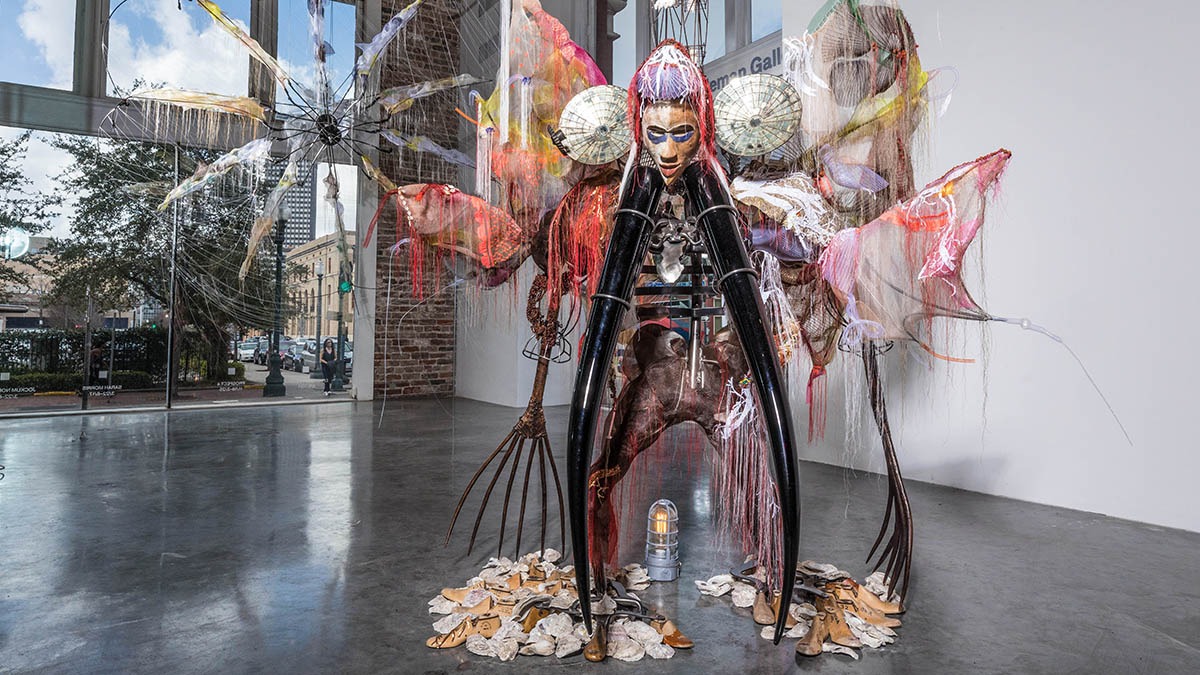
Rina Banerjee (b. 1963), Make me a summary of the world! She was his guide and had traveled on camel, rhino, elephant and kangaroo, dedicated to dried plants, glass houses—for medical study, vegetable sexuality, self-pollination, fertilization her reach pierced the woods country by country, 2014. Wood rhino, Chinese umbrellas, sea sponges, linen, beads, pewter soldiers, grape vines, glass chandelier drops, acrylic horns, wire, nylon and bead owers. 7 x 4 ft. Courtesy of the artist and Galerie Nathalie Obadia, Paris/ Brussels. © Rina Banerjee. Image courtesy Galerie Nathalie Obadia, Paris/Brussels. Well, I think it's really important to recognize that my personal history was primarily in urban sites. I grew up primarily in New York city. I lived in India when I was born for three years in Calcutta and four years between London and Manchester. So seven years of my 57 years on earth have been outside of New York City and outside of the United States.
So my feelings about New York city as an urban site, it is messy. It is very naturally messy in the sense that neighborhoods do not really, because of our density of population, are not contained. They bleed into each other and we remain interdependent for resources where we cannot stay in our neighborhood and get all the things we want and not go to the neighboring location, which it can be socially, culturally, very different.
So there is an integration that takes place when you're an urban culture and when you have a public commuting system, like the subway, which everyone takes. So even if I had my exclusive group of friends who may be homogenous, it doesn't force me to think of the world that way. Because I'm in the subway, I'm walking three blocks and I'm in a different neighborhood.
And so that kind of mobility is real access and access in a way that is forced. It's not like the Internet where you pick and choose what you've heard your friends are doing and what your peer group wants you to look at. So it's forced in so many different ways, in terms of age groups, your socialization, your culture, all these different aspects which come together when I take the subway.
And if you are in a car culture, you can’t experience that. So definitely those things have really enlightened me about these kinds of subject matters.
Installation View, Rina Banerjee: Make Me a Summary of the World, Fowler Museum at UCLA, 2020. Photo: Fredrik Nilsen.I could see that experience of being on the subway, and being forced into proximity with people that you might not otherwise choose to spend your time with, I could see that reflected in your work too, because of your choice of materials, whether it's feathers or glass or other kinds of fabrics or shells or hair. The fact that they come from all over the world, that you have things from China and Italy and Korea and Africa all blended together, that seems to be one of your driving aesthetics, is this combination of different materials and of different places all kind of mashed together into a fusion.
I think the thing is that we have to be really aware that we get to enjoy this kind of lifestyle where we can forage into different locations. And then we have to be aware of where these things come from. You know, where do your green beans in the supermarket come from? How far do they have to travel? To get to this kind of awareness is easily lost unless you practice a kind of wishfulness to be in those other places, and not think of the world as a supermarket to get things from and then rush away home.
And I think that sense of journey is essential in the way I hope viewers learn about my work and learn about themselves through that experience with the work.
There's a real timeliness in some of the issues that you're raising about identity and migration. We've been in the midst of a discussion of climate change and how that affects us all globally, and now with a pandemic, we're seeing this thing that doesn't respect national borders even as we're trying to build walls to keep out refugees or to block trade. We’re forced to recognize that we all have one common mission. Do you think there's an added poignancy to some of the messages that you're hoping to convey in your work, given the situation we're in now?
Rina Banerjee (b. 1963), Her captivity was once someone’s treasure and even pleasure but she blew and ew away took root which grew, we knew this was like no other feather, a third kind of bird that perched on vine intertwined was neither native nor her queens daughters, a peculiar other., 2011. Anglo-Indian pedestal 1860, Victorian birdcage, shells, feathers, gourds, grape vines, coral, fractured Charlotte doll heads, steel knitted mesh with glass beads, Kenyan tourist sculptures, apple gourds. 7 x 7 x 6 ft. Cornell Fine Arts Museum, Purchased with funds from the Michel Roux Acquisitions Fund, 2016.20. © Rina Banerjee. Image courtesy Rina Banerjee Archives. The situation basically points out that, no matter how much weaponry and vigilance and homeland security we play out, and how politics come into play to create a kind of division which is around establishing a hierarchy and a power that is centralized, we can't be centralized. Because we're really one community; the human community. And even within that scope, which we call the human community, we need to be very intimate with our food. The only things that are really important is food, water, daylight, basic things that we can't in all our aggression and our ambition to organize, can’t seem to distribute throughout the world in a way that is fluid and available for everyone.
That's what we've failed at doing right now. We’re going to see what will end our wish for this luxurious future for a few. You can't have that luxury where a few have everything unless everyone is happy and has access to basic things that humans need. So I think it's brought attention to the fact that we're not in those kinds of power situations, that nature still is a commanding force that we have so much to learn from.
And we're really not depositing all our energies emotionally, intellectually, and economically to these kinds of deposits. Like what is nature? What is it up to? What is our relationship? How do we handle nature? And I think that the language we've created makes us feel like we do get what we want as long as we raise a lot of walls so we don't have to see everything. Ironically, which is what the Internet's supposed to allow us to do, but of course, there's lots of propaganda here and everywhere, and lots of censorship that is happening all the time to help us not think about things. But this allows us to think about everything. And I hope that it becomes a very rich place for artists to work in.
You rely on the Internet as a source for a lot of your materials. So many of us now are really encountering the world through the Internet. Imagine how different this experience would be if we didn't have the Internet. And as an artist who uses the Internet as part of your work, I wonder if you can speak to the experience that we're all having now, this simulacra of person-to-person interactions with Zoom meetings and conference calls. This is a world that you have experience with, but you also know how much is missed from not being able to see things in person.
I think it’s a really important way for many people to realize that physical is very special. And when we don't have it like now, we're much more aware of its value. And so when, especially with my students, they sometimes believe that their experience on the Internet is a real experience. And I think this situation allows us to realize that it's not. That’s a valuable kind of awareness that this has brought to our attention. Zoom feels like a compromise to what we really want to do and what we need to do in order to feel like reality exists, that we're actually living. I mean, our sense of time and hearing from people when I'm talking to them in Zoom is, I don't know what day it is. I don't know what time of day it is, what part of the weekend we're in. We really lose touch with reality when we don't have that physical experience.
It's not enough to be able to go out to the park for a couple of hours and say, well, you were outside, wasn't that good enough? And you realize, no, it wasn't good enough. I think that’s valuable.
Culture Fix: Betty Seid on Rina Banerjee from Fowler Museum on Vimeo.
Stay engaged. Use #UCLAarts to stay connected.