Review: With 'Doctor Atomic,' Santa Fe stages a nuclear tale as the opera of our time
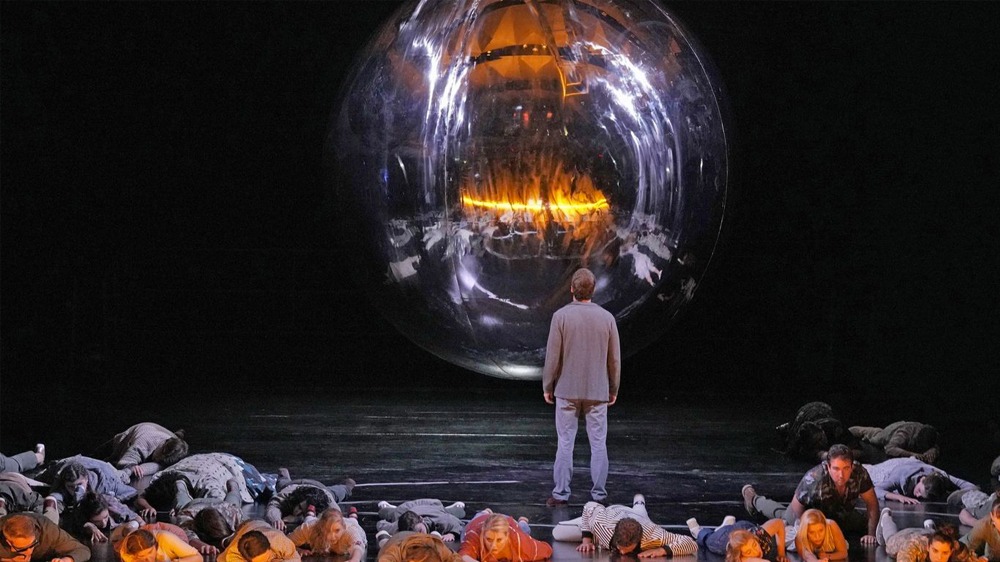
Renowned theater director and UCLA Department of World Arts & Cultures/Dance professor, Peter Sellars, wrote the libretto for Santa Fe Opera performance of John Adams’ “Doctor Atomic,” which Los Angeles Times theater critic Mark Swed calls "the most significant, I’d say the greatest, opera of our time."
"The weather was nervous-making that summer evening 73 years ago when the first atomic bomb was tested at a remote desert site a little more than 200 miles south of here. An unpredictable warm air mass capable of producing a violent thunderstorm could blow radiation fallout to nearby populations. Lightning, some scientists feared, might trigger a cosmic chain reaction igniting the Earth’s atmosphere.
Ryan McKinny as Robert Oppenheimer awaits the first test of the atomic bomb in the Santa Fe Opera production of John Adams' "Doctor Atomic." Just such a violent desert thunderstorm came out of nowhere Thursday night during a Santa Fe Opera performance of John Adams’ “Doctor Atomic,” which dramatizes and provides uniquely essential insight into the most disquieting scientific event in history.
The outdoor opera house is only partly protected from the elements. When the night is clear and the back of the stage is open to the enchanting desert, as it is in this production, you can see the distant twinkling lights of the Los Alamos laboratories. There, the bomb was developed in top secrecy during World War II in a rush to beat the Nazis to nuclear weaponry, and it’s where atomic weapons are still being produced. You are, operatically and in actual fact, there.
The test at the Trinity site had to go off as scheduled the early morning of July 16, 1945. Germany had recently surrendered to the Allies, and that day, President Truman was to meet with the Soviet Union’s Joseph Stalin in Potsdam, Germany. The war still raged in the Pacific, although there was no longer a clear need to overpower Japan with the most deadly force ever devised. Truman instead wanted the Russians to quake at our capacity to be the first superpower.
Leslie Groves, the Army general in charge of the project, demanded that the military branch’s Caltech-trained top meteorologist forecast a favorable time for the detonation that day or he would hang. At 5:30 a.m., the plutonium bomb produced a blinding light minutes before dawn, making it the first double sunrise in history.
A lot has changed in 73 years. This may be the nuclear age, but we still can’t fully predict storms in this part of the world. Santa Fe’s opera-goers know to check their weather apps, and the odds favored a mild evening. It was warm and pleasant as the audience quietly and solemnly took its seats while members of neighboring pueblos performed a sacred Corn Dance.
Peter Sellars, the opera’s librettist and director of the San Francisco Opera premiere of the piece in 2005, has rethought “Doctor Atomic” for Santa Fe. There was no need for sets, when we were already in situ. This was Native American land, and Sellars wanted to acknowledge that to the audience. (To be certain of the director’s sacred ceremonial bona fides, the tribes first sent elders to Walt Disney Concert Hall last spring to attend Sellars’ ritualistic Los Angeles Master Chorale production of Orlando di Lasso’s 16th century sacred motet, “Lagrime di San Pietro.”)
At the end of the Corn Dance, lightning suddenly lighted up the sky. The atmosphere became infused with static as the recorded crackling of 1940s airplanes was piped around the theater. Thunder crashed, echoed by the startlingly portentous orchestral discharge that opens the opera. The wind picked up. Then, the deluge. The temperature dropped from the upper 80s to the 50s in no time.
Throughout the nearly 90-minute first act, rain blew onto the stage from the sides and the rear. The orchestra thinned out as violinists fled to protect their precious instruments. To remain ever mindful that the bomb was developed on sacred land, Native American dancers, choreographed by Emily Johnson, were ever present on what had became a dangerously slippery stage.
Nothing could stop the making and detonating of the bomb. Nothing has been able to stop the proliferation of nuclear weapons since. And nothing stopped a performance of the most significant, I’d say the greatest, opera of our time."— Mark Swed, Aug. 6, 2018


This post is an excerpt. Read the full article on the Los Angeles Times website.
Stay engaged. Use #UCLAarts to stay connected.


