Review: The power of memory shines through in Bill T. Jones' remembrance of things past and present
“The sun has an appointment with the moon.”
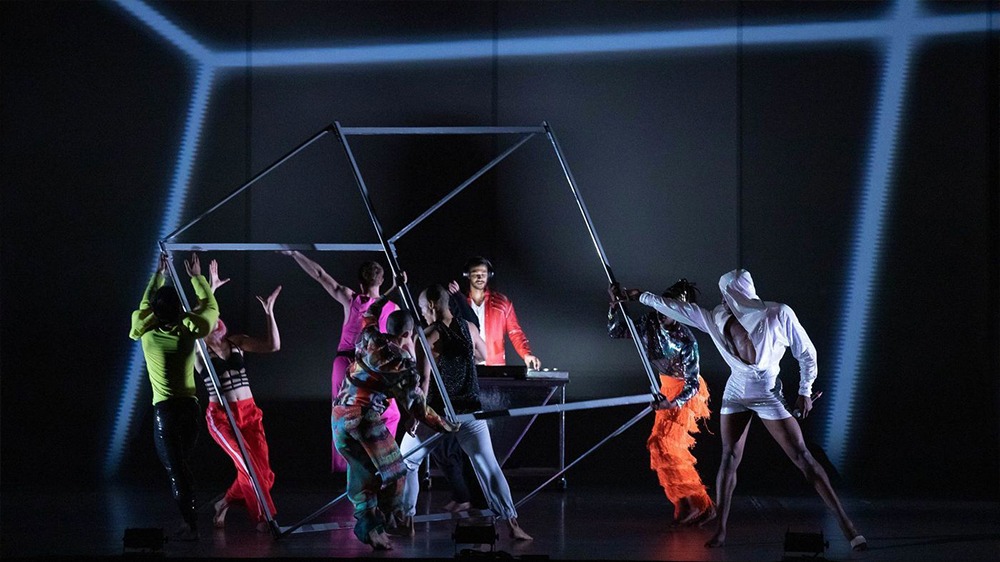
Bill T. Jones' "Analogy/Lance: a.k.a. Pretty the Escape Artist" at Royce Hall, UCLA, Sunday (Reed Hutchinson /CAP UCLA) That is how a Jewish Belgian teenager, Dora Amelan, described her world turned upside down by the invasion by Nazi Germany in 1940. It is also, in one way or another, the essence of displacement felt by emigrants, for whom memories of one world remain in constant arbitration with those of another. Though often a prescription for success, forgetfulness isn't always an option. Ghosts get in the way.
The sun’s appointment comes early but lasts long in Bill T. Jones’ “Analogy Trilogy,” given its Los Angeles premiere by the Center for the Art of Performance at UCLA in two marathon performances Saturday and Sunday in Royce Hall (I attended the second). Three stories of displacement caused by war and/or society are painstakingly excavated from seemingly trustworthy memory. They’re interpreted through a combination of dance, spoken narrative, music and a touch of video. But imaginative, expressive and, when needed, exalted dance by the Bill T. Jones/Arnie Zane Company remains primary.
The three parts are given over a nearly seven-hour span, broken up by a 45-minute intermission and a 90-minute dinner break. The first, “Analogy/Dora: Tramontane,” is based on Jones interviewing his octogenarian mother-in-law about her World War II experiences, which included working with the Jewish underground at the Gurs and Rivesaltes Vichy French internment camps near the Spanish border.
In “Analogy/Lance: Pretty a.k.a. the Escape Artist,” Jones confronts his nephew, Lance T. Biggs. Like his uncle, Lance is a talented dancer, African American and gay. But unlike his uncle, who came from a large family of migrant farmworkers in Florida and who rose to become one of today’s leading American performing artists, Lance left ballet school early, seduced by drugs and the nightlife of the 1980s and 1990s; that led to prison and, through his physical abuse, paralysis from the waist down.
The third part, finished last year, “Analogy/Ambros: The Emigrant,” is taken from a chapter in W.G. Sebald’s “The Emigrants.” A uniquely illuminating excavation of haunted figures from the narrator’s past, it explores with a touch of exceptional lightness the weight of memory.
“Memory,” Sebald concludes in writing about the narrator’s mysterious Great-Uncle Ambros Adelwarth, “makes one’s head heavy and giddy.” It is as though we are looking down on Earth from “one of the towers whose tops are lost to view in the clouds.” It is Jones’ arresting innovation to make the dancers personify that lost memory, continually gesturing upward but unable to fully reach us above the clouds
This company of nine dancers accomplishes any number of unexpected things, including narration and singing. Jones has said that he no longer considers the group, which he founded with Arnie Zane in 1982 and which he has headed since Zane’s death six years later — a dance company. Instead, the ensemble is devoted to performance in the broadest sense."— Mark Swed, Nov. 5, 2018


This post is an excerpt. Read the full article on the Los Angeles Times website.
Stay engaged. Use #UCLAarts to stay connected.


