Review: Saltwater as Lifeblood
"Art of the Austronesians: The Legacy of Indo-Pacific Voyaging" at the Fowler Museum
The Wall Street Journal calls the Fowler Museum's Art of the Austronesians exhibition, the first of its kind in the United States, "remarkable."
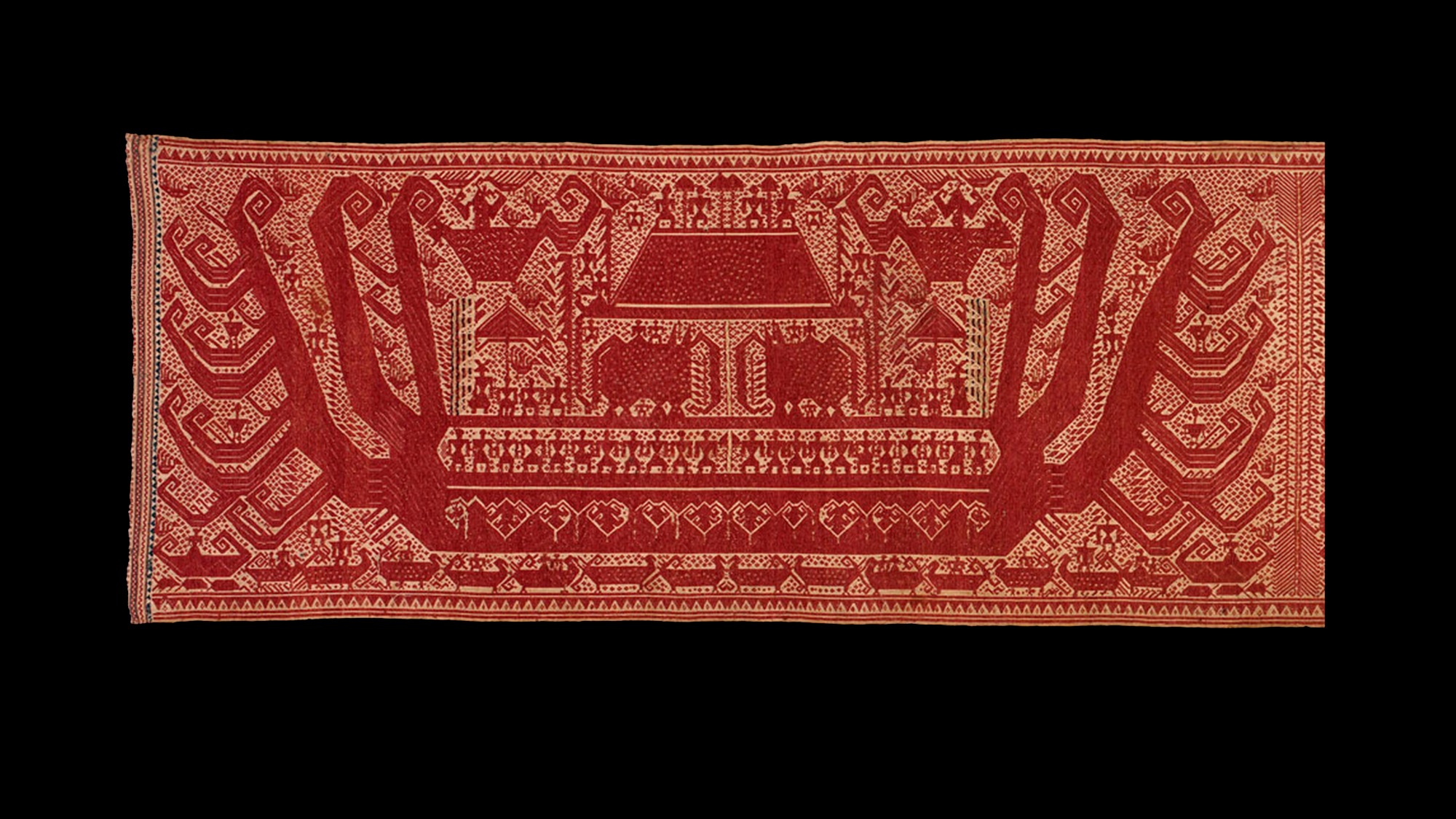
"The first major artifact you see at the remarkable exhibition “Art of the Austronesians: The Legacy of Indo-Pacific Voyaging” at the Fowler Museum at UCLA is, appropriately, a canoe. This is an exhibition about seafaring peoples of the Pacific for whom the canoe is both womb and tomb—the object which, in ancient times, had borne them across the seas to their homes, and the vessel that may bear them onward into the afterlife. If cultures are shaped by their surroundings, these varied peoples, who speak some 1,200 different languages, and live on islands, atolls, peninsulas and regions scattered across half the globe, have all been molded by the ocean. That is one reason why land-based cultures of the West have long seen these peoples as embodiments of exoticism, from the 18th-century explorations of James Cook to the 20th-century romanticism of Margaret Mead.
Boat imagery is so fundamental that it recurs throughout the exhibition. There is a boat-shaped funerary marker carved of wood like those found in Muslim cemeteries in the southern Philippines, and a rooster prow that once extended from the façade of a ritual house of the Sa’dan Toraja peoples in South Sulawesi, Indonesia, as if it too might have been seaworthy. We are told of how even in the “arid uplands” of Sumba in Indonesia, when heavy stone tombs are dragged overland they are still compared to sailing ships. It is as if any aspect of life associated with rites of passage was associated with the people’s primal migratory experience over water.
This is billed as the first major exhibition in the U.S. to survey the visual culture of these peoples. Its curator, Roy W. Hamilton, gathered most of the 200 or so objects—funerary markers, exquisite textiles, ceremonial mats, nut cutters, shadow puppets, ceramics and religious artifacts—from the museum’s collection originally acquired by the eccentric pharmaceutical entrepreneur Sir Henry Wellcome. Others have been borrowed from private collectors. Many are on public view for the first time."— EDWARD ROTHSTEIN, July 11, 2016

Read the full article at the Wall Street Journal website.