Review: Ex-President Trump claims to be a witch hunt target. These feminist artists beg to differ
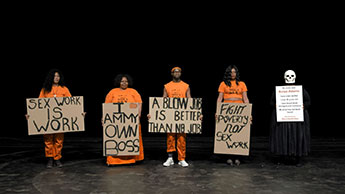
Candice Breitz, TLDR, 2017 How many times over the last four years has twice-impeached former President Trump uttered the words “witch hunt”?
A hundred? A thousand? A bazillion?
In 2018, as the Robert S. Mueller investigation into Russian collusion and obstruction of justice heated up, an avalanche of Trump tweets claimed he was the innocent focus of a hysterical cabal, not unlike the poor residents of 17th century Salem, Mass., 20 of whom (mostly women) were hounded into early graves from unfounded accusations of sorcery.
He’s continued ever since.
A Vox story on the disgraced president’s unceasing usage of the term witch hunt aptly noted that there is “something distasteful about men in power — particularly [those] credibly accused of sexual assault — using a term that harks back to an era in history in which a patriarchal society wrongfully persecuted (mostly) women.”
Stacy Schiff, the author of a book about Salem entitled “The Witches,” explained to the publication: “We’ve turned the expression on its head. Traditionally a witchcraft charge amounted to powerful men charging powerless women with a phony crime. Now it is powerful men screeching that they are being charged with phony crimes.”
The curators of the often cheeky but nonetheless serious exhibition “Witch Hunt” would likely concur. Their show’s snappy title, wrapping recent art by 16 women within a familiar sobriquet shrouded with hostility in order to defuse it, is anything but a coincidence.
“We began with a question,” the exhibition catalog announces. “What does it mean to be feminist in the age of Donald Trump?”
On view until Jan. 9 at the UCLA Hammer Museum in Westwood and the Institute of Contemporary Art, Los Angeles, across town, the show brings together international artists — the 16 were born or work in 13 countries as far afield from one another as Brazil, Germany and South Africa — who reflect the diverse experiences of women’s lives in patriarchal societies today. Most are Gen Xers, born in the media-saturated 1960s and 1970s, who grew up during feminism’s so-called third wave.
That wave has now passed. This selection underscores that advocacy of women’s rights on the basis of equality of the sexes has been supplanted. The old binaries have given way, opening up myriad new paths. Feminisms — plural — proliferate. — Christopher Knight, Nov. 1, 2021


This post is an excerpt. Read the full article on the Los Angeles Times website.
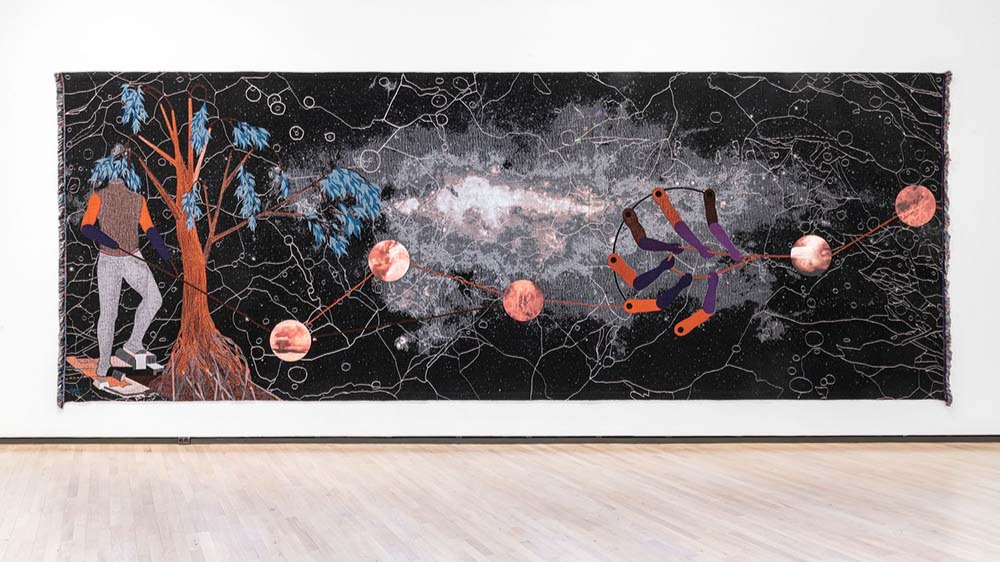
HEADER IMAGE: Otobong Nkanga, Double Plot, 2018. Woven viscose bas, polyester, bio cotton, cashwool, acrylic, with photography. (265 x 770 cm). Installation view, Henie Onstad Kunstsenter, Nov 2020 - May 2021. Courtesy of the artist. Photo: Øystein Thorvaldsen
Stay engaged. Use #UCLAarts to stay connected.


