Review: Can one artist summarize the whole world? Nope, but it’s fun to see Rina Banerjee try
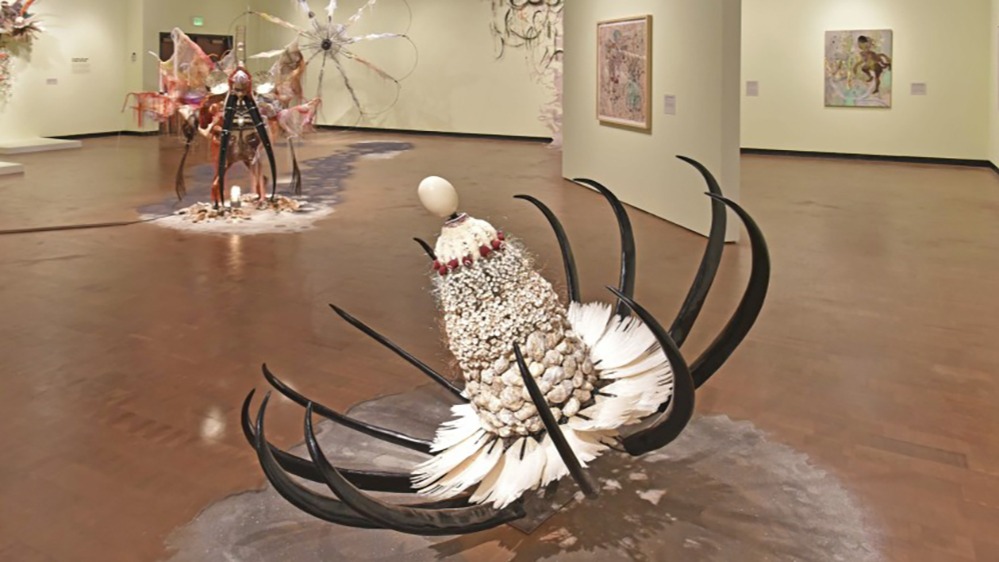
Make Me a Summary of the World brings together several of Banerjee’s monumental installations in conversation with more than two dozen sculptures, as well as a thorough selection of works on paper to create an otherworldly and multi-sensory space. Using a variety of gathered materials ranging from African tribal jewelry to colorful feathers, light bulbs, and Murano glass, Banerjee’s works investigate the splintered experiences of identity, tradition, and culture, prevalent in diasporic communities. These sensuous assemblages present themselves simultaneously as familiar and unfamiliar, thriving on tensions between visual cultures and raising questions about exoticism, cultural appropriation, globalization, and feminism. Her works are paired with thought-provoking and poetic titles that are works of art in themselves, ranging in length from 50 to nearly 200 words.
"This is the start of the title for one of Rina Banerjee’s recent sculptures, currently on view in an arresting traveling exhibition at the UCLA Fowler Museum (take a deep breath):
“Viola, from New Orleans-ah, an African Woman, was the 19th century’s rescue worker, a global business goods raker, combed, tilled the land of Commerce, giving America a certain extra extra excess culture, to cultivate it, making home for aliens not registered, made business of the finer, finer, had occupations, darning thread not leisure with reason and with luster, in ‘peek-a-boo’ racial disguises …”
The sculpture’s title continues on for another 115 words, 177 in all. Together they make up a kind of nonsense prose-poem — nonsense here meaning absurdist and without the usual sense of things, rather than balderdash.
The artist is dismantling common English language, knocking it over, busting it into a thousand pieces and reassembling meaning into something evocative and new. That its music and rhythm sound vaguely Cajun — Viola, from New Orleans-ah — suggests a deliberate, careful ear rather than a Dada-style pile-up of random words.
There’s no “Untitled” work by Banerjee anywhere in the show, which brings together six sculptures, a dozen wall reliefs, 19 mostly small paintings on paper or panel and two videos, virtually all with extravagant monikers. (It was jointly organized by the Pennsylvania Academy of Fine Arts and the San Jose Museum of Art.) Seen alone, such titles might seem pretentious, a showy and affected pitch simply to be different and get noticed.
Notice, they certainly do want; what artist doesn’t? But, seen with her sculptures, the titles fit like a glove. Banerjee’s art is showy too. The lists of the materials used to compose her flamboyant works are nearly as long as the titles.
The above-named sculpture, for example, is an assemblage made from Murano glass horns, Indian rakes, seed beads, steel, a Yoruba African mask, oyster shells, cowrie shells, Charlotte dolls, polyester horsehair trim, Korean silks, Indian silks, vintage Kashmir shawls, a French wire Ferris wheel, Congolese elbow bangles, colonial mirror sconces, Japanese seed glass beads, sequins and threads.
Banerjee cobbled this vast array of materials together into a strange, otherworldly, almost baroque standing figure. A helpful wall label cites “Winged Victory of Samothrace,” the famous 2nd century BC Greek statue, as one inspiration for her sculpture. The other is the life of Viola Ida Lewis, an African American woman married to a Bengali immigrant in a coastal Louisiana bayou at the start of the 20th century.
The sculpture, standing atop a bed of oyster shells strewn across the floor, sports the suggestion of wings spreading out behind it. The figure, at once angelic and ferocious, tips forward, like the ancient Hellenistic Nike leaning into the wind and straining to maintain steadiness.
One big difference: Banerjee’s trails a big, scalloped, open-frame object behind it, connected to the figure by long, taut threads. This is no boat, as the Samothrace sculpture headed. This object looks like a tattered parachute. It hints at both rescue and liberation, as if the avenging angel has dropped in by chance from some faraway place unknown."— Christopher Knight, Dec. 20, 2019


This post is an excerpt. Read the full article on the Los Angeles Times website.
See Rina Banerjee: Make Me a Summary of the World through May 31 at the Fowler Museum at UCLA.
Stay engaged. Use #UCLAarts to stay connected.


