Resolutely Political LA Artists Focus on the Body in the City’s Latest Biennial
The body is at the center of much of the work in Made in LA, and overwhelmingly, that body is brown
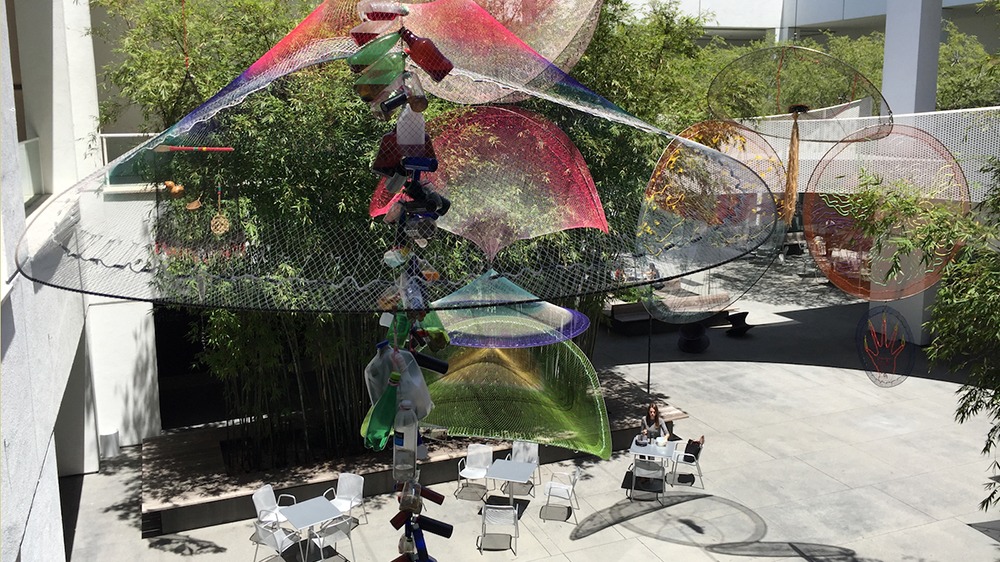
Made in L.A. 2018 is the fourth iteration of the Hammer’s biennial exhibition, continuing to highlight the practices of artists working throughout Los Angeles and the surrounding areas. This year's lineup includes ten alumni from the UCLA School of the Arts and Architecture, representing more than 25 percent of the artists selected. The exhibition is organized by Hammer curators Anne Ellegood and Erin Christovale. The exhibition will be accompanied by a comprehensive catalogue, as well as a full roster of free public programming. Refer to the UCLA Arts Calendar for the full listing of events and exhibitions at the Hammer Museum and across the School.
"LOS ANGELES — On Sunday, June 3 the fourth iteration of the Hammer Museum’s Los Angeles biennial, Made in LA, opened to the public, featuring the work of 33 artists, from emerging to mid-career, and some long overlooked. Although all the artists currently live in Los Angeles, Hammer Director Ann Philbin remarked that “it kind of is an international exhibition” at a press preview on Friday, with artists hailing originally from 13 states and seven countries.
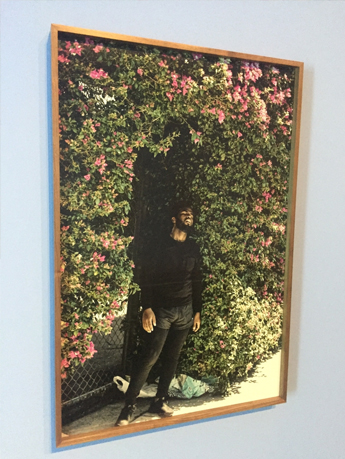
Alumnus EJ Hill's work, from “Excellentia, Mollitia, Victoria (2018), on view in the Hammer Museum The show lacks a clear-cut central theme — not surprisingly, considering Los Angeles’s heterogeneous nature — however, co-curator Erin Christovale, who organized the show with Hammer curator Anne Ellegood, pointed out that the body is at the center of much of the work: the political body, the contested body, the reclaimed body. Overwhelmingly, that body is brown and black, female, queer, and indigenous. These artists are responding to political, cultural, and environmental crises, both on national and global levels, but also focusing on the hyper-local, from the African American community of South Los Angeles, to the Tongva people, the area’s first residents.
Although the show aims to challenge the status quo in terms of who is represented, traditional media like painting and sculpture are still prominently featured, proving you don’t need to chase current technological trends to be disruptive. The last Made in LA biennial in 2016 focused much more on institutional critique and expanding the boundaries of art, from Todd Gray’s sartorial performance piece that existed mostly outside the museum to Guthrie Lonergan’s website interventions. Even the name of the show, “a, the, though, only,” was a work by poet Aram Saroyan. This time around, the emphasis is on the here and now, as material, craft, and the object take precedence.
Some of these artists represent the body itself, as with paintings by Christina Quarles, Celeste Dupuy-Spencer, and 97-year old artist Luchita Hurtado, who has two bodies of work from the late ’60s and early ’70s on view. In one series, the geometric designs of floor rugs are interrupted by her nude body parts, monumental and unapologetic, as seen from her point of view. (Showcasing the work of late-career artists like Hurtado who are finally getting their due seems to be a pattern with Made in LA, following the inclusion of artists like Huguette Caland and Kenzi Shiokova in 2016.) Charles Long’s room-size installation is an ambitious phallus-filled fantasy, though the numerous members are depicted in castrated cross-section, a hopeful vision of the death of the patriarchy.
Other artists only imply the body, creating sculptures or environments that invite participation from viewers, or stand in as evidence of past events or uncharted histories. Lauren Halsey’s “Crenshaw District Hieroglyph Project” features 600 white gypsum boards onto the surface of which the artist has carved images of Afro-Futurist utopia, signs and scenes from her South Los Angeles neighborhood, and the names of African Americans killed by police. Assembled into a temple-like structure that visitors can walk through, it is a prototype for a larger edifice that will function as a cultural center and gathering place in South Los Angeles."— Matt Stromberg, Jun. 4, 2018


This post is an excerpt, read the full article on the Hyperallergic website.
Stay engaged. Use #UCLAarts to stay connected.


