Reaching beyond campus to connect across age and geography through the arts
UCLA’s Visual and Performing Arts Education program facilitates art in response to “10 Questions"
This fall, the UCLA School of the Arts and Architecture presented 10 Questions: If not now, when?, the fourth installment of the annual event series that invites the public to join UCLA students, faculty, alumni, and community members in the virtual classroom to engage in vibrant conversation in response to fundamental and timely questions.
In 2020, 10 Questions: Reckoning grappled with the profound inequities of our time, set against the context of a global pandemic, a presidential election, a racial justice movement, and the climate crisis. In 2021, 10 Questions: If not now, when? brought together 30 leading artists, scholars, researchers and thinkers from across UCLA to explore and probe the generative possibilities and opportunities with which we can individually and collectively shape a better future.
Building on the success of last year’s program, UCLA Arts again extended the 10 Questions conversations deeper into the community through a partnership with its Visual and Performing Arts Education program. As part of the 10 Questions series, VAPAE collaborated with a range of participants, including middle and high school students from public schools across the city as well as cohorts of local senior citizens and families. Each group generated their own classroom and program conversations and created artwork in response to select questions. The videos, which you can view below, were shown as part of the public programs.
“By extending this conversation into our communities, UCLA is putting inclusivity into practice. These younger, and in this case elder, generations of artists have much to teach us. Their perspectives and creativity are paramount as we make sense of the world we are living in and seek ways to address the challenges ahead,” said Kevin Kane, director of VAPAE.
Read on to learn more about the 10 Questions/VAPAE partnership, view the extraordinary responses from our five partner cohorts, and consider feedback from the community leaders who played key roles in producing this work.
How do we Connect?
Monday October 11, 2021
Los Angeles County High School for the Arts, Grade 9: Theatre & Testimony/ Advocacy
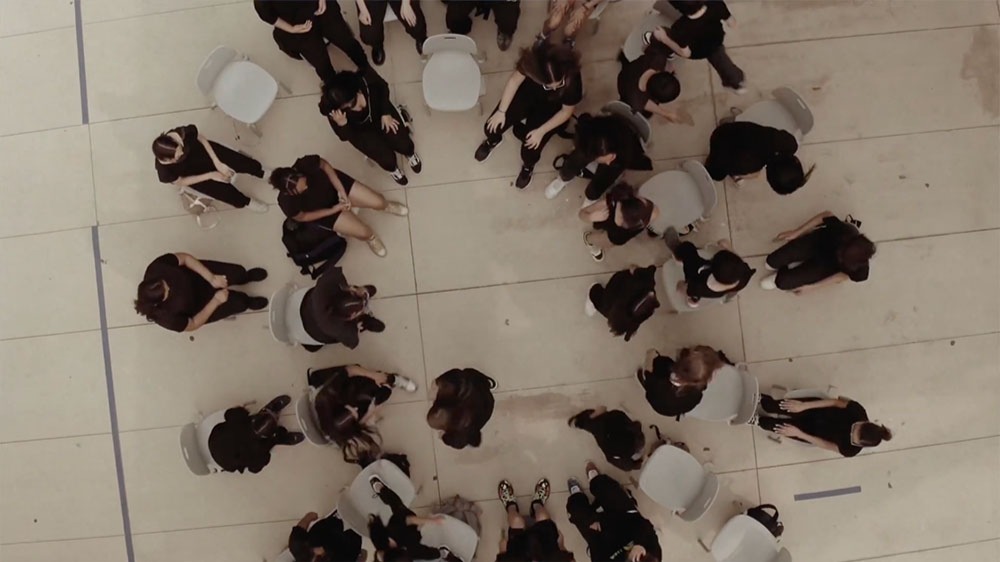
The ninth grade “Intro to Theatre” students from Los Angeles County High School for the Arts responded to the question: How do we connect? For those of us that might forget exactly how old a ninth grader is: these are 13 and 14 year-olds, and bear in mind that these students spent the majority of their middle school years in their solitary home spaces, studying entirely on Zoom.
It is particularly wonderful to see them back in-person, albeit masked, studying the art form they are most inspired by (theatre), exploring ideas of connection, both intellectually and kinesthetically. To make this video, the students and I began with group conversations about the nature of connection, in the arts and in life. These led to reflective writing prompts answered at home via self-tapings. It all culminated in a full group filming experience on their campus – capturing games and activities that are helping them feel the rush of social contact, touch and group collaboration, experiencing a kind of joy that is only possible when we are connected again in the same space, at the same time, together in community. – Kevin Kane
The “How do we Connect” video is really beautiful and inspiring! Thanks so much to Dr. Kane and the UCLA Arts 10 Questions team for including our students. It speaks so well of your university’s appreciation for the arts and your love of theatre, your care and respect for our LACHSA students and all the children of our city. – John Lawler, Principal, Los Angeles County High School for the Arts
How do we Remember?
Monday October 18, 2021
UCLA Community School, MASA Program: Visual Arts & Dia de los Muertos
The MASA Program at the UCLA Community School, located in historic Koreatown, is VAPAE’s longest running and among our most beloved community arts programs.
The program’s name actually has two meanings: MASA as an acronym for the Multigenerational Afterschool Arts program. These weekly art sessions provide a designated time for participants to make art together as a family, at the same time building and nurturing community; and masa as in the key ingredient of many important Latin American dishes: tortillas, pupusas, gorditas, and tamales.
So, Masa, like art, is an essential ingredient to life, to family.
And our prompt for the evening: How do we remember?
For the MASA program, this is not a hypothetical question or an intellectual exercise. It is a daily practice, and one that is highlighted every year at this time, through the community’s Dia de Los Muertos, or Day of the Dead, events; a treasured, sacred indigenous celebration, an opportunity to remember loved ones that we continue to keep alive in memory.
Dia de Los Muertos for the MASA program is an annual community and arts event that is anchored in family, steeped in cultural significance, comprising traditional art making and family customs that have been passed along for generations, mixed with other components that adapt and evolve with each passing year, with each new generation that reimagine and re-construct the traditional.
The ofrendas or altars created for the event hold cherished photos, meaningful possessions, favorite foods and drinks, fragrant flowers, candles, and numerous pieces of hand crafted art and artifacts. This year and last, the MASA program responded to the pandemic by having participants make individual cajitas – small, symbolic boxes, handmade and unique, painted and decorated, each one in memory of a cherished loved one; some were made at home while others created in-person at the school. These would be collected, combined and installed together as a full group altar, on display to the entire school community.
Together, they represent the vastness of remembering, of the love and lives that stay eternal in all of us, a light that forever burns bright, a loss that never quite erodes, a symbol of family and community.
I’m thrilled to share a sneak preview of this year’s MASA Dia de Los Muertos celebration. What an honor it is for all of us to witness their creativity and receive their generosity. – Kevin Kane
We love the MASA Program, the VAPAE Program and the way our collaboration enriches so many lives. This project allowed all our families to share their precious memories and their extraordinary creativity; we are very grateful. – Leyda Garcia, Principal, UCLA Community School
The 10 Questions project provided the school community an opportunity and space for us to ponder the question: how do we remember? The altars that our families created reminded us that remembering done through art and in community is healing, unifying, and honoring of people's identities, histories, and futures. We shared this video during the staff professional development and the video – another form of art – opened up another space for staff and teachers to reflect and remember, so we can move forward as we do the work of teaching and learning. – Rebekah Kang, Assistant Principal, UCLA Community School
How do we Heal?
Monday October 25, 2021
Torres East LA Performing Arts Magnet, Grades 9-12: Music & Poetry
The Torres East LA Performing Arts Magnet, fondly referred to as ELAPA, is located deep in the heart of East Los Angeles, beyond downtown, situated between the 10, 60, and 710 freeways.
Tonight’s creative offering from these high schoolers is their response to how music and poetry can be a tool for healing. It’s an important moment for these students.
According to Torres ELAPA Principal Carolyn McKnight, the school-wide community of ELAPA has experienced a disproportionate amount of loss and grief throughout the pandemic, and gathering as a community for support and inspiration was impossible.
And of course learning the arts, practicing and performing, was entirely remote. No one got off easy, but perhaps no art form was as difficult to teach on the zoom platform as instrumental and choral music; just keeping the students signed in, cameras on, being heard and hearing, making music, on key and in tempo proved to be a daily plight for music educators.
And without music and poetry as a creative outlet, many ELAPAA students share that they lost an immediate and important connection to each other, over a year and a half of their high school years without a crucial outlet to help them process and express their fears and worries, as well as their extraordinary perseverance and community spirit.
Principal McKnight shares: “The truth is our school community and our student body have always faced more loss and socio-economic challenges than most other LAUSD schools. The resilience of our students has always been one of their greatest strengths and one of the things I’m most proud of about this community of learners. Our music program has traditionally been a lifeline for our students and a primary way for them to connect and share. Hearing their voices and having their songs sung live once again is bringing joy and hope to the entire campus.”
And so, together again, the Torres ELAPA students ARE singing, moving from isolated solo a cappella voices to the full choir; mandatory masking may be slightly muffling their sound but not drowning them out; their voices and harmonies once again reverberating across campus and now, this evening, across the city. – Kevin Kane
Thank you for the experience of making this video with us. It truly captures the heart and spirit of our students. For many of our students, UCLA is like a dream school but somehow far away and out of reach. Thanks for bringing this opportunity to our students, and letting them see themselves as part of your community. Please let us know anytime you want to collaborate. – Daniel Guzman, Torres ELAPAM teacher
How do we Change?
Monday November 8, 2021
Pasadena Senior Center, Various Ages: Movement & Dialogue
There are many ways to respond to the question How do we Change?
Yes, the ancient Greeks understood that “change is the only constant,” and philosophers such as Octavia Butler have reminded us that “all that you touch, you change” - realities that seem clearly true and universal, but incredibly complex nonetheless. Change encompasses what we do or make happen, as well as what is constantly happening to us.
Hopefully our community art project tonight will add even more nuance and clarity to that question.
VAPAE recently has had the pleasure to work closely with a new group of community members to take on this pertinent question, and understand it from a rather new perspective for our VAPAE Program: from elders in our community. So, rather than hearing from middle and high school students, or even multigenerational family groupings, we were ever so fortunate to talk about change with folks in our community that have lived through a lot of change in their lifetimes: the senior citizens attending VAPAE’s weekly art sessions at the Pasadena Senior Center.
And with Covid-19 safety guidelines slowly lifting, and we can once again be in person with our local communities, it was a great opportunity to share actual space and time with this remarkable group. It was also a chance to explore the question of the week through a different art medium. These past few weeks we’ve responded to the profound questions being posed using art forms such as music, visual arts and crafts, and theatre. And this week, we worked within the art form of dance to address the challenges of change - but also the great wisdom, growth and new opportunities that are possible when we explore and accept the reality of change in our lives, otherwise known as aging.
It’s been a great honor to explore these ideas by working with a dynamic group of movers known as “The Tap Chicks,” a self-formed and self-directed group of dancers of a certain age, working out of the Senior Center in Pasadena.
As part of this year's Creative Aging focus in VAPAE, a concerted effort to help UCLA’s arts education students understand what it means to be a lifelong learner in the arts, and as teaching artists to develop more strategies to teach the arts to people of all ages, tonight‘s video is told through the perspective of a UCLA undergraduate, Miel Lei Apostol, a dance major and VAPAE minor, tracking her experience of meeting, teaching and learning from and with this extraordinary group of women.
To my mind, this short video could certainly be developed into a full length documentary, as the subjects in the video are so inspiring, their commitment to dancing so uplifting, and their reflections so powerful and thought provoking. – Kevin Kane
Your team treated us so respectfully, made us all look very good, and sound knowledgeable and “important” – plus, the whole video looked so professional. It is possible to keep dancing and moving well into your older years! Thanks and congrats to you! – Pamela Adams, Tap Chicks director
The “How We Change” project spurred me to reflect on what I get out of creative activities. The answer is: Enjoyable challenges keep me feeling young! It’s easier to say “Maybe I shouldn’t try this,” or “I should just stay home and watch Netflix.” But when I’m a little scared of putting myself out there, I know that’s exactly the time to put myself out there! Dancing with the Tap Chicks, I get exercise and warm social connection. Plus, learning the ever-changing patterns and routines keeps my brain flexible. This combination of challenging my brain with movement and music really is a joy. I cannot stop smiling when we’re tap dancing together! – Marcie Chan, Tap Chicks participant
How do we Build?
Monday November 15, 2021
Social and Gender Equity (SAGE) Magnet @ Millikan Middle School, Grades 7-8: Digital Arts & Architecture
VAPAE’s final offering to this year’s 10 Questions comes with a sense of urgency and opportunity. The question How do we build? probes the ways we build, and in some cases rebuild or preserve, critical questions that force us to think about the world we want to live in and the promises we have made to create safe and healthy environments for our children.
The students at the Social and Gender Equity Magnet (SAGE) at Millikan MS, under the guidance of VAPAE teaching artists Raymundo, Carrie and Julie, looked at this challenge straightforwardly and with deep consideration – inspiring creativity, collaboration and critical thinking.
This multifaceted, multidisciplinary art project asked seventh and eighth graders to tackle such important questions as: how do we build a truly safe and equitable world, inclusive spaces for all, green communities that can sustain as well as contain, a society that is non-binary, and a future that is non-restrictive?
The project, utilizing a range of art techniques, took 4 weeks to complete from beginning to end, and is a mix of urban planning, architectural studies, and digital arts, informed by queer theory and theories of creative play.
For the students of SAGE, already engaging in deep and meaningful dialogues and praxis regarding social and gender equity, this project was an opportunity to materialize a world they’ve already been thinking about for quite a while, a world where they and all of us can be free to be ourselves, a world they are already building every day. – Kevin Kane
The video featuring our SAGE students is gorgeous and amazing! It showcases our school’s belief in the power of the arts to sustain community, truly encapsulates the creativity and spirit of our students, and accurately represents their seriousness about tackling some of the biggest challenges and possibilities of our time. This question (How do we build?) was a perfect fit for our kids, and the VAPAE teaching artists led them with a great combo of encouragement and kindness. Thank you so much for including us in this wonderful project. – Joseph Porter, Magnet Coordinator, SAGE @ Millikan Middle School
Stay engaged. Use #UCLAarts to stay connected.


