Paul McCarthy's Hammer Museum retrospective reveals lines of continuity
Los Angeles exhibition reveals how drawings have shaped the multi-media artist’s work over 56 years
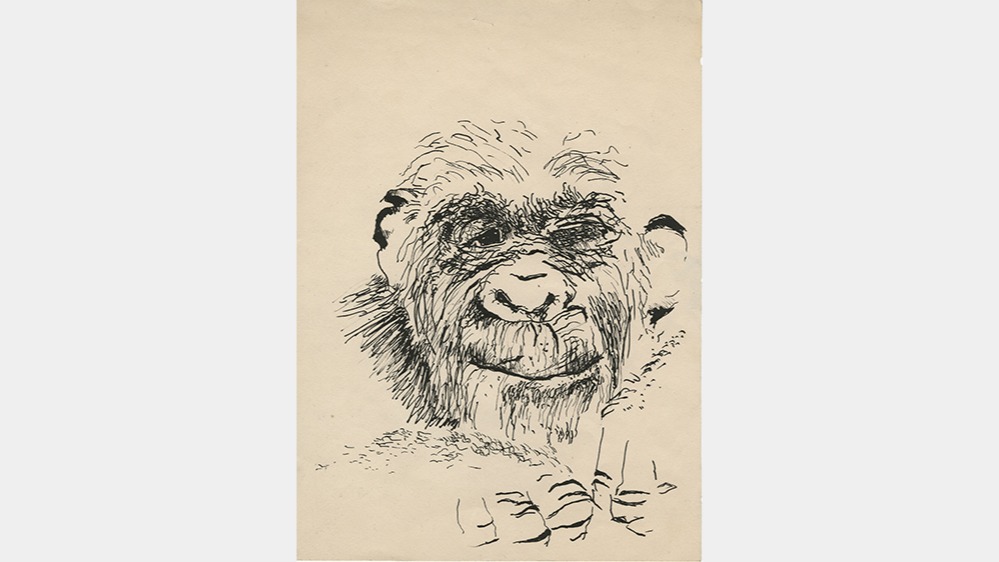
This exhibition is the first comprehensive survey in the United States of drawings and works on paper by the Los Angeles-based Paul McCarthy (b. 1945, Salt Lake City), one of the most influential artists of his generation. Spanning more than five decades, the exhibition examines the significant role of drawing as it relates to McCarthy’s broader practice involving performance, video, photography, sculpture, and installation.
Paul McCarthy: Head Space, Drawings, 1963–2019 is organized by Aram Moshayedi, curator, and Connie Butler, chief curator, with Ikechukwu Onyewuenyi, curatorial assistant, and Nicholas Barlow, curatorial assistant.
"In 1963, while still a high school student in Salt Lake City, Paul McCarthy did an ink drawing of a smiling, wizened chimpanzee. He called it Self-Portrait, and—to his apparent bemusement—it has become the lead image for a retrospective of McCarthy’s drawings at the Hammer Museum, Los Angeles.
McCarthy's Dead H Crooked Leg Maze (1979) Photo: Fredrik Nilsen: courtesy of the artist and Hauser & Wirth Co-curated by Aram Moshayedi and Connie Butler, Paul McCarthy: Head Space, Drawings 1963—2019 does a compelling job of tracing through-lines from the 74-year-old artist’s earliest work to his latest gargantuan multi-media productions melding performance, film and installation. “Drawing becomes a way of understanding the breadth and depth of McCarthy’s artistic process,” says Moshayedi. “It grounds almost everything he has made over the past five decades.”
Walking through the partly hung exhibition a week before its opening, McCarthy expresses gratified surprise at how prescient many of his early experiments were. “It’s crazy how some of these works became really important later on,” he says, looking at a framed grid of Stoned Blue Drawings (1968–69), made before he gave up drugs in the 1970s. Among grotesque caricatures and abstracted genitalia is a smiling Santa. “How many Santa Clauses did I make?” he muses.
Other works from the 1960s include typed instruction pieces (“Pile dirt on your desk and leave it”), proposals for Minimalist sculptures such as Dead H Drawing (1968) and drawings of mummies from a Salt Lake City museum. Piles, stacks and boxes have all recurred throughout McCarthy’s oeuvre. (Even that chimp reappeared in a 1980 performance, Monkey Man, not in the exhibition.)
Airplane Painting (1965-66), a violent, expressive painting on paper with collaged elements depicting fighter aircraft, is uncannily congruent with the huge drawings from the 2000s that viewers encounter in the final room of the broadly chronological show."— Jonathan Griffin, Feb. 7, 2020


This post is an excerpt. Read the full article on the ***NAME OF PUBLICATION*** website.
Read more about ***FACULTY NAME***.
Stay engaged. Use #UCLAarts to stay connected.


