Pang! A new podcast by Professor Dan Froot
Froot's audio drama builds on two decades of creative work on food insecurity
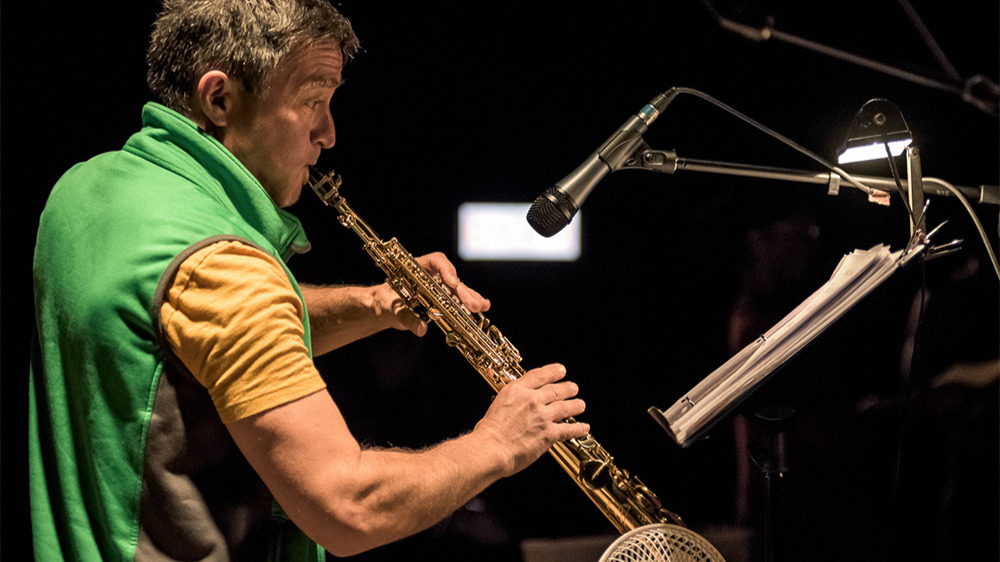
For nearly two decades, Department of World Arts and Cultures/Dance Professor and Chair Dan Froot has been focused on issues of food insecurity. What began as an exploration of hunger in Los Angeles has become a series of oral histories and theater productions sharing the stories of families living with food insecurity across the country. This summer, Professor Froot released the latest iteration of his creative work to much acclaim: an audio drama podcast, Pang!, which attemps to answer the question, "What does hunger sound like?" The podcast has been streamed in more than 25 countries and earned a spot on the New York Times' Podcast Playlist that Digs Deeper. Read on for Professor Froot's conversation with UCLA Arts about his work.
UCLA ARTS: How did Pang! begin for you?
DAN FROOT: Performance and food have always been connected for me. I have always considered cooking to be a performance and performance to be a kind of meal. My first performances in New York in the 1980s were meals that I cooked for the audience. In both cooking and performance you take disparate ingredients and perform a sort of alchemy on them. The result is this completely other thing that you offer for people to consume, and which is hopefully nourishing for them.
Later, when my kids were born in 2000, I felt the power of my family's privilege—that we were able to provide for these children everything they needed to be healthy and active. I wanted to use that privilege as a platform. I thought, "All I know how to do is tell stories." And then I thought, "Maybe that could be of service.”
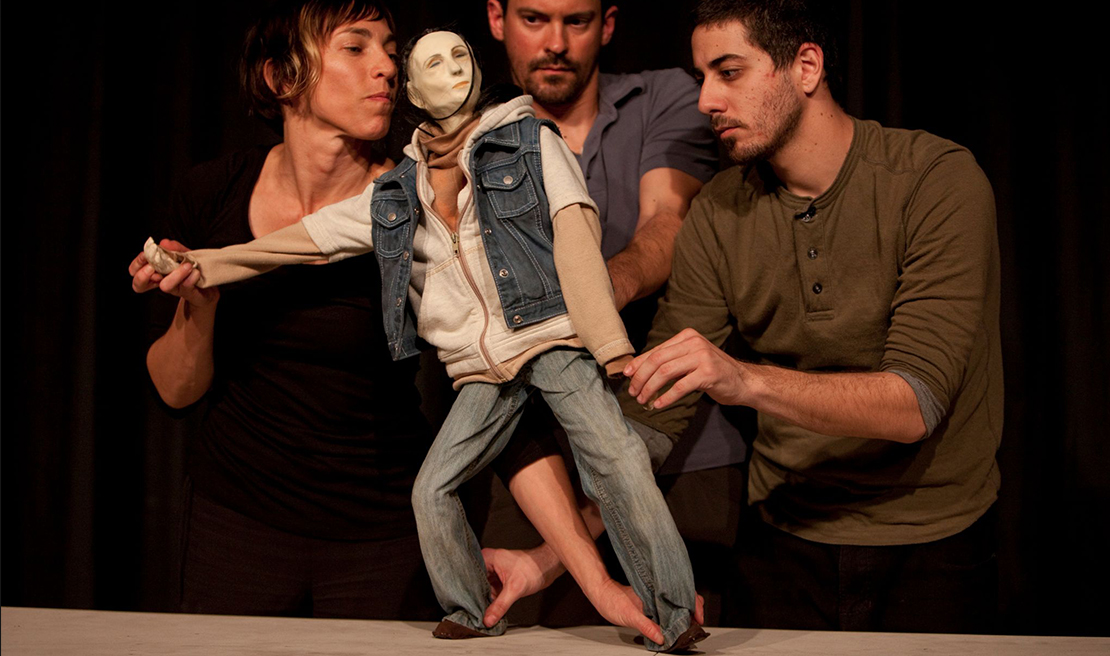
Who's Hungry - Santa Monica (2012) Dan Froot's collaboration with Dan Hurlin
I have a history of volunteering for organizations that support homeless and hungry people. I started conducting book-length oral histories of families living with food insecurity, that are now archived in the UCLA Center for Oral History Research. Each oral history takes nearly a year to produce. Then we ask some families if they would like to work with me to adapt their oral history into theatrical form. We go very, very slowly, and we do everything in close contact with the families themselves. Every step along the way is incentivized strictly by the family's desire to tell their story. We premiered the work in 2017 as a triptych of short plays, staged in the style of radio drama.
"I am in awe at the final stories.
It brings tears to me still to revisit those moments."
– Conching Matthews, whose oral history is the focus of the first two episodes of the podcast
After premiering the live theater production, I wanted Pang! to have more impact—more reach and scope, and I landed on podcasting. I wanted to triangulate food insecurity in the United States by sampling families from three very different cities around the United States. It's not a definitive overview of food insecurity in America, but it's a snapshot.
UCLA ARTS: What are your goals for the podcast?
DF: The primary goal is to have us all start thinking about income disparity, and the systems that conspire to create food insecurity. I want to start a conversation about these issues within our bubbles and across our bubbles. The live shows give us the opportunity to have intergroup dialogue in real time, while the podcasts allow us to listen to the stories from perspectives that perhaps we hadn't been able to imagine in the past. That might open up our perspectives a little bit, and help decrease the stigma of people living below or close to the poverty line and contending with a variety of issues, especially given our current political climate.
UCLA ARTS: Why address these stories through theater? How does that adaptation help address these issues?
DF: The stupid answer is that that's all I know how to do. But I think one important aspect of this process is that it requires myself and the artists that I work with to meet the story halfway, to bring our experience to the story that's told in the family's own words. The process of adapting those oral histories into theatrical form is the impossible process of trying to get inside them and understand them. So, it's no longer strictly the family's story. It's the outcome of dialogue between us and the families. No decision is ever finalized without the families' permission. We take artistic license, not to recreate their story, but to tell their story in a way that is formally compelling for a theater audience, or a podcast audience; to engage their imaginations.
UCLA ARTS: Not only is your goal for the finished podcast and performances to start a dialogue between people of different communities and backgrounds, but the creative work itself takes place across these bubbles because of your collaborative process.
DF: That's a great point. There is a tension because we are telling somebody else's story. Yes, we are telling these people's stories because we're the artists, we're making art, and they have asked us to make the art. But there’s a tension, because we come from such different circumstances. At the end of the day, I still go home to a nice house, I'll be able to retire comfortably, and I have everything I want and need. For these families, that is not the case, and it's likely not going to change. They know that. I know that. But we have a relationship and this artwork in spite of and because of that.
UCLA ARTS: Tell us about your research process.
DF: I learned the methodology of oral history from the Legacy Oral History Program in San Francisco. I did a lot of research on food insecurity, just regular old book research, but my volunteer regimen is also a significant part of my research process. I always begin a project with a volunteer regimen, and I generally have to try out three or four placements before I find the one that's going to sustain me. I try to learn firsthand from my co-volunteers and from the community members who I work with.
UCLA ARTS: What about you, has your approach to the issue of hunger changed over the course of working on this project?
DF: What I learned about food insecurity is that for some families, it's practically invisible. It's insidious in that you're not necessarily always aware of it, but it's having an effect. It just becomes the water that you swim in. Food insecurity was my entry point with each family, in that they're all food insecure in one way or another. But when we got deeper into their stories, food insecurity turns out to be a small part of their narrative, even though they live with it on a daily basis. Other issues loom much larger. I don't know if that's a generalized aspect of food insecurity, that you're not aware of the erosion effect that it has on your health; your capacity; and your ability to perform in school, at work, and in civic life, but that's what the stories of these families were. It was these other issues – foreclosure, immigration bias, gun violence – that were important to them, and those are the stories they wanted to share.
"I hope that this project will give awareness
to those that have seniors as homeowners.
I hope that it will bring up discussions amongst families
so that they can stop situations like what we went through."
– Conching Matthews
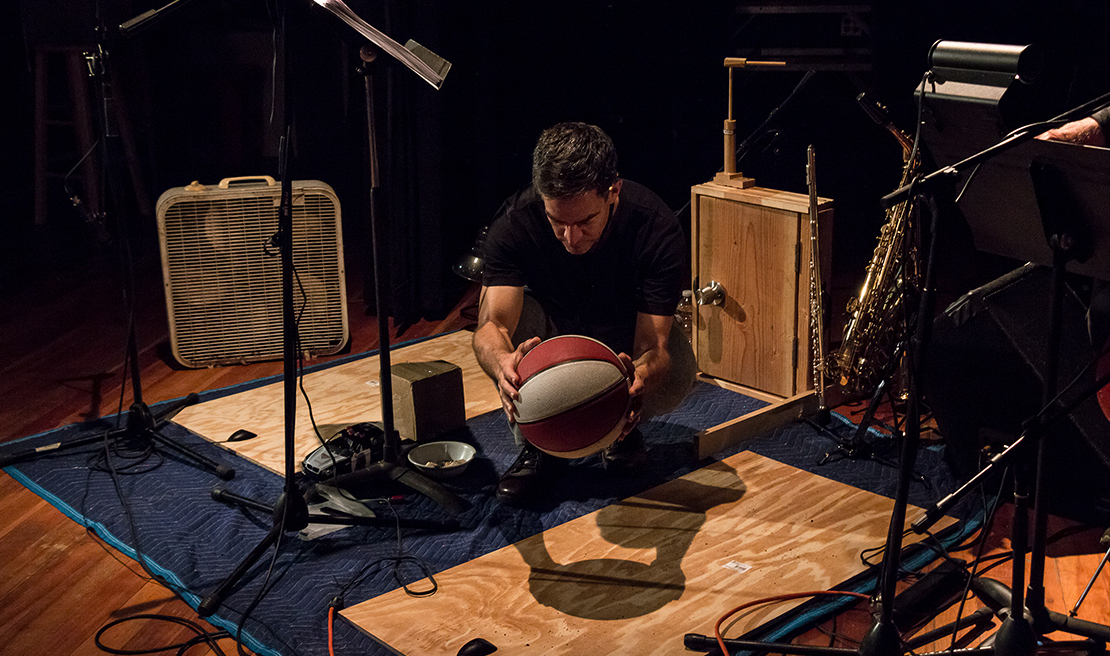
Dan Froot creates sound effects with a basketball during a 2018 performance. Photo by Hector David Rosales.
UCLA ARTS: What keeps you engaged with Pang! and motivated to keep producing different iterations?
DF: In a very personal way, with these last few projects I've been trying to reinvent myself as an artist. I wanted to find a way to keep working that was sustainable, that had impact, and that brought me back to where I feel my biggest strengths are. I'm trained mostly as a musician. Podcasting is really about sound and rhythm. I really get to exercise that part of my training and skill set. And I really, really enjoy that.
I am also motivated by the many-faceted relationships that we’ve developed with our partners in each city, getting deeply into the community of each family, and, with the live work, bringing more low-income people to the theater. These young people that I'm working with, the actors, are so involved as creators of this work. All of the people I needed to bring into the fold to make Pang! into a podcast, and all the different ways we work together, become part of the art and the design of the project. That has really sustained me and made me feel like this work has impact, regardless of its ultimate reach and reception.
"My experience has been amazing. They are all so very talented and
just a warm group of people whom I've grown to love.
I never imagined that my story would be heard by so many."
– Conching Matthews
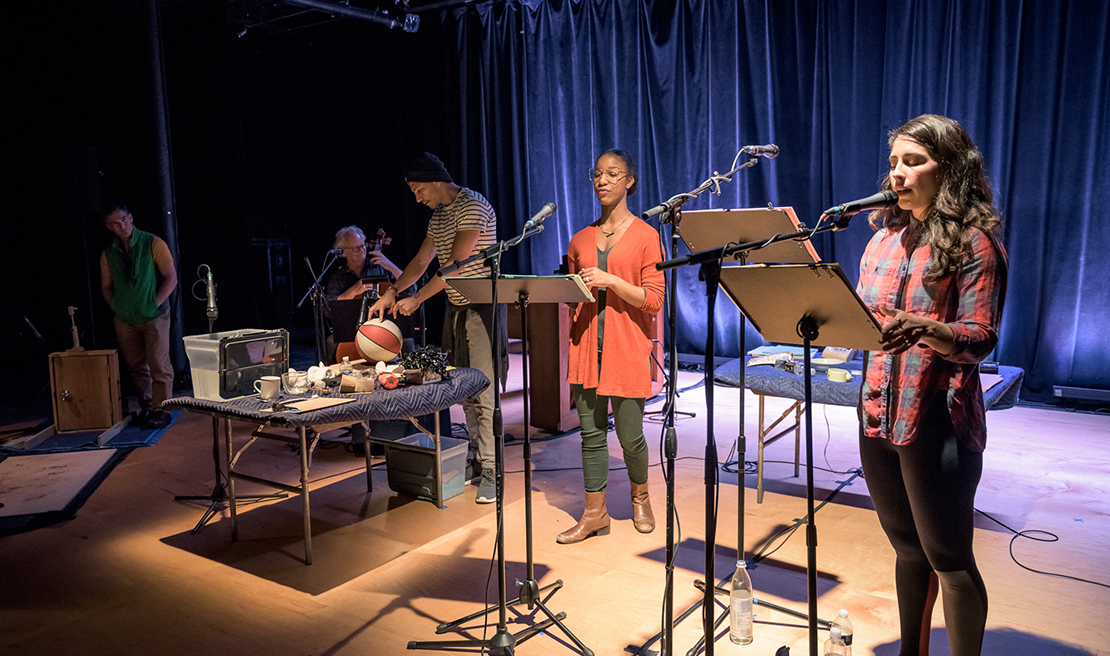
Pang! performance in 2018. Photo by Hector David Rosales. Actors: Christopher Rivas, Donna Simone Johnson, Natalie Camunas, Cristina Fernandez; producer: Ari Andersen; composer: Robert Een; dramaturge – stage adaptation: Bobby Gordon; production assistant: Tula B. Strong.