On London's Reopened Ballet Stages, a Focus on the Contemporary
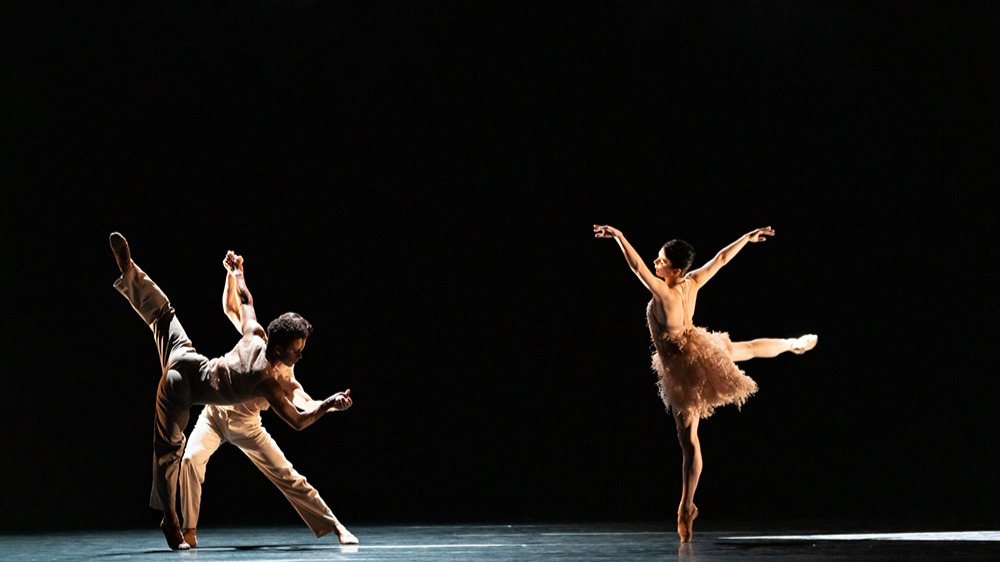
The Royal Ballet’s program, “21st Century Choreographers,” featured a new work by World Arts and Cultures/Dance professor Kyle Abraham.
"LONDON — The mood was ebullient on Tuesday night at the Royal Opera House, as the audience settled in for the first performance by the Royal Ballet in almost six months, a day after theaters and museums were officially allowed to open in England. The disembodied voice asking people to turn off their cellphones got rousing applause before the lights went down for the evening’s program, “21st Century Choreographers,” a mixed bill that included a new work by Kyle Abraham, his first for the Royal Ballet.
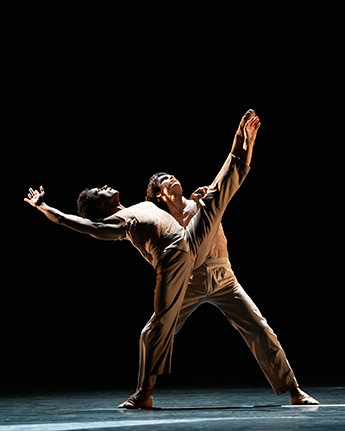
Marcelino Sambé and Stanislaw Wegrzyn in Kyle Abraham’s premiere, “Optional Family: A Divertissement.” Credit: Bill Cooper Abraham, one of the few Black choreographers to be commissioned by the Royal Ballet, has shown his wide-ranging curiosity about working in different modes and tones over the last few years. His new dance, “Optional Family: A Divertissement,” is entirely unlike his work for his own company, A.I.M., or his two pieces for the New York City Ballet — the inventive, glamorous “The Runaway” (2018) or the recent spare and serene “When We Fell,” a filmed dance.
He is right to call “Optional Family” a divertissement: The 10-minute work for three dancers is amusing, well crafted and intriguing. But it also feels incomplete, like an idea for something bigger. (Perhaps it is; he has been commissioned to create an ensemble work for the Royal Ballet in spring 2022.)
The piece opens with a voice-over (the text was written by Abraham) offering a viciously polite, very funny ode to the horrors of marriage and perhaps an allusion to lockdown close quarters. (“To be without you would be pure and utter bliss.”) The curtain opens on Natalia Osipova, whirling in a virtuosic sequence of turns around the stage to the suspenseful, jerky, percussive spills of Nídia Borges’s “Intro” as Marcelino Sambé watches. Diamonds of light fragment the stage, creating isolated pods for the dancers, who keep intersecting and peeling apart, the light fading as Osipova circles in Sambé’s arms.
When the lights come up again, a third figure, Stanislaw Wegrzyn, is crawling downstage on a diagonal, then propelling himself into an energetic series of jumps, feet crisscrossing, body angling. This man is the spoke in the wheel, the catalyst for change, discontent. Moving now to Grischa Lichtenberger’s “Kamilhan: Il y a Péril en la Demeure,” he dances with Osipova, sometimes with Sambé, their lines moving through balletic stretch, idiomatic, naturalistic gesture and a more contemporary weightedness.
Abraham makes more interesting use of the men, in knotty complex formations and off-kilter partnering, than of Osipova, who spends a lot of time doing fast turns around the stage. Perhaps her exclusion is the point, but it seems that nothing is meant to be clear. “Optional Family” feels paradoxically lightweight and intriguing, a piece you immediately want to see again to try to work it out."— Roslyn Sulcas, May 19, 2021


This post is an excerpt. Read the full article on the New York Times website.
Read more about Kyle Abraham.
Stay engaged. Use #UCLAarts to stay connected.


